
A horse is ahead of the handicapper when it has the potential to perform better than its current handicap mark suggests. The clearest example is a horse that has already been reassessed after a recent win but is due to race from its previous rating, with a penalty that is smaller than its forthcoming rise.
These horses are often described as well in at the weights. They can attract considerable attention because their published future rating suggests they would carry more weight if the same race took place after the new mark came into effect.
There is also a broader use of the phrase. A lightly raced or improving horse may be considered ahead of the handicapper if its ability is greater than its current Official Rating. That is a judgement based on form, rather than a confirmed advantage between today’s racing mark and a published future rating.
Both situations are worth investigating, but neither guarantees a winning bet.
Well Handicapped Horses Today
The daily runners list identifies horses that may be competing on favourable handicap terms. It provides a starting point for checking each runner’s rating, recent form and race conditions.
A horse appearing on a well-handicapped list should still be assessed against its opposition. A favourable mark can be offset by unsuitable going, a demanding race, a quick return after a hard effort or a betting price that already reflects the apparent advantage.
Check the latest declarations and the individual today’s racecards before making a selection. Race times, runners and jockey bookings can change.
Here are the best well-handicapped horses today.
| Meeting | Time | Name | Add To Bet Slip |
|---|---|---|---|
| Fairyhouse (IRE) | 16:50 | Full Noise | Add to BetSlip → |
| Kempton Park | 18:15 | Sparksmith | Add to BetSlip → |
| Kempton Park | 19:15 | Camera Shy | Add to BetSlip → |
| Killarney (IRE) | 14:45 | Rampage | Add to BetSlip → |
| Pontefract | 14:40 | Mister Sox | Add to BetSlip → |
| Pontefract | 15:50 | Cape Ashizuri | Add to BetSlip → |
| Pontefract | 17:33 | Knicks | |
| Stratford-On-Avon | 15:26 | Another Folly | |
| Wolverhampton | 18:30 | A Lott Of Kane | |
| Wolverhampton | 20:00 | Takeitorleaveit | |
| Yarmouth | 16:05 | Cuff It |
The shrewd horse racing punters always look to wager on the best bookies offering extra places, like Sky Bet EW extra places or bet365 EW extra places.
What Does Ahead of the Handicapper Mean?
The phrase has two related meanings in horse racing.
Technically ahead of the handicapper describes a horse that is due to race from a lower effective mark than its newly published or forthcoming rating. This often happens when a horse wins and runs again before its revised rating takes effect.
Considered ahead of the handicapper describes a horse whose ability may be better than the Official Rating currently assigned to it. This is an interpretation of its form and potential, not necessarily a confirmed difference between two ratings.
The distinction matters when assessing a horse’s chance. A published future rating provides a measurable comparison with today’s effective mark. An opinion that a horse is improving requires a closer examination of its performances and circumstances.
The starting point is understanding how horse racing handicap ratings work. A handicap rating represents the handicapper’s assessment of a horse’s ability, expressed in pounds. In a handicap, the weights are set to account for differences between runners’ ratings, subject to the race conditions.
A higher-rated horse generally carries more weight than a lower-rated rival. The aim is to make the race competitive, although the weights cannot account perfectly for every horse’s current form, suitability or potential to improve.
How Does a Horse Become Technically Well In at the Weights?
A horse can win a handicap and then run again before its revised rating takes effect.
The BHA reassesses handicap marks through its weekly ratings process. A horse that wins during the relevant period may be able to run again from its previous mark with an additional penalty, rather than immediately racing from the full revised rating.
If the handicapper subsequently raises the horse by more than the penalty it carries in its next race, the horse is technically well in.
Example of a Horse Ahead of the Handicapper
Consider a horse that wins a handicap from an Official Rating of 80.
The horse is entered to run again before its revised mark takes effect. Under the conditions of that race, it carries a 5lb penalty, giving it an effective racing mark of 85.
The handicapper has assessed its recent win and published a future rating of 91.
| Rating or weight adjustment | Pounds |
|---|---|
| Previous Official Rating | 80 |
| Penalty for recent win | 5lb |
| Effective mark for today’s race | 85 |
| Published future rating | 91 |
| Difference | 6lb |
In this example, the horse is 6lb well in compared with its future rating.
The figures are illustrative. Penalties depend on the race conditions and applicable rules, so they should be checked for the individual runner rather than assumed.
The 6lb advantage is a comparison between two handicap assessments. It does not mean the horse will necessarily run 6lb better than its rivals or that its chance of winning can be calculated from that figure alone.
Why Does the New Rating Not Apply Immediately?
Handicap ratings are revised and published on a weekly timetable. Entries and weights for some races are established before the latest reassessments take effect.
Allowing eligible horses to run under a penalty during that interval means connections can enter a horse again without waiting for its next rating to apply. The penalty adds weight for its recent win, but it may be smaller or larger than the eventual reassessment.
A horse is not automatically well in because it runs under a penalty. If its future rating rises by the same amount as the penalty, there is no difference between the two effective marks. If the rise is smaller, the penalty may leave it worse off by that comparison.
How to Read an Ahead of the Handicapper List
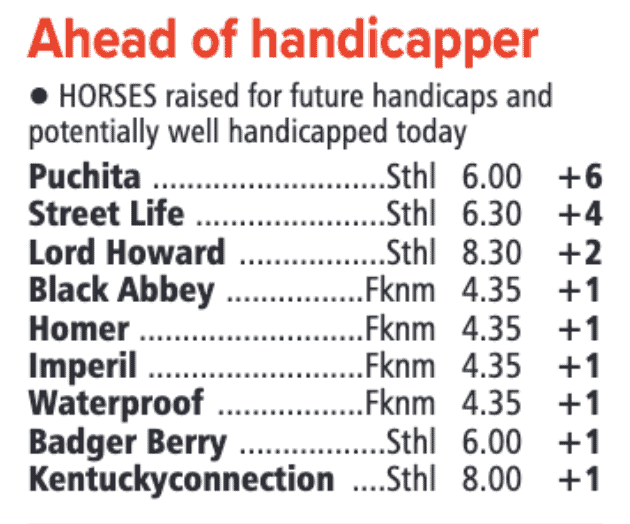
A daily list may show a horse’s meeting, race time, current mark and the amount by which its rating is due to rise.
The key figure is the difference between the rating from which it is effectively racing today and the future rating used for comparison.
For example, a notation indicating that a horse is 4lb well in means its effective mark for the race is 4lb lower than the relevant future rating. It does not mean the horse is carrying 4lb less than every rival or receiving a 4lb jockey allowance.
Check that the figure accounts for any penalty and refers to the correct race. A horse may hold different ratings on the Flat, all-weather, over hurdles and over fences. A rating from one discipline should not be treated as interchangeable with another.
The horse’s current form also matters. Our Racing Post Ratings explanation covers a separate performance-rating measure that can help you compare individual runs with a horse’s Official Rating.
Does Being Well In Make a Horse More Likely to Win?
A favourable handicap position can improve a horse’s prospects relative to carrying more weight, but it does not make the result predictable.
A horse may have earned a substantial ratings rise after an unusually strong performance that it cannot reproduce. It may also be returning quickly after a demanding race or meeting rivals whose own marks underestimate their ability.
The conditions of the new race can be decisive. A horse that won over six furlongs on good ground may not reproduce the same performance over a longer trip on soft ground. A different course configuration or draw can also change the demands of the race.
The most useful question is whether the horse can run close to the level that produced its higher future rating under today’s conditions.
A well-handicapped horse can also be a poor bet if its odds are too short. A favourable mark is one part of the assessment; the available price determines whether the potential return is attractive.
How to Tell if a Horse Is Well Handicapped
A horse does not need a published future rise to be of interest. Some runners have current ratings that may underestimate their ability, particularly when their recent results do not tell the whole story.
The following factors can help identify those horses.
Compare Its Current Mark With Previous Winning Ratings
Look at the ratings from which the horse has won or performed well in the past.
A horse rated 75 that previously won from 82 may be attractively handicapped if it retains enough ability to reproduce that performance. The seven-pound difference is worth noting, but it is not proof that the horse is well treated today.
Age, injury, changes in distance and a prolonged decline in form may explain why its rating has fallen. A previous winning mark is most useful when the horse has recently shown signs that it can still perform at a comparable level.
Check the strength of its past races rather than relying on the winning mark alone. The course-and-distance winners page provides another useful angle when a horse returns to conditions under which it has already performed well.
Look for Improving Horses
A lightly raced horse may improve faster than its handicap rating changes.
This is particularly relevant when a runner has only recently entered handicaps or is still learning how to race. A horse that wins with something in hand may be capable of a stronger performance than the bare result suggests.
Winning distances require context. A narrow winner may have been eased late, while a wide-margin winner may have benefited from a weak field or unusually favourable race conditions.
Our winning distances guide explains how to interpret margins without treating them as a complete measure of ability.
Examine the Form Behind Recent Results
Finishing positions can conceal useful performances.
A horse may have been denied a clear run, raced on an unfavourable part of the track, been poorly positioned in a slowly run race or finished strongly after the leaders had gained an advantage.
Those circumstances may explain why its recent results have not produced a higher rating. They do not establish that the horse would have won with a different passage, but they can justify reviewing the form more closely.
Use the horse racing statistics alongside race replays and the form book to compare a runner’s recent efforts.
Check Whether the Race Conditions Suit
A horse can appear well handicapped on past ability but still face unsuitable conditions.
Distance, going, track layout and likely pace all affect how a race develops. A runner that has produced its best efforts on a straight course may face a different test around a sharp bend. A front-runner may be disadvantaged if several rivals are likely to contest the lead.
The horse racing draw guide explains why starting position can matter, particularly in some Flat races. Ground preferences also deserve attention when assessing soft-ground horses or runners returning to faster conditions.
A favourable handicap mark is most useful when the horse has a realistic opportunity to reproduce its best form.
Assess the Trainer’s Recent Results
A trainer’s recent form can add context to a horse’s chance, especially when the runner has been absent or its recent performances have been disappointing.
An improving stable strike rate does not make an individual horse ahead of the handicapper. It may, however, support a wider assessment when the horse’s own form and race conditions are also favourable.
The in-form trainers page provides a way to examine recent stable results without relying on reputation alone.
Can Wind Surgery, Gelding or Headgear Put a Horse Ahead of the Handicapper?
Changes to a horse’s circumstances may lead to improvement, but they do not automatically make it well handicapped.
A horse returning after wind surgery may perform better if an airway problem had been affecting its previous results and the treatment has addressed it. The operation itself does not establish how much improvement, if any, the horse will show.
The same principle applies to a horse that has been gelded or is wearing first-time blinkers. These changes can affect an individual runner, but their impact varies.
If the horse subsequently produces stronger form while its handicap mark remains unchanged, there may be evidence that its rating underestimates its current ability. Until then, the change is a factor to investigate rather than proof of a handicap advantage.
Does a Change in Distance Make a Horse Well Handicapped?
A different trip can reveal ability that was not apparent in earlier races.
A horse that repeatedly finishes strongly over a mile may improve when stepping up in distance. Another runner may perform better when dropped back in trip if it has been failing to stay.
The handicapper can only assess the evidence available. A horse making its first start under more suitable conditions may therefore have scope to outperform its current rating.
That does not mean every change of distance is a positive. The horse’s pedigree, running style and previous performances should support the case.
Check how long horse races are if you are comparing form across different trips, and consider how the likely pace may affect stamina.
Can a Horse Be Ahead of the Handicapper Without Winning Its Last Race?
Yes. The handicapper can raise a horse after a strong placed effort, and a horse may also have shown more ability than its finishing position suggests.
A runner that finishes second in a competitive handicap may produce a performance above its previous rating. Equally, a horse that meets trouble and finishes further back may be of interest to someone who believes the result understates its ability.
There is a difference between identifying a promising run and establishing a ratings advantage. Check the horse’s current and future marks, the strength of the opposition and the circumstances of the race before deciding that it is well handicapped.
A horse’s top speed ratings can provide another comparison, although speed figures and Official Ratings measure performance differently.
Do Horses Ahead of the Handicapper Get Backed Heavily?
Some technically well-in horses attract substantial betting support because the difference between their current and future ratings is visible to everyone studying the race.
The advantage is not necessarily overlooked by bookmakers. A horse that is 6lb well in may already be priced as though it has a strong chance of winning.
A shortening price is evidence of a market move, not proof that the horse is fit, suited by the conditions or certain to reproduce its previous run. Conversely, a horse can drift for reasons unrelated to its handicap mark.
Compare the current price with your assessment of its chance. Our betting odds drifting guide explains why prices lengthen, while the best-backed horses today page helps put market support into context.
Is Backing Horses Ahead of the Handicapper a Profitable System?
A list of well-in horses is a useful research tool, but it is not a complete betting system.
A horse’s handicap advantage may be widely recognised, resulting in a short price. It may also be returning too quickly after a hard race or competing under less suitable conditions.
To assess whether a particular approach is profitable, you need a consistent selection method and a sufficiently large record of results. Record the odds available when each bet was placed, not just the Starting Price, and account for losing bets as well as winners.
A high strike rate does not guarantee a profit. If the average winning price is too short, frequent winners can still produce a loss.
Use the bet calculator to check returns and compare them with the risk involved. If you are comparing bookmakers, focus on the price and relevant terms rather than assuming that one operator will always offer the best value.
What Can Go Wrong With a Well-In Horse?
The most obvious risk is that the horse fails to reproduce the performance that earned its higher rating.
A recent winner may have benefited from ideal conditions or an uncontested lead. It may face a stronger field on its next start or return before it has fully recovered from its previous effort.
There is also a difference between a ratings advantage and a betting advantage. If a horse is widely expected to win because it is well in, its price may already be too short to offer value.
Finally, check the race conditions carefully. A penalty, an allowance or a change in the weights can alter the effective mark from which the horse competes. Do not rely on a headline figure without confirming what it includes.
Ahead of the Handicapper FAQs
What does 5lb well in mean?
A horse described as 5lb well in is competing from an effective mark 5lb lower than the relevant rating used for comparison, usually its published future rating. It does not mean the horse is guaranteed to perform 5lb better or beat its rivals.
Is ahead of the handicapper the same as well handicapped?
The phrases overlap, but they are not always identical. Ahead of the handicapper can refer to a measurable difference between today’s effective mark and a future rating. Well handicapped is also used more broadly for a horse believed to have a favourable current mark based on its ability.
Does a horse have to win to be ahead of the handicapper?
No. A horse can be raised after a strong placed performance. A lightly raced or improving horse may also have more ability than its current mark suggests without having won its latest race.
Why can a horse run under a penalty?
A horse may be eligible to run again before its revised rating takes effect. The applicable race conditions can require it to carry additional weight for a recent win. The penalty and the eventual ratings rise are not necessarily the same.
Is a horse automatically well in when it runs under a penalty?
No. You must compare its effective racing mark, including the penalty, with the relevant future rating. A penalty can be equal to or greater than the ratings rise.
Should I back every horse ahead of the handicapper?
No. Check the horse’s recent form, recovery time, race conditions, opposition and odds. A favourable handicap position can be useful, but the price still needs to offer value relative to the horse’s chance.
Can a horse be ahead of the handicapper on the Flat and not over jumps?
Yes. Horses can hold different ratings for different racing disciplines. A favourable Flat mark does not establish that the horse is well treated over hurdles or fences.
Summary
A horse is technically ahead of the handicapper when it races from an effective mark below a relevant future rating. The difference can arise when a recent winner runs again under a penalty before its reassessment takes effect.
The phrase also describes horses whose ability may be better than their current Official Rating. That broader judgement requires careful study of form, conditions and the horse’s potential to improve.
A well-in figure identifies a possible advantage at the weights. The horse still has to reproduce the form that justifies its rating, and its odds must be attractive enough to make the bet worthwhile.