

Britain has 59 active racecourses, but choosing where to go racing involves much more than finding the closest track.
Every British racecourse is different. Some are internationally famous venues hosting the biggest meetings in the sport. Others are smaller regional courses where racegoers can get close to the horses, jockeys and racing action.
British Racecourses has visited racecourses across England, Scotland and Wales. Our individual racecourse guides cover the track, major races, fixtures, travel, facilities and characteristics that make each venue different.
This page is designed to help you find, compare and choose a British racecourse to visit.
If you already know the course you want, head directly to our complete A-Z directory of UK racecourses, which contains all 59 active British racecourses.
Find the Right British Racecourse
The best racecourse for you depends on what you want from the day.
Some racegoers want to experience the Cheltenham Festival, Grand National or Royal Ascot. Others would rather spend a relaxed afternoon at their local track.
You might prioritise:
- A racecourse close to home
- Flat or National Hunt racing
- A major racing festival
- Good public transport
- A smaller and more relaxed course
- A racecourse suitable for families or groups
- A historic racing venue
- A scenic racecourse
- Evening racing
- All-weather racing
- A course suitable for a weekend away
There is no single British racecourse that is best for everybody.
The important question is which racecourse best matches the experience you want.
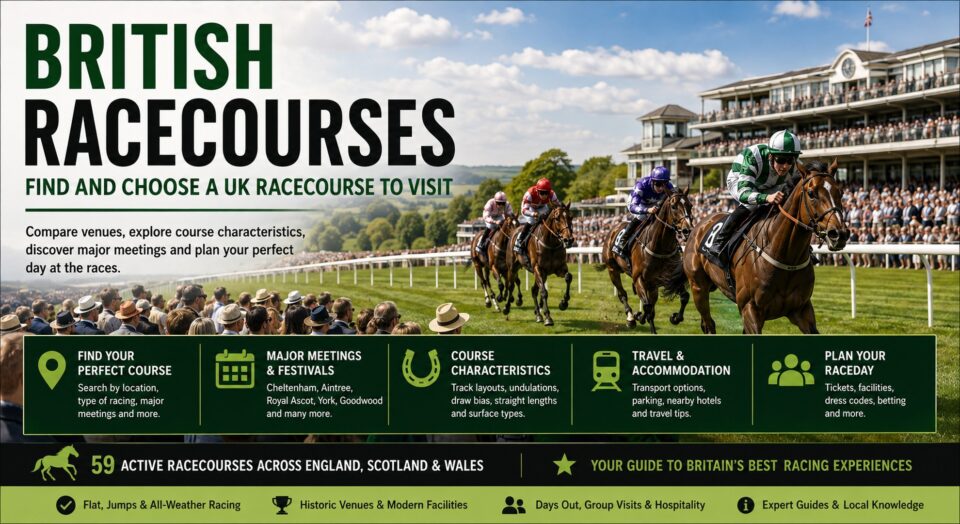
What Information is in our Racecourse Guides?
Our individual racecourse guides are intended to tell you considerably more than where a course is located.
Depending on the venue, our guides examine:
- Racecourse history
- Track layout
- Left or right-handed configuration
- Flat, jumps or mixed racing
- Racing surface
- Straight length
- Undulations and gradients
- Draw bias where relevant
- Major races and meetings
- Fixtures
- Address and contact information
- Travel and transport
- Nearby accommodation
- Visitor information
- Betting information
- Course-specific characteristics
Understanding the track itself is particularly useful because British racecourses are far from uniform.
Some are broad, flat and galloping. Others are tight, turning or undulating.
Certain courses have long finishing straights. Others place greater emphasis on tactical position because the run from the final bend to the winning post is relatively short.
These differences matter to both racegoers and people analysing the racing.
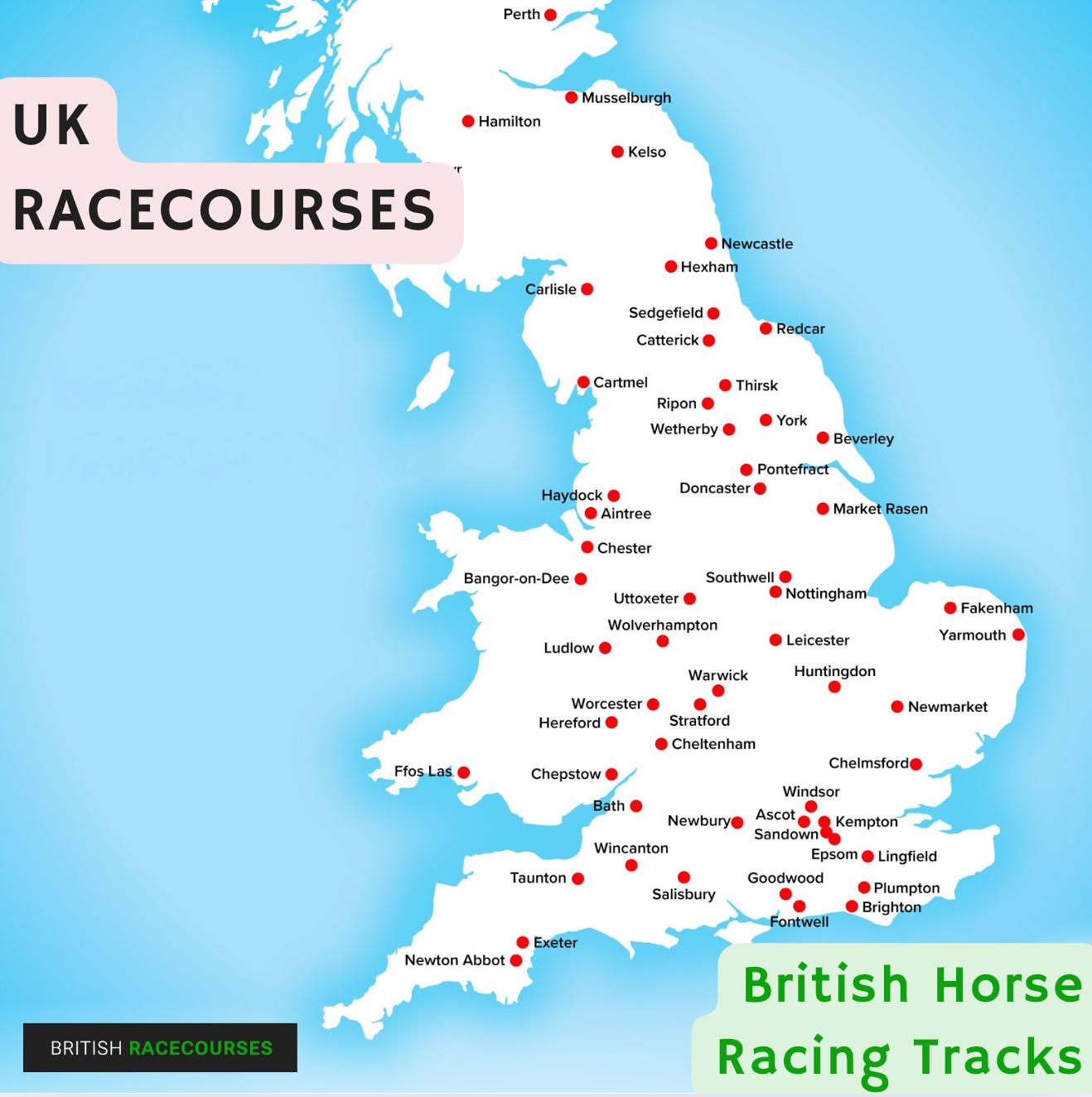
Map of UK Racecourses
Our UK racecourse map helps you see where racing takes place across Britain and identify tracks within travelling distance.
Britain’s racecourses stretch from Scotland to the South West of England, with particularly strong concentrations of courses in areas such as Yorkshire and the South East.
The map is particularly useful if you are searching for horse racing near me but do not already know the names of your local courses.
Once you identify a venue, use our individual racecourse guide to investigate the track, fixtures and practical information before travelling.
For the straightforward alphabetical directory rather than the visitor-focused information on this page, use our UK racecourses A-Z.
How Many Racecourses Are There in The UK?
How to Choose a UK Racecourse to Visit
Start by deciding what matters most about your raceday.
Choose by Type of Racing
The first distinction is between Flat racing and National Hunt racing.
Flat racing takes place without obstacles and is concentrated heavily through the spring, summer and autumn, although all-weather racing provides Flat fixtures throughout the year.
Major Flat venues include Ascot, Newmarket, York, Goodwood, Doncaster, Epsom and Chester.
National Hunt racing includes hurdle races, steeplechases and National Hunt Flat races.
Cheltenham and Aintree are the most internationally recognised jumps venues, but Britain has National Hunt racing at courses across the country.
If jumps racing is your priority, see our guide to the best racecourses for jumps racing and our broader National Hunt horse racing guide.
Several courses stage both codes, meaning the experience at the same venue can change significantly throughout the year.
Choose by Race Meeting
The meeting can be just as important as the racecourse.
A quiet weekday fixture at a major venue can feel completely different from attending its biggest festival.
The Cheltenham Racecourse experience during the Cheltenham Festival, for example, is very different from an ordinary raceday at the course.
The same applies to Aintree during the Grand National meeting, York during the Ebor Festival and Ascot during Royal Ascot.
Major festivals provide:
- Higher-quality racing
- Larger crowds
- Greater atmosphere
- More hospitality options
- Higher demand for tickets
- Busier transport
- Greater demand for nearby hotels
Ordinary fixtures can provide:
- Smaller crowds
- Easier movement around the course
- Better access to viewing areas
- A more relaxed atmosphere
- Lower ticket costs
- An easier introduction for first-time racegoers
Neither type of meeting is automatically better.
Choose according to the experience you want.
Choose by Location
Your nearest racecourse is often a sensible starting point.
A local course reduces travel and makes it easier to attend an ordinary meeting without organising an entire weekend around the event.
Britain’s racecourses are not distributed evenly, however.
Racecourses in Yorkshire
Yorkshire has one of Britain’s strongest concentrations of racecourses.
Courses in the wider Yorkshire racing region include:
- Beverley
- Catterick
- Doncaster
- Pontefract
- Redcar
- Ripon
- Thirsk
- Wetherby
- York
These venues provide a mixture of Flat, National Hunt and dual-purpose racing.
Racecourses Near London
People travelling from London have several major courses within reach.
Options include Ascot, Epsom, Kempton, Sandown and Windsor, although journey times depend heavily on where in London you are travelling from.
Our London racecourses guide looks at the options in more detail.
Racecourses in Scotland
Scotland has five active racecourses:
- Ayr
- Hamilton Park
- Kelso
- Musselburgh
- Perth
They provide a mixture of Flat and National Hunt racing.
Racecourses in Wales
The three active Welsh racecourses are:
- Bangor-on-Dee
- Chepstow
- Ffos Las
Chepstow and Ffos Las stage Flat and jumps racing, while Bangor-on-Dee concentrates on National Hunt racing.
For the definitive country-by-country breakdown and complete list of all 59 tracks, use our UK racecourses directory.
Best Racecourses for Major Racing Festivals
Britain’s major festivals provide some of the biggest occasions in world horse racing.
Cheltenham Racecourse
Cheltenham is the focal point of the National Hunt season.
The Cheltenham Festival attracts many of the leading British and Irish jumps horses and includes the Cheltenham Gold Cup, Champion Hurdle and Queen Mother Champion Chase.
Cheltenham is a natural choice if top-class National Hunt racing is the priority.
Aintree Racecourse
Aintree is home to the Grand National.
The Grand National course and its distinctive fences make Aintree different from a conventional National Hunt venue.
The three-day Grand National meeting is one of the biggest events in the British racing calendar.
Ascot Racecourse
Ascot combines major Flat and National Hunt racing.
Royal Ascot is the course’s best-known meeting and brings together top-level Flat racing with the traditions and ceremony associated with the five-day event.
The course also stages significant jumps fixtures during the winter.
York Racecourse
York is one of Britain’s leading Flat courses.
The Ebor Festival includes the International Stakes, Yorkshire Oaks, Nunthorpe Stakes and Ebor Handicap.
York is a strong choice for racegoers who want high-quality Flat racing at a major venue.
Goodwood Racecourse
Goodwood provides a very different racing experience.
The Sussex setting and unusual course configuration form a significant part of the venue’s character.
Its major summer meeting, popularly known as Glorious Goodwood, combines high-quality Flat racing with one of the most recognisable racecourse settings in Britain.
Newmarket Racecourse
Newmarket sits at the centre of the British Flat racing industry.
Racing takes place on the Rowley Mile and July Course.
Major races include the 1,000 Guineas, 2,000 Guineas and July Cup, while the surrounding town contains training yards, studs and racing organisations.
Epsom Downs Racecourse
Epsom hosts the Derby and Oaks.
The track’s gradients, cambers and Tattenham Corner make it one of the most distinctive courses in British Flat racing.
For a broader comparison of leading venues, see our Top 10 UK racecourses.
Best Racecourses for Flat Racing
Britain offers considerable variety for Flat racing fans.
Ascot provides major international Flat racing and Royal Ascot.
Newmarket offers the strongest connection with Britain’s Flat racing industry.
York combines high-quality racing with a large modern venue.
Goodwood provides a distinctive course and setting.
Epsom combines racing history with an unusual and demanding track.
Chester offers a tight circuit close to the city centre.
Doncaster provides a more galloping test and hosts the St Leger.
Smaller Flat courses such as Beverley, Ripon, Thirsk, Redcar, Salisbury and Brighton provide a different atmosphere from the major festival venues.
Best Racecourses for Jumps Racing
Cheltenham and Aintree dominate much of the discussion around British National Hunt racing, but the jumps programme extends far beyond those two courses.
Kempton hosts the King George VI Chase.
Newbury stages important National Hunt fixtures alongside its Flat programme.
Haydock hosts major staying chases.
Wetherby has a strong National Hunt tradition in Yorkshire.
Courses including Wincanton, Exeter, Warwick, Uttoxeter, Chepstow, Kelso, Perth and Hexham provide further variety.
Smaller jumps tracks can be particularly appealing to racegoers who enjoy getting closer to the horses and racing action.
See our best racecourses for jumps racing for a more focused comparison.
Britain’s All-Weather Racecourses
All-weather racing provides year-round Flat racing and has become an established part of the British programme.
Britain has six established all-weather racing venues:
- Chelmsford City
- Kempton
- Lingfield
- Newcastle
- Southwell
- Wolverhampton
The tracks are not identical.
Course configuration, surface, bend position and straight length differ, which means form at one all-weather course should not automatically be treated as equivalent to form at another.
Our all-weather racecourses guide compares the venues in greater detail.
Does Racecourse Shape Matter?
Yes.
One of the most important differences between British racecourses is their physical configuration.
Left-Handed and Right-Handed Racecourses
Some horses appear more comfortable racing in one direction than the other.
Britain contains both left-handed and right-handed tracks, while certain courses have unusual configurations that make simple classification less useful.
We have separate guides to left-handed racecourses and right-handed racecourses for readers interested in track direction.
Tight and Galloping Courses
A tight track tends to place greater emphasis on positioning and the ability to negotiate bends efficiently.
A broad, galloping course can give horses more time to build momentum.
That does not mean one type automatically favours front-runners and the other favours hold-up horses. Pace, distance, field size and race circumstances still matter.
Gradients
British racecourses can contain significant uphill and downhill sections.
An uphill finish can place additional emphasis on stamina, while downhill sections can affect balance and racing speed.
Finishing Straights
The length and nature of the finishing straight can influence tactics.
A short run from the final bend can make track position important.
A longer straight can give horses racing farther back more opportunity to challenge, although the pace of the race remains critical.
Draw
Stall position can matter in Flat racing, particularly where the distance to the first bend is short or where the field develops a preference for one part of the track.
Draw effects are not permanent rules. They can change with distance, field size, going and pace.
Our horse racing draw guide explains how to assess draw bias properly.
Course and Distance Form
Previous success at a particular track can provide useful evidence that a horse handles its configuration.
A CD marker on a racecard indicates that the horse has previously won over both the course and distance.
Course form should still be considered alongside current form, class, going, pace and other relevant factors.
Our course and distance form guide explores this in greater detail.
Best Racecourses for First-Time Racegoers
Your first raceday does not need to be one of Britain’s biggest festivals.
In many cases, a normal meeting at a local racecourse provides a better introduction.
Smaller crowds make it easier to understand the layout, move between the parade ring and track, watch what happens before each race and learn the rhythm of a raceday.
When choosing your first course, look for somewhere that is:
- Straightforward to reach
- Racing on a convenient date
- Within your budget
- Easy to navigate
- Offering the facilities you require
- Staging the type of racing you want to watch
Arriving early is useful because you can familiarise yourself with the venue before racing begins.
Racecourses for Groups
Horse racing works particularly well for groups because a raceday naturally divides into periods before, during and after each race.
People can visit the parade ring, get food or drink, watch the racing and meet between races without having to remain in one place throughout the day.
Large festivals provide greater atmosphere but can also mean:
- Bigger crowds
- Higher ticket prices
- Busier bars and restaurants
- Greater demand for transport
- More expensive accommodation
A smaller fixture can make it easier for a group to stay together and explore the racecourse.
Historic British Racecourses
British racing has developed over several centuries, and many modern venues remain closely connected with that history.
Chester is generally recognised as Britain’s oldest racecourse still operating, with racing at the Roodee dating back to the 16th century.
Newmarket became central to organised racing during the 17th century and remains the headquarters of British Flat racing.
Doncaster has a long racing history and hosts the St Leger, first run in 1776.
Ascot was established during the reign of Queen Anne in the early 18th century.
Historic importance is only one reason to visit a course, but it gives many British racing venues a character that newer sporting arenas cannot reproduce.
Finding Hotels Near Racecourses
Accommodation becomes important when attending festivals, evening fixtures or courses a long distance from home.
Hotel demand can increase sharply around major meetings.
If you intend to stay overnight:
- Check accommodation before buying non-refundable travel
- Compare hotels near the racecourse with options near transport links
- Consider staying farther away if rail or taxi connections are straightforward
- Book major festival weekends early
- Check how you will return from the course after the final race
Our individual racecourse guides include information to help you plan where to stay.
Travelling to a British Racecourse
Transport varies substantially between venues.
Some racecourses have convenient rail connections.
Others are much easier to reach by car.
A course that looks close on a map can involve a difficult public-transport journey, while another farther away may have a direct rail connection.
Before travelling, check:
- Nearest railway station
- Walking distance from the station
- Racecourse shuttle services
- Local buses
- Taxi availability
- Racecourse parking
- Festival traffic restrictions
- Planned rail disruption
- Last trains after evening racing
Transport arrangements can change for major meetings, so always check the specific fixture rather than relying solely on normal travel information.
Planning a Day at the Races
Once you have chosen your racecourse and meeting, a small amount of preparation makes the day easier.
Check:
- Tickets and enclosure
- Gate opening time
- First race
- Last race
- Transport
- Parking
- Dress code
- Weather
- Food and drink options
- Accessibility requirements
- Any racecourse-specific restrictions
Arriving before the first race gives you time to understand the layout and visit the parade ring.
It also gives first-time visitors an opportunity to see how horses move from the parade ring to the track and how the course operates between races.
What Should You Wear to the Races?
There is no universal British racecourse dress code.
Requirements vary between racecourses, meetings and enclosures.
Royal Ascot is very different from an ordinary midweek meeting at a smaller course.
Premium hospitality and certain enclosures can also have different rules from general admission.
Always check the racecourse’s current dress requirements before attending.
Our what to wear at the races guide provides broader advice.
Can You Bet at British Racecourses?
Yes.
British racecourses generally provide betting facilities for adults aged 18 or over, including on-course bookmakers and Tote facilities.
Betting is optional. You do not need to place a bet to enjoy racing.
If you choose to bet, decide what you are comfortable spending before the meeting and treat that money as part of the cost of entertainment.
Racecourse characteristics can form part of race analysis, but no course statistic or betting method guarantees a profit.
Readers interested in analysing races can continue to our horse racing analysis guide.
British Racecourses or UK Racecourses?
The terms are commonly used interchangeably by racing fans searching online, but there is a technical distinction worth understanding.
Great Britain consists of England, Scotland and Wales.
The United Kingdom also includes Northern Ireland.
British racing under the British Horseracing Authority covers the 59 active racecourses in England, Scotland and Wales.
Northern Ireland has racecourses, but racing there operates within the Irish racing system.
For that reason, our definitive UK racecourses directory focuses on Britain’s 59 active racecourses and directs Northern Irish racing towards our Irish racecourse coverage.
British Racecourses FAQs
How many British racecourses are there?
There are 59 active racecourses in Britain, spread across England, Scotland and Wales.
Our complete UK racecourses A-Z lists every current venue.
Where can I find a complete list of British racecourses?
Use our UK racecourses directory.
That page is specifically designed as the factual A-Z reference for Britain’s active racecourses.
This page is designed to help you compare courses and decide where to go racing.
What is the best racecourse in Britain?
There is no single best racecourse for every visitor.
Cheltenham is a leading choice for National Hunt racing, Ascot for major Flat racing, Aintree for the Grand National, York for high-quality summer Flat racing and Newmarket for visitors interested in the centre of Britain’s Flat racing industry.
Our Top 10 UK racecourses provides a more detailed comparison.
What is the oldest racecourse in Britain?
Chester is generally recognised as Britain’s oldest racecourse still in operation.
Racing at the Roodee dates back to the 16th century.
What is the newest British racecourse?
Ffos Las in Carmarthenshire is Britain’s newest active racecourse and opened in 2009.
Which British racecourse hosts the Grand National?
Aintree Racecourse hosts the Grand National.
Which racecourse hosts the Cheltenham Gold Cup?
Cheltenham Racecourse hosts the Cheltenham Gold Cup during the Cheltenham Festival.
Where is the Derby run?
The Derby is run at Epsom Downs Racecourse in Surrey.
Where is Royal Ascot held?
Royal Ascot takes place at Ascot Racecourse in Berkshire.
Which British racecourses have all-weather tracks?
Chelmsford City, Kempton, Lingfield, Newcastle, Southwell and Wolverhampton have established all-weather Flat tracks.
See our all-weather racecourses guide for more information.
Which racecourse should I visit first?
Start with a course that is straightforward to reach and has a fixture that interests you.
A smaller or ordinary meeting can provide a more relaxed introduction than one of Britain’s biggest festival days.
Are there racecourses near London?
Yes.
Racecourses accessible from London and the wider South East include Ascot, Epsom, Kempton, Sandown and Windsor.
See our London racecourses guide for a more focused comparison.
Are all British racecourses the same shape?
No.
British racecourses vary considerably in shape, direction, gradient, surface, straight length and configuration.
These differences are one reason horses can perform differently from one course to another.
Are all British racecourses turf?
No.
Most British racing takes place on turf, but six venues have established all-weather Flat tracks: Chelmsford City, Kempton, Lingfield, Newcastle, Southwell and Wolverhampton.
Are all racecourses left-handed?
No.
Britain contains both left-handed and right-handed racecourses, as well as courses with more unusual configurations.
See our left-handed racecourses and right-handed racecourses guides.
Can children go to British racecourses?
Many racecourses welcome children and families, but admission arrangements vary between venues and meetings.
Always check the current ticket policy for the specific fixture before travelling.
Can I go racing without betting?
Absolutely.
Betting is optional. Many people attend race meetings for the horses, sporting action, atmosphere, social occasion and experience of visiting the racecourse.
Do racecourses have dress codes?
Some do, particularly for certain enclosures and major meetings.
Dress policies vary, so check the relevant racecourse before attending.
Our what to wear at the races guide provides further information.
Summary
Britain’s 59 active racecourses provide an enormous range of racing and visitor experiences.
The right course depends on what you want from your day.
You can choose according to location, Flat or National Hunt racing, major festivals, atmosphere, transport, history, course characteristics or the type of raceday you prefer.
Cheltenham, Aintree, Ascot, York, Goodwood, Newmarket and Epsom stage some of Britain’s most famous racing occasions, but smaller regional racecourses can provide an equally enjoyable and often more relaxed experience.
British racecourses also differ considerably as sporting venues. Direction, gradients, bends, finishing straights, surfaces and draw characteristics mean the course itself can influence how races develop.
Use this page when you are finding, comparing or choosing a British racecourse to visit.
If you already know which venue you need and simply want its individual guide, use our complete A-Z list of UK racecourses.
For a much deeper exploration of how Britain’s tracks developed and why they are so different, read The Ultimate Guide to British Racecourses.