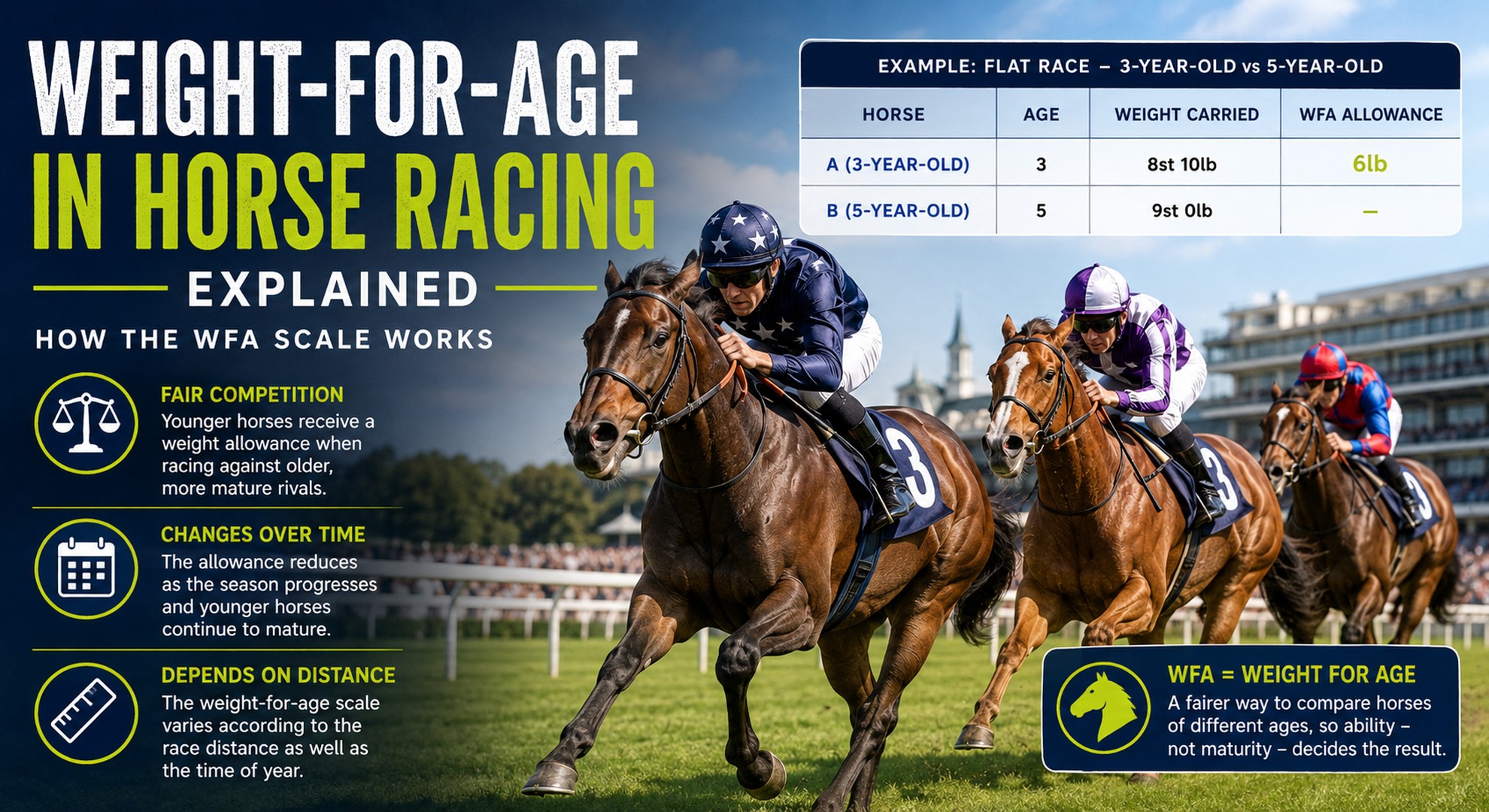
Weight-for-age is the system used in horse racing to allow younger horses to compete more fairly against older, more physically mature rivals.
A three-year-old racing against a four-year-old or older horse may receive a weight allowance because the younger horse is still developing. The amount of weight received is not fixed throughout the season. It changes according to the horse’s age, the race distance and the time of year.
This is known as the weight-for-age scale, commonly shortened to WFA.
Weight-for-age becomes particularly important when different generations meet in major Flat races. It can also affect handicaps containing horses of different ages.
Understanding WFA helps explain why two horses can carry different weights even when a race is not a conventional handicap, why three-year-olds receive more weight earlier in the season and why the allowance becomes smaller as younger horses mature.
What Does Weight-for-Age Mean in Horse Racing?
Weight-for-age is a structured allowance designed to compensate younger horses for their physical immaturity when they race against older horses.
Thoroughbreds begin racing before they reach full physical maturity.
A three-year-old in the spring is therefore generally less mature than a four-year-old or five-year-old.
If they competed under identical conditions at exactly the same weight, the older horse could have a natural physical advantage simply because it has developed further.
The weight-for-age scale attempts to compensate for that difference.
The younger horse carries less weight.
As the season progresses and the younger horse matures, that allowance generally reduces.
The system allows different generations to compete against one another on terms intended to provide a fairer comparison of ability.
What Does WFA Stand for in Horse Racing?
WFA stands for Weight For Age.
You may encounter the abbreviation when:
- reading race conditions
- analysing racecards
- comparing horses of different ages
- studying ratings
- looking at Group races
- analysing handicaps containing younger and older horses
- reading professional form analysis
It should not be confused with a standard handicap allowance.
WFA is based primarily on age, time of year and race distance, rather than an individual horse’s handicap rating.
Why Do Younger Horses Carry Less Weight?
Younger horses carry less weight against older horses because they have not normally reached the same stage of physical development.
Racehorses develop quickly, but a three-year-old in April is not at the same stage of maturity as a five-year-old.
The difference is particularly important when three-year-olds begin competing against older horses during the Flat season.
Weight-for-age attempts to quantify that developmental difference in pounds.
Imagine two horses of theoretically equal racing ability:
Horse A: three years old
Horse B: four years old
If the WFA allowance for their particular race is 8lb, Horse A may receive 8lb from Horse B.
The theory is that the weight difference compensates for Horse A’s relative immaturity.
They can then compete on terms designed to reflect their underlying ability rather than simply their stage of physical development.
How Does the Weight-for-Age Scale Work?
The British weight-for-age scale assigns allowances according to several factors.
The main ones are:
Age
A younger horse may receive weight from an older horse.
The age difference that matters depends on the race conditions and stage of the season.
Time of Year
The allowance changes as the racing season progresses.
This is crucial.
A three-year-old is considerably less mature relative to an older horse at the beginning of the year than towards the end of it.
The allowance therefore reduces as the younger generation develops.
Race Distance
Distance also affects the WFA allowance.
Carrying additional weight has a greater cumulative effect over longer distances.
The official scale therefore takes race distance into account rather than applying one universal allowance to every race.
Racing Code
Flat racing and Jump racing use different weight-for-age arrangements.
Age differences are particularly important on the Flat because horses begin competing at a younger age.
Is the Weight-for-Age Allowance Always the Same?
No.
This is one of the most important things to understand about WFA.
There is no universal rule such as:
“Three-year-olds always receive 7lb from older horses.”
The actual allowance depends on the conditions.
A three-year-old could receive one allowance over a particular distance at one stage of the season and a different allowance over another distance or later in the year.
That is why race conditions and the current official WFA scale matter.
Why Does the Weight-for-Age Allowance Reduce During the Year?
Young horses continue developing throughout the season.
Consider a three-year-old racing against a five-year-old.
Early in the year, the three-year-old is relatively immature.
Several months later, much of that maturity gap has closed.
The WFA scale reflects this development by progressively reducing the allowance.
This makes intuitive sense.
If the same allowance remained in place all year, an improving three-year-old approaching maturity could receive an increasingly generous advantage against older horses.
Weight-for-age therefore works as a sliding scale rather than a permanent age allowance.
Weight-for-Age Example
Consider a simplified example.
Two horses are judged to have similar ability.
Three-year-old: rated 110
Four-year-old: rated 110
They meet in a race where the applicable WFA allowance for the younger horse is 6lb.
The three-year-old receives 6lb from the four-year-old.
That does not mean the younger horse is considered 6lb inferior.
Quite the opposite.
The allowance is intended to put horses of equal underlying merit on comparable terms despite their different stages of maturity.
This distinction becomes important when analysing horse racing handicap ratings.
Weight-for-Age Versus Handicap Weight
Weight-for-age and handicap weights serve different purposes.
A handicap tries to compensate for differences in demonstrated ability.
Weight-for-age tries to compensate for differences in maturity associated with age.
Handicap
Suppose:
Horse A is rated 100.
Horse B is rated 90.
In a straightforward handicap relationship, Horse A would normally be required to concede weight to Horse B because the official handicapper considers Horse A the better horse.
Weight-for-Age
Now suppose two horses have comparable ability but one is three and the other is five.
The younger horse may receive weight because it has not yet reached the same stage of maturity.
These concepts can interact when horses of different ages compete in handicaps.
Our guide to handicap horse racing explains the wider handicapping system.
Can Weight-for-Age Apply in Handicaps?
Yes.
Weight-for-age is not limited to Group or conditions races.
When younger horses compete against older horses in handicaps, the WFA scale can affect the weights.
This is important because a bettor looking only at official ratings could misunderstand why a younger horse is carrying the weight shown on the racecard.
The handicap rating establishes the basic relationship between the horses’ assessed abilities.
Age allowances can then alter the actual racing weights where applicable.
Other factors can also affect the final weight, including:
- jockey claims
- penalties
- race conditions
Reading the race conditions is therefore important when analysing weights.
Weight-for-Age Versus Weight-for-Sex
Weight-for-age and weight-for-sex are different allowances.
Weight-for-age compensates for differences in maturity between age groups.
Weight-for-sex provides an allowance to fillies and mares when they compete against colts, horses or geldings under qualifying race conditions.
A younger filly facing older male horses could therefore compete under conditions where more than one allowance is relevant.
Do not assume every weight difference between runners is caused by WFA.
The race conditions explain why each horse carries its allocated weight.
What Is a Weight-for-Age Race?
A weight-for-age race allows horses of different ages to compete according to predetermined weight terms that recognise their relative maturity.
These races differ from conventional handicaps.
In a handicap, the official handicapper attempts to equalise runners according to ability.
In a WFA race, horses compete under race conditions based on factors including age and sometimes sex, rather than each runner being individually weighted according to its handicap mark.
This is why weight-for-age racing is strongly associated with elite competition.
The aim is to discover the best horse under established conditions rather than compressing the field through handicapping.
Are Group 1 Races Weight-for-Age Races?
Many major Group 1 races involving horses of different generations use weight-for-age conditions.
That is one reason WFA matters so much at the highest level of Flat racing.
Major races can bring together:
- improving three-year-olds
- established four-year-olds
- older horses
The younger generation receives the relevant age allowance under the race conditions.
British Racecourses explains the wider hierarchy in our guide to different types of horse races.
Famous Races Where Weight-for-Age Matters
WFA becomes particularly visible when three-year-olds begin competing against older horses in major races.
Examples include contests such as:
Coral-Eclipse
The Coral-Eclipse is one of the first major opportunities of the British Flat season for leading three-year-olds to meet top older horses over a middle distance.
The age allowance can therefore become an important part of pre-race analysis.
King George VI and Queen Elizabeth Stakes
The King George brings generations together over a mile and a half.
Three-year-old Classic horses can meet established older middle-distance runners, making the relative weights an important element of the contest.
Juddmonte International
York’s major summer Group 1 regularly attracts leading horses from different age groups.
A high-class three-year-old can meet proven older performers under conditions that incorporate the appropriate allowances.
Champion Stakes
By the autumn, the maturity difference between three-year-olds and older horses has narrowed.
The WFA relationship therefore differs from comparable contests held earlier in the season.
This demonstrates why the date of a race matters.
Why Is Distance Important to Weight-for-Age?
Carrying weight over five furlongs is not identical to carrying it over a mile and a half.
The longer a horse carries additional weight, the more opportunity that weight has to influence its performance.
That principle is reflected in racing handicapping more generally.
A pound does not translate into exactly the same performance effect over every distance.
Weight-for-age therefore accounts for distance rather than treating every race identically.
This is one reason simplistic statements such as “a pound equals a length” can be misleading.
The relationship between weight and performance depends on context.
Does 1lb Equal One Length in Horse Racing?
No.
There is no universal rule saying 1lb always equals one length.
The relationship varies according to:
- distance
- race speed
- going
- course
- pace
- finishing speed
Over shorter races, one length can represent more pounds than over longer races.
Professional handicappers account for these differences when assessing performances.
This matters when interpreting WFA because an allowance of 5lb cannot simply be translated into “five lengths”.
How Much Difference Does Weight Make to a Racehorse?
Weight matters, but its effect should not be analysed in isolation.
A horse carrying several pounds more than a rival is not automatically at a major disadvantage.
You need to consider why the weight difference exists.
A superior horse may carry more because it has a higher handicap rating.
An older horse may carry more because a younger rival receives WFA.
A horse may carry extra weight because of a penalty.
Another runner may carry less because its apprentice jockey claims an allowance.
The important question is whether the horse is well treated at the weights relative to its ability.
What Does “Well In at the Weights” Mean?
A horse described as “well in at the weights” is considered favourably treated by the conditions of the race compared with one or more rivals.
That judgement may involve:
- official ratings
- race conditions
- penalties
- age allowances
- sex allowances
- jockey claims
Suppose two horses have demonstrated similar ability but one receives a significant allowance under the race conditions.
The horse receiving weight could be considered favoured at the weights.
This does not guarantee it will win.
Form, fitness, pace, going, distance and many other factors still matter.
Weight-for-Age and Horse Racing Ratings
Ratings are easier to compare when the analyst accounts properly for age.
A raw comparison can otherwise be misleading.
Imagine a top three-year-old and a top older horse both hold ratings of 120.
The rating is intended to describe their underlying merit on the relevant scale.
When they meet during a period where the younger horse is entitled to WFA, the actual weights they carry can differ.
The allowance does not necessarily mean the younger horse has an inferior rating.
It reflects its stage of maturity.
This is an important distinction when using ratings to analyse a horse race.
Weight-for-Age and Three-Year-Olds
Three-year-olds are the age group most bettors associate with WFA on the Flat.
The reason is straightforward.
They begin the season while still developing rapidly but increasingly compete against older horses as the year progresses.
Early in the season, many of the most important three-year-old races are restricted to their own generation.
The British Classics include races such as:
Once those horses move into all-aged races, WFA becomes much more relevant.
Three-Year-Olds Versus Older Horses
The first major clashes between three-year-olds and older horses are one of the most interesting parts of the Flat season.
Three-year-olds have several potential advantages.
They can still be improving quickly.
Their true ability may have moved ahead of their most recent rating.
They also receive the applicable WFA allowance.
Older horses have different advantages.
Their ability is usually better established.
They are physically mature.
They may have greater racing experience.
They may already have proven themselves against strong all-aged opposition.
A bettor should therefore avoid assuming that either generation automatically holds an advantage.
The weights are only one component of the race.
Is Weight-for-Age an Advantage for Three-Year-Olds?
The allowance is intended as compensation rather than a bonus.
In theory, WFA should put horses of different ages on fair terms.
In practice, bettors frequently debate whether particular age groups are advantaged under certain circumstances.
One reason is that horses do not mature at identical rates.
The WFA scale represents the expected development of the broader population.
An individual three-year-old may mature earlier or later than average.
A rapidly developing horse can therefore be particularly interesting when meeting older rivals.
The important point is that WFA is a population-level framework.
It cannot perfectly describe the physical development of every individual horse.
Do All Three-Year-Old Horses Develop at the Same Rate?
No.
This is one of the limitations of any standard age scale.
Some horses are precocious and mature early.
Others improve considerably between three and four.
Some horses continue progressing at five or even later.
Breeding, size, racing experience, training and individual physiology can all influence development.
The WFA scale cannot inspect each horse individually and decide precisely how mature it is.
It instead provides standardised race conditions.
That creates an analytical opportunity.
If you believe an individual younger horse is unusually mature or improving faster than average, the standard allowance could potentially make its race conditions attractive.
That remains a judgement rather than a certainty.
Does Weight-for-Age Matter in Two-Year-Old Racing?
Age and maturity are extremely important for two-year-olds, but many juvenile races are restricted to horses of the same age.
When horses are all from the same generation, there is no older generation requiring the standard type of age compensation.
Other weight differences can still exist because of:
- sex allowances
- penalties
- race conditions
- sales conditions
Two-year-old form requires particular care because horses can develop rapidly between starts.
Does Weight-for-Age Matter in Jump Racing?
Yes, although the situation differs from Flat racing.
Jump horses generally begin and continue their careers at older ages than Flat horses.
The maturity gap is therefore less central than it is when young Flat horses meet older rivals.
There is nevertheless a separate weight-for-age framework for Jump racing.
Age allowances can apply when younger jumpers compete against older horses under relevant conditions.
Never apply a Flat WFA assumption directly to a Jump race.
Check the conditions applicable to that code and race.
Weight-for-Age and National Hunt Racing
National Hunt horses tend to have longer careers.
It is common to see horses racing at:
- five
- six
- seven
- eight
- nine
- ten years old
- or older
The physical difference between a six-year-old and an eight-year-old is very different from the developmental difference between a three-year-old and five-year-old on the Flat.
This is why age needs to be interpreted differently between racing codes.
Our National Hunt horse racing guide explains Jump racing in more detail.
Weight-for-Age and the Racecard
When reading a racecard, do not look at the weight column without considering the race conditions.
A lower racing weight could result from:
- WFA
- handicap rating
- sex allowance
- jockey claim
- race-specific conditions
The number alone does not tell you whether a horse is favourably weighted.
Start by identifying the race type.
Then examine:
- the ages of the horses
- their official ratings
- the actual weights
- applicable allowances
- penalties
- jockey claims
Our guide to reading a horse racing racecard covers the wider information available before a race.
How to Analyse Weight-for-Age When Betting
WFA should form part of a wider race-analysis process.
Check the Ages
Identify whether different generations are competing.
If every horse is the same age, WFA between generations is not an issue.
Check the Race Conditions
Establish why each horse carries its stated weight.
Do not assume.
Compare Ratings
Look at the runners’ official or private ratings.
This provides an indication of their demonstrated ability.
Apply the Weight Terms
Consider which runners are favoured by the actual conditions.
Assess Improvement
Younger horses can improve rapidly.
A three-year-old’s latest rating may not fully reflect its current ability.
Consider the Distance
The effect of weight needs to be interpreted in relation to race distance.
Assess the Going
Different conditions can change the physical demands of a race.
Our horse racing going guide explains how ground conditions influence performance.
Analyse Pace
Weight does not operate independently of race shape.
A slowly run tactical contest creates different demands from a strongly run race.
Use our horse racing pace maps guide when assessing likely race shape.
Weight-for-Age and Pace
Pace can influence how much emphasis you should place on weight.
A strongly run race tests stamina and efficiency.
A slowly run race can become more tactical and place greater emphasis on acceleration.
That does not mean WFA stops mattering in a slowly run race.
It means the outcome is determined by several interacting factors.
This is why analysing weight without analysing the likely race shape can produce an incomplete view.
Our pace bias guide explores this subject in more detail.
Weight-for-Age and Going
Ground conditions also change the physical demands placed on horses.
Soft or heavy ground can make a race more demanding.
Fast ground creates a different test.
The official allowance does not simply change because rain arrives on race day.
Bettors therefore need to assess whether the conditions increase or decrease the importance they personally attach to the weights.
A horse receiving weight but poorly suited to soft ground may still be at a considerable disadvantage.
Weight-for-Age and Sectional Times
Sectional analysis can help identify younger horses capable of progressing beyond their current ratings.
Suppose a three-year-old produces an unusually strong finishing sectional despite racing in an unsuitable position.
That performance could indicate greater ability than the bare result suggests.
If the horse subsequently meets older runners while receiving WFA, the combination can become particularly interesting.
Our guide to horse racing sectional times explains how to analyse different parts of a race rather than relying only on finishing positions.
Weight-for-Age and Betting Odds
Bookmakers know the race conditions.
Do not treat a WFA allowance as information the betting market has somehow missed.
If a three-year-old receives weight from an older rival, that advantage is visible to:
- bookmakers
- professional bettors
- exchange traders
- form analysts
- betting models
The allowance therefore contributes to the market price.
The useful question is not:
“Does this horse receive weight?”
It is:
“Does the market correctly value this horse after accounting for the weight it receives?”
That distinction is fundamental to finding value bets in horse racing.
Weight-for-Age and Pricing a Race
A serious approach to WFA involves incorporating the actual racing weights into your assessment of each runner.
Start with an estimate of ability.
Then consider:
- weight carried
- WFA
- improvement
- race distance
- going
- pace
- draw
- course suitability
- current form
This helps convert form analysis into a price.
Our guide to how to price a horse race explains the wider process.
The objective is not to find the horse carrying the least weight.
The objective is to determine whether each horse’s chance is greater or smaller than the betting odds imply.
Weight-for-Age and Betting Models
Anyone building a horse racing betting model needs to handle age carefully.
Simply entering:
Age = 3
and:
Age = 4
may not capture the full relationship.
A three-year-old in May is at a different developmental point from a three-year-old in October.
Distance also interacts with WFA.
Useful model variables could therefore include:
- exact age group
- date
- race distance
- actual weight
- official rating
- WFA entitlement
- sex allowance
- race type
- historical age performance within comparable races
Our guide to building a horse racing betting model explains how to develop these ideas systematically.
Weight-for-Age and Historical Trends
Historical results can help assess how different generations perform in particular race types.
But be careful.
A statistic showing that three-year-olds have a strong record in a particular all-aged race does not prove WFA caused that record.
Other explanations might include:
- stronger three-year-olds being selectively entered
- rapidly improving horses
- differences in field composition
- small samples
- changes to the WFA scale
- changing race conditions
- individual exceptional generations
Always separate correlation from cause.
Has the Weight-for-Age Scale Changed?
Yes.
Weight-for-age is not an untouchable historical formula.
Racing authorities review the scale using racing data and can amend it.
The British Horseracing Authority introduced a revised Flat WFA scale from 2025 as part of a wider European review and harmonisation process.
This is important for anyone analysing historical results.
A weight relationship from an older race may not be identical to the current scale.
Do not assume a historical WFA table remains current.
For the latest official allowances, consult the British Horseracing Authority’s Rules and Guides.
Who Sets the Weight-for-Age Scale in British Racing?
The British Horseracing Authority publishes the official weight-for-age scales relevant to British racing.
The BHA provides separate information covering areas including:
- Northern Hemisphere Flat racing
- Jump racing
- Southern Hemisphere-bred horses
The distinctions matter because horses bred in different hemispheres have different breeding seasons and therefore different relative ages and stages of maturity.
For current race analysis, use the latest official scale rather than relying on an old chart copied elsewhere.
Northern and Southern Hemisphere Horses
The breeding season differs between the Northern and Southern Hemispheres.
This creates an important age consideration when horses from different regions compete.
A nominal age label does not necessarily mean two internationally bred horses are at exactly the same physical stage.
Official WFA arrangements account for these differences through separate scales where appropriate.
This becomes particularly relevant in international racing.
Common Weight-for-Age Mistakes
Assuming WFA Is a Handicap
It is not the same thing.
A handicap weights horses according to assessed ability.
WFA compensates for age-related maturity differences.
Assuming Three-Year-Olds Always Receive the Same Allowance
They do not.
The allowance varies with factors including date and distance.
Ignoring the Time of Year
A three-year-old in spring is not treated identically to a three-year-old later in the season.
Assuming Lower Weight Means a Horse Is Better Treated
You need to understand why it carries less.
The lower weight may simply reflect the standard age allowance.
Treating Every Pound as One Length
The pounds-to-length relationship changes with race distance and circumstances.
Ignoring Improvement
Young horses can progress quickly.
Their latest published rating may underestimate their current ability.
Assuming WFA Guarantees Fairness
The scale is designed to create fair competition across age groups, but individual horses mature at different rates.
Using an Old WFA Table
The official scale can change.
Use current BHA information when exact allowances matter.
How Important Is Weight-for-Age to Bettors?
WFA is important whenever different generations meet.
It is particularly useful for understanding:
- why horses carry different weights
- how ratings compare across ages
- three-year-olds taking on older horses
- Group race conditions
- mixed-age handicaps
- racecard weights
- performance ratings
But WFA should never become the only reason for a bet.
A horse still needs to handle:
- the distance
- the going
- the racecourse
- the pace
- the competition
- its current form
Weight is one variable within a much larger racing problem.
Frequently Asked Questions
What does weight-for-age mean in horse racing?
Weight-for-age is a system that gives younger horses a weight allowance when competing against older horses to compensate for differences in physical maturity.
What does WFA mean in horse racing?
WFA stands for Weight For Age.
Why do three-year-old horses carry less weight?
Three-year-olds may receive weight from older horses because they are still physically developing. The WFA scale attempts to compensate for that relative immaturity.
How much weight does a three-year-old receive from an older horse?
There is no single allowance. The amount depends on factors including the time of year and race distance. Consult the current official WFA scale for the exact race conditions.
Does the weight-for-age allowance change during the year?
Yes. The allowance generally reduces as younger horses mature through the season.
Does race distance affect weight-for-age?
Yes. The official scale takes distance into account because carrying weight over longer distances has a different effect from carrying it over shorter distances.
Is weight-for-age the same as a handicap?
No. Handicapping attempts to compensate for differences in ability. Weight-for-age attempts to compensate for differences in maturity between age groups.
Can WFA apply in handicap races?
Yes. Weight-for-age can affect the weights when younger and older horses meet in relevant handicaps.
Are Group 1 races weight-for-age?
Many Group 1 races involving different generations use weight-for-age conditions. Exact conditions vary by race.
Is weight-for-age only used in Flat racing?
No. Jump racing also has weight-for-age arrangements, although age and maturity operate differently because Jump horses generally race at older ages.
Is weight-for-age the same as a fillies’ allowance?
No. A fillies’ or mares’ allowance is a weight-for-sex allowance. WFA is based on age and maturity.
Does carrying less weight mean a horse will run faster?
Carrying less weight can help, but race performance depends on many variables. Ability, distance, going, pace, course characteristics and fitness all matter.
Does 1lb equal one length in horse racing?
No. The relationship between pounds and lengths varies according to race distance, speed and other conditions.
Can weight-for-age give three-year-olds an advantage?
The scale is designed to compensate three-year-olds for immaturity rather than give them an advantage. Individual horses develop at different rates, however, which is why age remains interesting from an analytical perspective.
Who decides the weight-for-age scale?
The British Horseracing Authority publishes the scales used in British racing and reviews them using racing data.
Has the British weight-for-age scale changed?
Yes. The scale has been reviewed and amended over time. A revised European Flat WFA scale took effect from 2025, so bettors should use current official information rather than relying on historical tables.
Why are Southern Hemisphere horses treated differently?
Northern and Southern Hemisphere breeding seasons occur at different times, meaning horses with the same nominal age can be at different stages of physical maturity. Separate provisions account for those differences.
Where can I find the current weight-for-age scale?
The latest official scales are available through the British Horseracing Authority’s Rules and Guides section.
Summary
Weight-for-age is one of the fundamental systems behind horse racing weights.
It exists because younger horses begin competing before reaching the same physical maturity as older horses.
When generations meet, the younger horse can receive a weight allowance designed to compensate for that difference.
The size of the allowance depends on factors including:
- age
- time of year
- race distance
- racing code
The allowance generally decreases as younger horses mature.
Weight-for-age is different from handicapping. A handicap attempts to compensate for differences in demonstrated ability, while WFA attempts to compensate for age-related maturity.
This distinction becomes particularly important when three-year-olds start racing against older horses in major Flat races.
For bettors, the key is not simply to identify which horse receives weight.
Analyse why the horse receives it, how the actual weights compare with the runners’ ability, whether the younger horse is still improving and whether the betting market has correctly priced those factors.
Used alongside form, ratings, pace, going, distance and race conditions, weight-for-age provides another important part of understanding how a horse race is constructed.