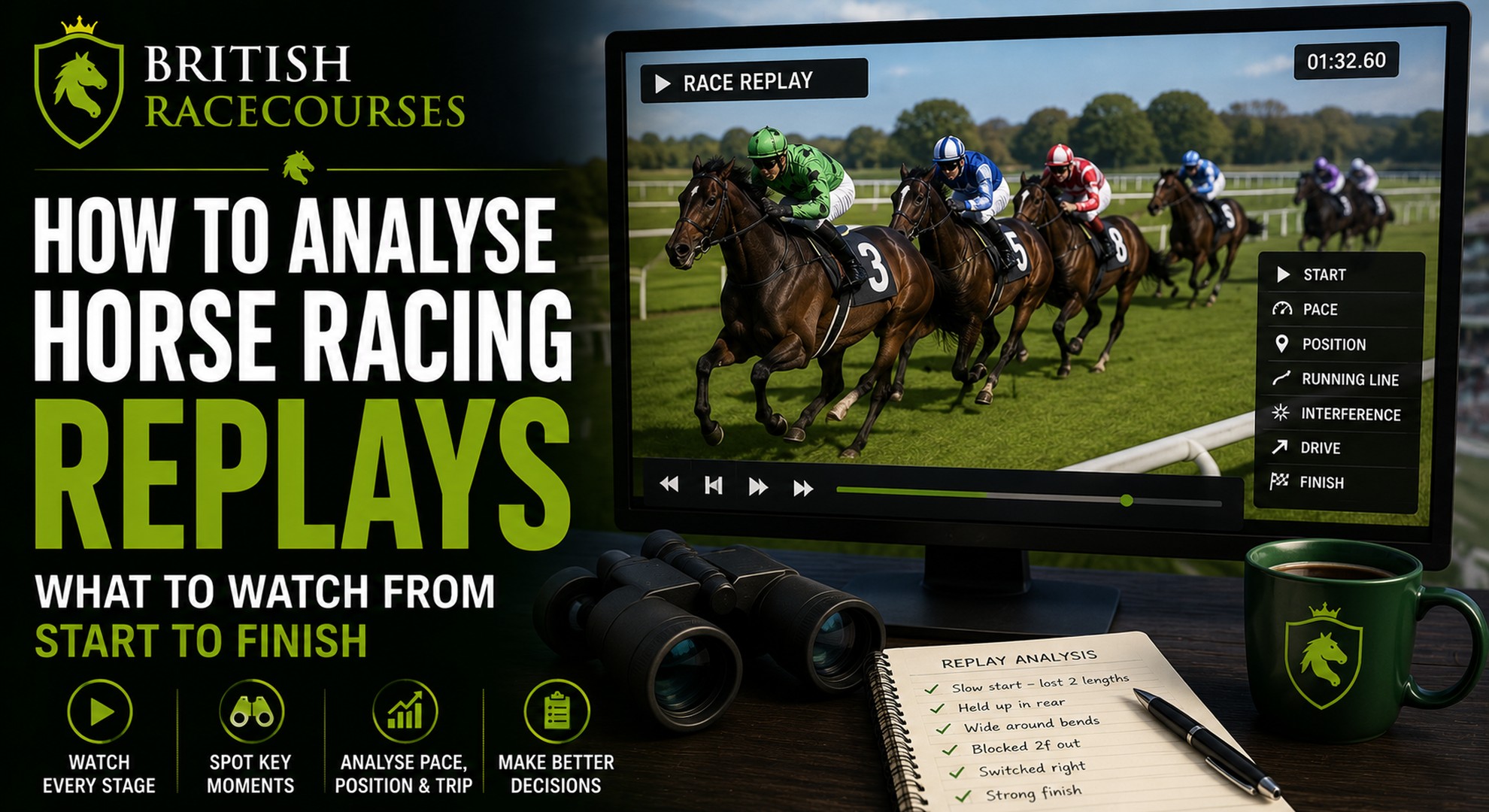
Race replays can reveal information that a finishing position, racecard or form comment cannot fully capture.
A result tells you that a horse finished fourth.
A replay can show you that the same horse:
- broke slowly
- raced further back than intended
- travelled strongly
- was forced wide around the bend
- lost momentum behind weakening horses
- switched for a clear run
- finished strongly after the race was effectively over.
The opposite also applies.
A horse that finished second may have enjoyed:
- an uncontested lead
- the best part of the track
- a perfect position
- no interference
- a favourable pace
- a clear run throughout.
Watching a replay properly means assessing how the entire race developed, not simply looking for an unlucky horse in the final furlong.
The most effective process is systematic.
Watch the start. Understand the pace. Follow the horse’s position. Assess how efficiently it travelled. Look at the racing line, bends, interference and jockey decisions. Study when the race became serious. Then examine how the horse finished.
Finally, compare what you saw with the form, pace, draw, going, class, speed ratings and sectional times.
A replay should help explain the numbers rather than replace them.
Why Watch Horse Racing Replays?
Racecards compress a performance into data.
You might see:
4th of 12, beaten 3¼ lengths
That information is useful.
It is also incomplete.
Twelve horses can run the same race and experience twelve different trips.
One horse may race prominently against a strong pace.
Another may sit behind that pace and conserve energy.
One may cover extra ground.
Another may save ground on the rail.
One may have a clear run.
Another may repeatedly lose momentum.
The finishing order records the result.
The replay helps explain how that result was produced.
This is why watching previous races should form part of a complete horse race analysis.
Race Replay Analysis Is More Than Looking for Unlucky Horses
One of the biggest mistakes is watching replays only to find horses that encountered trouble.
Interference matters.
But replay analysis goes much further.
You can use video to assess:
- starting ability
- early speed
- race position
- running style
- pace
- racing line
- travelling
- balance
- jumping
- interference
- jockey decisions
- acceleration
- finishing effort
- stamina
- whether a horse was fully extended.
British Racecourses has a separate guide to identifying a horse that ran better than the result.
This page takes the wider approach.
The objective is to understand the whole performance.
Watch the Race More Than Once
Trying to understand everything from one viewing is difficult.
Your attention naturally follows the leaders, winner or commentator’s focus.
A better replay process uses several viewings.
First Viewing: Watch the Whole Race
Do not concentrate exclusively on one horse.
Understand:
- the overall pace
- which horses led
- where the winner raced
- when the race began to develop
- whether the field became stretched
- which part of the track appeared favourable.
You are trying to understand the shape of the race.
Second Viewing: Follow One Horse
Ignore the winner unless it is the horse you are studying.
Track your horse from the start to the finish.
Do not lose it when the camera changes angle.
Ask what happened at every stage.
Third Viewing: Examine the Important Moments
Return to specific points such as:
- the start
- first bend
- a pace change
- interference
- the home turn
- when the jockey first asked for an effort
- the final furlong
- the finish.
Pause or slow the footage when necessary.
Fourth Viewing: Compare Other Runners
If the race is particularly relevant, watch important rivals.
A horse’s performance often becomes clearer when compared with horses that occupied similar positions.
Step 1: Watch the Start
The first few seconds can shape the entire race.
Look at how the horse leaves the stalls on the Flat.
Does it:
- break quickly?
- break on terms?
- hesitate?
- rear?
- stumble?
- jump left or right?
- need riding immediately?
- lose several lengths?
A slow start does not affect every race equally.
Losing two lengths over five furlongs can be much more damaging than losing two lengths in a slowly run staying race.
The important question is:
What did the poor start force the horse to do afterwards?
Was the Slow Start Normal?
One bad break may be random.
Repeated slow starts indicate a pattern.
Watch several previous runs.
If the horse regularly gives away ground at the start, do not repeatedly describe it as unlucky.
That behaviour is part of its racing profile.
A horse that:
slowly away → held up → finishes strongly
in race after race may simply be a habitual slow starter.
That matters when assessing its chance next time.
Watch for Horses Using Energy Early
A horse can break slowly and then be rushed forward.
That creates a second problem.
Imagine a runner loses three lengths at the start.
The jockey immediately asks it to regain position.
The horse uses significant energy during the opening furlong and eventually races just behind the leaders.
Its finishing effort later weakens.
The bare form may suggest:
failed to stay strongly.
The replay may suggest:
used too much energy correcting the poor start.
These are different interpretations.
Step 2: Identify the Early Position
Once the field settles, note where your horse races.
Broad positions include:
- leader
- prominent
- midfield
- held up
- last.
Compare that position with the horse’s normal running style.
A habitual front-runner racing in midfield may not be experiencing its preferred setup.
A hold-up horse unexpectedly disputing the lead may be using more energy than normal.
Running style is central to horse racing pace-map analysis.
The replay lets you check whether the anticipated running style actually occurred.
Step 3: Understand the Pace
Pace is one of the most important elements of replay analysis.
Do not judge a horse’s position without judging the speed of the race.
A horse sitting ten lengths behind the leader can be perfectly positioned in a strongly run race.
The same ten-length deficit can be disastrous in a slowly run race.
Ask:
- Was the early pace strong?
- Did the leaders get an easy time?
- Was there competition for the lead?
- Did the field bunch up?
- Did the field become stretched?
- When did the tempo increase?
Our horse racing pace bias guide explains why race shape can favour some running styles over others.
How to Spot a Slowly Run Race
You do not always need sectional data to suspect a slow pace.
Visual clues include:
- leaders travelling comfortably
- jockeys restraining horses
- a tightly grouped field
- horses pulling because they want to go faster
- several runners still travelling strongly late
- the race turning into a sprint near the finish.
A slowly run race often favours horses positioned near the front.
Hold-up horses may be disadvantaged because they are asked to make ground while the leaders are also accelerating.
How to Spot a Strongly Run Race
Possible clues include:
- several horses contesting the lead
- field becoming stretched early
- jockeys working sooner than expected
- leaders weakening sharply
- horses coming from behind late.
Strong pace can favour closers.
But avoid simplistic conclusions.
A genuinely high-class front-runner can set a strong pace and keep going.
Use the replay alongside sectional times and speed figures where available.
Step 4: Watch the Horse’s Racing Position
Position means more than whether the horse was first or eighth.
Ask where it raced relative to:
- the rail
- other horses
- the pace
- bends
- traffic.
A horse can be fifth and have a perfect trip.
Another can be fifth but:
- three horses wide
- without cover
- pulling hard
- repeatedly losing ground around bends.
The form book records both as fifth at that stage.
The replay shows the difference.
Step 5: Look at the Racing Line
Ground covered matters.
A horse racing wide around several bends travels further than one following the inside rail.
The precise effect depends on the course and race.
Do not automatically upgrade every horse that races wide.
Sometimes the wider route is deliberate because:
- the ground is better
- the inside is congested
- the horse needs room
- the pace is positioned away from the rail.
Ask:
Was racing wide actually a disadvantage in this race?
Context matters.
Draw and Racing Line
The starting stall can influence the trip, particularly on the Flat.
A wide draw may force a horse to:
- race wide
- use energy to move forward
- drop back for cover.
A low draw may create traffic problems if the horse becomes trapped behind rivals.
Use the replay alongside the horse racing draw rather than judging stall position in isolation.
The draw tells you where the horse started.
The replay tells you what happened because of it.
Step 6: Assess Whether the Horse Settled
Watch how comfortably the horse travels during the early and middle stages.
A settled horse generally races efficiently.
A keen horse may:
- pull against the jockey
- throw its head
- fight restraint
- race too freely
- refuse to relax behind another runner.
Energy wasted early can matter later.
A horse that appears not to stay may actually have compromised its stamina by racing too keenly.
Repeated keenness is also important.
If the same horse pulls hard in several races, it is a characteristic rather than a one-off excuse.
Horses Racing Without Cover
Some horses settle better behind other runners.
A horse left exposed without cover may:
- race keenly
- use unnecessary energy
- struggle to relax.
Again, avoid automatically upgrading it.
Ask whether the horse created the problem itself or whether the race circumstances caused it.
Step 7: Watch How the Horse Travels
The phrase travelling well is widely used in racing.
It usually describes a horse moving comfortably without the jockey having to apply significant pressure.
Watch the jockey.
Are the reins still relatively quiet?
Is the jockey sitting comfortably?
Is the horse maintaining position without being pushed?
Compare that with a horse whose jockey is:
- nudging
- pushing
- using the whip
- struggling to maintain position.
Travelling strongly is positive, but it is not the same as finishing strongly.
Some horses travel beautifully and find little when asked.
Others appear under pressure early but continue responding.
The entire race matters.
Step 8: Identify the First Moment of Pressure
One of the most useful replay observations is:
When did the jockey first have to ask the horse seriously?
Compare runners.
Horse A may be pushed along half a mile from home.
Horse B may still be travelling comfortably two furlongs later.
That provides information about how easily each horse was coping with the race.
But do not stop watching.
Horse A may respond strongly to pressure.
Horse B may find very little once asked.
Step 9: Watch the Critical Part of the Race
Most races have a point where the tempo changes and serious competition begins.
Depending on the race, this might occur:
- entering the straight
- around the final bend
- three furlongs from home
- approaching the final two fences.
Watch what happens when the race changes.
Does the horse:
- accelerate?
- maintain position?
- become outpaced?
- need time to respond?
- become trapped?
- drift?
- lose balance?
This point often reveals more than the final 100 yards.
Step 10: Assess Trouble in Running
Interference attracts attention because it is easy to see.
Common examples include:
- blocked run
- horse checked
- hampered
- bumped
- squeezed for room
- switched around rivals
- forced wide
- clipped heels
- momentum interrupted.
The important question is not:
Did the horse encounter trouble?
It is:
How much did the trouble actually affect the performance?
Do Not Automatically Upgrade an Unlucky Horse
Suppose a horse is blocked one furlong from home.
It looks unlucky.
Watch again.
Was it still travelling strongly?
Was a genuine gap available?
Did it lose substantial momentum?
How much ground did it lose?
Did it accelerate once clear?
Was it already weakening?
A horse can encounter visible interference without the incident changing the result significantly.
The most obvious unlucky horse is not always the horse that performed best.
Momentum Matters
Losing momentum can be more damaging than losing a small amount of ground.
A horse accelerating into contention may be forced to stop, switch and accelerate again.
That can be costly.
Watch:
- how quickly it was travelling before the incident
- whether the jockey had to stop riding
- how far it switched
- how long it took to regain speed.
This is why video can add information that the phrase “denied a clear run” cannot fully communicate.
Step 11: Assess the Jockey’s Decisions
Replay analysis should examine tactics without turning every defeat into a criticism of the jockey.
Ask:
- Was the horse positioned appropriately?
- Was cover available?
- Could the jockey have moved earlier?
- Was the jockey waiting for a gap?
- Did the horse have enough ability to take that gap?
- Was switching outside realistic?
- Was the jockey following instructions based on the horse’s usual style?
Race riding involves decisions made in seconds.
Avoid judging them with the benefit of hindsight alone.
The useful question is whether the ride affected how you should interpret the horse’s performance.
Step 12: Watch for Horses Becoming Outpaced
A horse can lose position because it temporarily lacks speed rather than because it is weakening.
This is particularly important when considering future distance changes.
Imagine a horse over a mile:
- travels comfortably
- becomes outpaced when the field accelerates
- drops several lengths
- begins staying on strongly near the finish.
That may suggest a longer distance could suit.
The horse was not necessarily tired.
It may simply have lacked the acceleration required at a key moment.
Combine the replay with the horse’s pedigree when considering whether additional stamina should help.
Step 13: Watch for Horses That Fail to Stay
The reverse can happen.
A horse may:
- travel strongly
- move into contention
- appear likely to challenge
- weaken sharply late.
Possible explanations include:
- distance too far
- overly strong pace
- racing too keenly
- difficult ground
- fitness
- class.
Do not immediately conclude that the horse failed to stay.
Review the entire trip.
A horse that wasted energy early may stay the distance under more efficient circumstances.
Step 14: Study Acceleration
Watch how quickly the horse responds when the jockey asks for an effort.
Does it:
- accelerate immediately?
- take several strides to respond?
- maintain one pace?
- produce a short burst?
- continue building speed gradually?
This can help identify what type of race may suit.
A horse with strong acceleration may be effective in tactical races.
A more galloping horse may prefer a sustained pace that allows stamina to become important.
Step 15: Watch the Final Furlong
The final furlong attracts the most attention.
By this stage, however, much of the race has already happened.
Look for:
- continued acceleration
- maintaining speed
- weakening
- drifting
- hanging
- changing leads
- jockey easing
- horse finishing with more available.
Compare the finish with what happened earlier.
A horse staying on strongly after a poor start and unsuitable pace has a different profile from one staying on after receiving a perfect economical trip.
What Does “Finishing Strongly” Actually Mean?
Be careful with visual impressions.
A horse can appear to finish strongly because other horses are slowing more quickly.
That is not necessarily the same as accelerating.
Sectional data can help distinguish:
horse speeding up
from
horse slowing down less than its rivals.
This is one reason horse racing sectional times complement replay analysis so well.
Watch Beyond the Winning Post
Where footage permits, continue watching immediately after the finish.
The gallop-out can occasionally provide additional clues.
A horse may:
- continue strongly past the line
- pull up quickly
- appear to have considerable energy left.
Treat this carefully.
The race has finished and jockey behaviour changes immediately.
The gallop-out is supporting evidence, not a substitute for what happened during the competitive part of the race.
Analyse the Winner Properly
Replay analysis should not focus only on beaten horses.
Winners need analysing too.
Ask:
How easy was the win?
Did the horse:
- receive the perfect pace setup?
- control the race from the front?
- save ground?
- get a clear run?
- win despite adversity?
- race wide?
- overcome an unsuitable pace?
- have more left?
A visually impressive winner can be overrated if everything went perfectly.
A narrow winner can be underrated if it overcame several disadvantages.
Did the Winner Get an Easy Lead?
Front-runners can become vulnerable next time if their previous victory came after controlling a slow pace.
Suppose a horse:
- breaks well
- takes the lead
- faces no pressure
- dictates comfortable fractions
- accelerates in the straight
- wins by two lengths.
The performance may look dominant.
Next time it faces three other habitual front-runners.
The pace environment has completely changed.
This is why previous replays should feed into your assessment of today’s pace map.
Analyse Horses That Raced Against the Bias
Track and pace biases can make certain performances more valuable than the result suggests.
Examples include:
- hold-up horse in a race dominated by leaders
- front-runner surviving a pace collapse
- horse racing wide when the inside was favoured
- horse staying on against a strong positional advantage.
Our guide to horse racing pace bias explains these patterns in more detail.
The replay helps you see how an individual horse interacted with that bias.
Compare Several Races From the Same Meeting
Watching only one replay can hide track-wide patterns.
When analysing an important performance, consider other races from the meeting.
Ask:
- Were front-runners dominating?
- Were hold-up horses winning?
- Was one part of the track faster?
- Were times unusually quick or slow?
- Did the going appear to change?
This can help separate an individual performance from the wider conditions of the meeting.
Going and Replay Analysis
Official horse racing going descriptions provide essential context.
The replay can add visual evidence.
Look for:
- horses kicking up substantial turf
- runners appearing to labour
- jockeys moving towards different parts of the course
- horses changing racing lines to seek better ground.
Do not try to replace official going information with a visual guess.
Use the replay to understand how horses coped with the stated conditions.
Replay Analysis on the All-Weather
Replays are equally useful on artificial surfaces.
At Britain’s all-weather racecourses, look for:
- position
- kickback
- bends
- racing line
- pace
- traffic.
A horse held up behind rivals may receive substantial kickback.
Some cope with it.
Others appear uncomfortable and improve once switched into clear air.
That can be valuable when the horse receives a different setup next time.
National Hunt Replay Analysis
Jump racing adds another major dimension:
the obstacles.
A finishing position cannot fully explain how efficiently a horse jumped.
When reviewing a hurdle or chase, watch every obstacle where possible.
Look for:
- approach
- take-off
- height
- fluency
- landing
- momentum
- mistakes
- jumping left or right.
Our National Hunt racing guide explains the broader demands of jump racing.
Efficient Jumping
An efficient jumper tends to maintain momentum over an obstacle.
A less efficient horse may:
- get too close
- stand too far off
- jump excessively high
- land awkwardly
- lose speed.
Small losses can accumulate across a race.
A horse losing half a length at several fences can surrender substantial ground without making one dramatic error.
Replay analysis makes these repeated inefficiencies easier to identify.
Major Jumping Mistakes
Watch how much a mistake actually costs.
A horse may:
- brush through the top
- peck on landing
- lose one length
- lose several lengths
- almost unseat the jockey
- lose all rhythm.
The written form comment may record:
mistake 6th.
The replay shows the severity.
That matters when deciding how much to forgive the final result.
Horses Jumping Left or Right
Repeatedly moving in one direction over obstacles can matter.
A horse consistently jumping left may be better suited by some track configurations than others.
Likewise for a horse jumping right.
Do not draw strong conclusions from one obstacle.
Look for repeated behaviour across several fences and races.
Watch the Horse, Not the Commentator
Commentary is useful for following a race.
It can also influence your interpretation.
Try watching important replays with the sound off.
This removes statements such as:
- “travelling strongly”
- “going easily”
- “looks beaten”
- “not finding much.”
Make your own judgement first.
You can then compare it with the commentator’s impression.
Written Form Comments vs Video
Written comments provide an efficient summary.
Examples include:
- slowly away
- keen
- held up
- ridden
- hampered
- stayed on
- weakened.
These are valuable.
But each phrase compresses a complex event.
Hampered could mean a minor interruption.
It could also mean losing several lengths at the decisive stage.
Use comments to identify what you need to investigate.
Use the replay to judge its significance.
Combine Replays With Speed Ratings
A replay explains the circumstances.
Speed ratings help quantify the time performance.
Suppose a horse looks visually impressive.
Its speed figure is ordinary.
Why?
Possibilities include:
- slow early pace
- weak opposition
- unusually favourable conditions
- visual impression exaggerating the performance.
Now consider a horse that looked less impressive but produced a high speed figure.
Perhaps it competed in a strongly run race and had to work throughout.
Numbers and video can challenge each other.
That is useful.
Combine Replays With Race Class
Always consider the quality of opposition.
A horse can look impressive when dominating weaker rivals.
Another can look less comfortable while competing in much stronger company.
Our horse racing classes guide explains why moving between classes changes the level of opposition.
When reviewing a replay, ask:
Who was this horse racing against?
Not simply:
How did it look?
Combine Replays With Handicap Ratings
A horse’s Official Rating provides another layer.
Suppose a horse finishes sixth from a mark of 85.
The replay reveals:
- slow start
- wide trip
- blocked run
- strong finish.
If its handicap mark later falls, that run may become increasingly interesting.
Conversely, a horse that enjoyed every advantage but still struggled from its current mark may have limited room for error next time.
Course and Distance Context
Course characteristics can explain what you see.
A horse may:
- struggle around a sharp bend
- become unbalanced downhill
- lose position on an undulating section
- respond well to a stiff finish.
Use the British Racecourses UK racecourse guides to understand the track.
Previous course and distance form can then tell you whether the replay reflects a recurring pattern.
Do Not Invent Excuses
Replay analysis becomes dangerous when you begin looking for reasons to forgive every defeat.
Almost every losing horse experiences something imperfect.
The questions are:
Was the disadvantage meaningful?
and:
Would removing it materially change your assessment?
A horse beaten ten lengths should not automatically be upgraded because it was briefly checked.
A horse repeatedly racing keenly should not receive a fresh excuse every time.
Separate:
bad luck
from
a recurring weakness.
Recurring Problems Matter More Than One-Off Problems
Watch several previous runs.
Patterns can emerge.
Examples include:
- repeatedly slow away
- regularly keen
- hangs under pressure
- jumps left
- struggles around bends
- gets outpaced at the same stage
- finds little off the bridle.
A recurring problem belongs in your assessment of the horse.
It should not be treated as a one-time excuse.
Look for Positive Recurring Patterns
Replays can also reveal repeatable strengths.
A horse may regularly:
- travel strongly
- jump efficiently
- maintain speed
- settle well
- handle traffic
- finish strongly.
When these traits align with today’s expected race conditions, the horse becomes easier to assess.
Separate Horse Performance From Race Outcome
A horse can run well and lose.
A horse can run poorly and win.
That sounds contradictory until you consider the circumstances.
A winner may:
- receive an uncontested lead
- beat weak opposition
- record a modest speed figure.
A loser may:
- race against the pace
- cover extra ground
- encounter interference
- finish strongly in a high-class race.
Your job is to assess performance, not merely outcome.
How to Make Race Replay Notes
Watching replays without recording anything reduces their long-term value.
Keep notes concise.
A useful format is:
Start: slow by 2L
Position: rear
Pace: slow, disadvantaged
Trip: inside, blocked 2f out
Response: quickened when clear
Finish: strong
Conclusion: better than 6th suggests; wants stronger pace
Avoid writing an essay for every horse.
The note should remind you what mattered when the horse runs again.
Avoid Emotional Notes
Do not write:
“Certainty next time.”
or:
“Should have won easily.”
Use factual language.
Better:
“Lost momentum when blocked 1½f out; stayed on after switching.”
The factual note remains useful.
The emotional conclusion can encourage poor betting decisions later.
Build Your Own Replay Tags
A simple tagging system makes patterns easier to find.
Possible tags include:
START
- slow away
- fast break
PACE
- pace disadvantage
- easy lead
- contested lead
TRIP
- wide
- blocked
- no cover
- traffic
HORSE
- keen
- outpaced
- stayed on
- weakened
- hung
JUMPS
- fluent
- jumping errors
- jumped left
- jumped right
Tags allow you to compare similar performances without relying on memory.
A Complete Race Replay Process
A repeatable system helps prevent selective viewing.
Before Watching
Record:
- finishing position
- distance beaten
- course
- distance
- going
- class
- draw where relevant.
Do not form a strong conclusion yet.
Viewing One
Watch the race normally.
Understand the overall shape.
Viewing Two
Follow the target horse from start to finish.
Viewing Three
Review the key moments.
After Watching
Write down:
- start
- position
- pace
- trip
- travelling
- interference
- response
- finish.
Final Check
Compare your visual assessment with:
- sectionals
- speed ratings
- Official Rating
- race class
- course and distance
- going.
Then decide whether the replay actually changes your view.
Worked Flat Race Replay Example
Imagine a horse finishes:
6th of 12, beaten 4 lengths
At first glance, the form looks ordinary.
Start
The horse breaks one length slowly.
Early Race
The pace is slow.
The horse settles near the rear.
Bend
It remains trapped behind rivals while the leaders control the race.
Two Furlongs Out
The pace increases sharply.
The horse needs room but cannot move.
One Furlong Out
The jockey switches outside.
Finish
The horse gains several places and finishes fastest visually.
The conclusion should not automatically be:
unlucky, back next time.
A better conclusion is:
The horse was disadvantaged by a slow pace and loss of momentum. A stronger pace or more prominent position could suit next time. Check sectionals and price.
That note is much more useful.
Worked Front-Runner Example
Now consider a winner.
1st of 10 by 3 lengths
It looks impressive.
Start
Breaks quickly.
Early Race
Takes an uncontested lead.
Middle
No rival challenges.
Turn
Jockey gradually increases the pace.
Straight
Horse accelerates from the front and wins comfortably.
A strong performance?
Yes.
But the replay also tells you the horse received an ideal setup.
Next time it faces:
- two other front-runners
- stronger opposition
- a wider draw.
The previous three-length victory should not automatically be treated as proof that it will dominate again.
Worked Jump Race Example
A chaser finishes fourth, beaten eight lengths.
The bare result appears moderate.
Watch the replay.
Early Fences
Jumps fluently.
Mid-Race
Makes a significant mistake and loses four lengths.
Next Fence
Jumps cautiously after the error and loses further momentum.
Final Turn
Recovers into contention.
Finish
Stays on without threatening the winner.
The mistake did more than cost four lengths.
It affected rhythm at the next obstacle too.
That context is difficult to understand from the finishing position alone.
How Many Replays Should You Watch?
You do not need to watch every race every horse has ever contested.
Prioritise.
Replays become particularly useful when:
- the form is difficult to interpret
- a horse is changing conditions
- the written comment mentions trouble
- pace appears important
- the horse produced an unusual speed figure
- it is stepping up or down in class
- the market disagrees with your initial assessment.
For major betting races, you may want to watch several previous runs for the leading contenders.
For simpler races, targeted viewing is usually enough.
Which Previous Run Is Most Relevant?
Do not automatically watch only the latest start.
Look for races comparable with today.
Prioritise previous runs with similar:
- distance
- going
- course type
- class
- field size
- pace scenario.
A race from four starts ago under nearly identical conditions may tell you more than the horse’s most recent run under completely different circumstances.
Should You Watch Every Horse in the Race?
For detailed analysis, watching every relevant contender can be valuable.
But time matters.
A practical approach is:
- analyse the racecard
- identify serious contenders
- identify horses whose form needs explaining
- watch their relevant replays
- expand the review if new questions appear.
This is more efficient than watching hours of footage without a clear purpose.
Race Replays and Market Prices
Replay analysis does not create value automatically.
Suppose thousands of bettors saw the same unlucky run.
The horse is heavily backed next time.
Its odds shorten from:
8/1
to
3/1.
The replay observation may be correct.
The value may have disappeared.
This is why visual analysis must ultimately connect with how to find value bets in horse racing.
The question is never simply:
Do I like this horse?
It is:
Is the available price bigger than the chance I believe the horse has?
Beware the Obvious Unlucky Loser
Obvious trouble attracts attention.
A horse dramatically blocked on television can become one of the most discussed runners next time.
That can make it shorter than it should be.
More subtle replay observations can sometimes be more useful:
- inefficient racing line
- unsuitable pace
- gradual loss of momentum
- repeated small jumping errors
- horse positioned in the wrong part of the track.
These factors may attract less public attention than one dramatic incident.
Replay Analysis and Betting Discipline
Do not allow replay notes to become emotional attachments to horses.
A horse does not “owe” you a win because it was unlucky last time.
Conditions change.
So do:
- opponents
- draw
- pace
- going
- class
- handicap mark
- odds.
Every race requires a fresh assessment.
Race Replay Analysis Checklist
When watching a Flat replay, ask:
Start
- Did the horse break well?
- Did it lose ground?
- Was it rushed forward afterwards?
Position
- Where did it settle?
- Was that its usual position?
- Did it obtain cover?
Pace
- Was the race fast or slow?
- Was the horse advantaged or disadvantaged?
Trip
- Did it save ground?
- Did it race wide?
- Was it trapped?
- Did it encounter kickback?
Travelling
- Did it settle?
- Was it keen?
- When did the jockey begin asking?
Critical Stage
- Did it accelerate?
- Was it outpaced?
- Was momentum interrupted?
- Was there interference?
Finish
- Did it stay on?
- Did it weaken?
- Did it hang?
- Was it eased?
Context
- What was the class?
- What was the going?
- Did the draw matter?
- What did the speed and sectional figures say?
When watching a jumps replay, add:
- Did it jump fluently?
- Did it lose momentum over obstacles?
- Did it jump left or right?
- Did mistakes affect later fences?
- Did its jumping improve or deteriorate during the race?
Frequently Asked Questions
Why should I watch horse racing replays?
Replays provide context that finishing positions and short form comments cannot fully capture. They can show pace, position, interference, racing line, jumping, jockey decisions and how strongly a horse actually finished.
What should I watch first in a horse racing replay?
Start by watching the entire race to understand the overall pace and shape. Then watch again while following the specific horse you want to analyse.
How many times should I watch a race replay?
For important races, two or three viewings are useful. Watch the whole race first, follow the target horse second, then review important moments again.
Should I watch the winner or the horse I am analysing?
Both can matter, but dedicate at least one viewing exclusively to the horse you are studying. Following the winner can cause you to miss important events elsewhere in the field.
How can I tell if a horse was unlucky?
Look for meaningful disadvantages such as losing substantial ground, being badly blocked, forced wide or having momentum interrupted. Then judge whether the incident genuinely affected the result.
Does being hampered mean I should back the horse next time?
No. Assess how severe the interference was, whether the horse was still travelling well and whether today’s new conditions suit. The betting price also matters.
How can I spot a slow pace from a replay?
A tightly grouped field, comfortable leaders, horses pulling against restraint and a late sprint can indicate a slowly run race. Sectional times provide stronger quantitative evidence where available.
How can I tell whether a horse finished strongly?
Watch whether it gains ground and position late, but remember that it may simply be slowing less than its rivals. Sectional data can help distinguish genuine acceleration from relative finishing speed.
What does travelling well mean?
A horse travelling well maintains its position comfortably without substantial pressure from the jockey. This does not guarantee it will respond strongly when asked to accelerate.
What should I look for in National Hunt replays?
Pay particular attention to jumping efficiency, mistakes, momentum, whether the horse jumps left or right, and how it responds after an error.
Is racing wide always a disadvantage?
No. Racing wide can mean covering extra ground, but the wider part of the track may sometimes offer better going or a clearer passage. Judge the circumstances of the individual race.
Should I watch replays with commentary?
Commentary helps follow the race, but watching important replays with the sound off can help you form an independent judgement.
Are written form comments enough?
They provide useful summaries but cannot capture every detail. A replay lets you assess the severity and context of events described by terms such as “hampered”, “keen” or “stayed on”.
Can replays help identify horses that need a longer distance?
Yes. A horse that becomes outpaced before staying on strongly may be worth assessing over further, particularly if its pedigree and previous form support the distance change.
Can replays help identify horses that do not stay?
Yes, but weakening late can have several causes. Consider pace, keenness, going and race position before deciding the distance was responsible.
Should I watch every previous race?
Usually not. Prioritise races under conditions similar to today and performances that contain information you need to understand.
How do speed ratings work with race replays?
Speed ratings quantify the time performance. The replay can help explain why that figure was produced. Using the two together provides more context than relying on either alone.
How do sectional times work with race replays?
Sectional times show how quickly different parts of the race were completed. The replay shows positioning, tactics and physical events that contributed to those times.
Can race replays help with value betting?
Yes, because they can change your assessment of a horse’s performance. They only create a betting opportunity if the available odds do not already reflect the information.
Do professional form analysts watch race replays?
Replay footage is an established form-study tool. Serious analysis combines video with results, ratings, written form and other race data.
Summary
Race replay analysis is about understanding how a performance happened.
Do not watch only the final furlong.
Start at the beginning.
Assess:
start → position → pace → racing line → travelling → pressure → interference → acceleration → finish.
For jump racing, add:
approach → take-off → jumping efficiency → landing → momentum.
Watch important races more than once.
First understand the whole race.
Then follow your horse.
Then revisit the decisive moments.
Most importantly, do not use replays to manufacture excuses.
Some horses genuinely encounter bad luck.
Others repeatedly:
- start slowly
- pull hard
- become outpaced
- hang
- jump poorly
- struggle in traffic.
Those are characteristics, not excuses.
Combine what you see with:
- form
- pace maps
- pace bias
- sectional times
- speed ratings
- draw
- going
- race class
- handicap ratings
- course and distance form
- pedigree
- the betting price.
A racecard tells you the recorded outcome.
The replay gives you the evidence needed to understand the journey to that outcome.
The best analysis uses both.