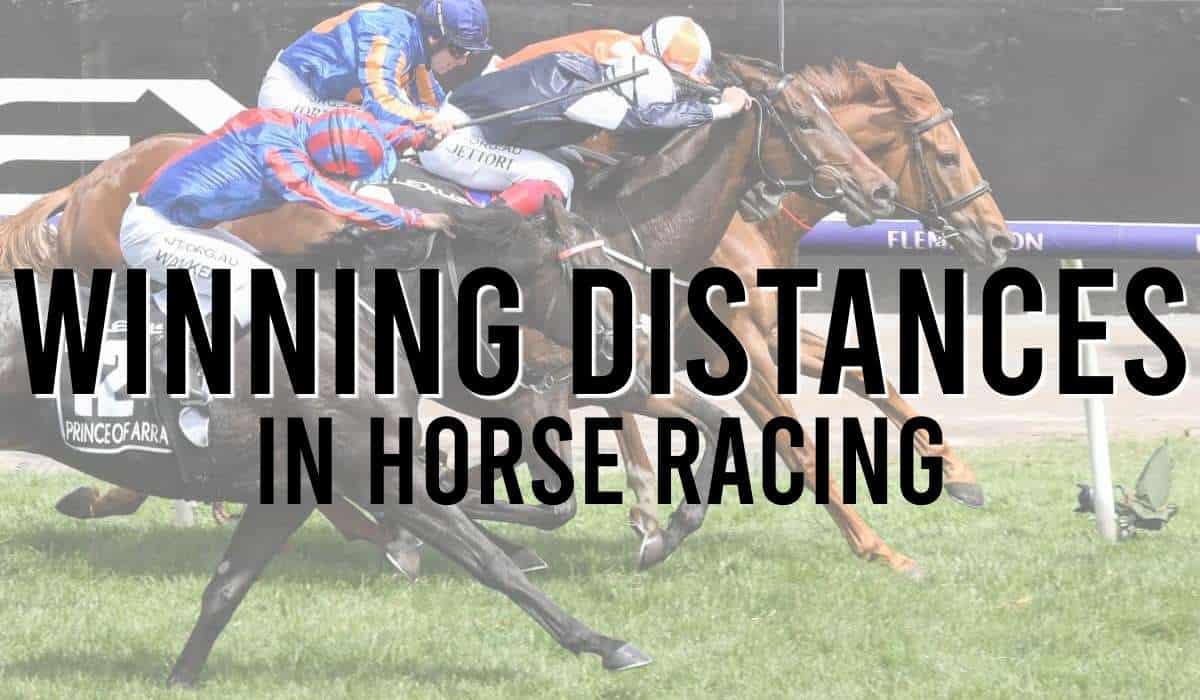
Winning distances show how far the winner finished ahead of the horse in second place. The same measurements are used throughout a result to record the margin between one finisher and the next.
A result might show that a horse won by a nose, half a length, two lengths or 10 lengths. If two horses cannot be separated at the finish, the result is declared a dead heat.
These margins provide more than a description of the finish. Winning distances can help when assessing the strength of a performance, how a race developed and whether a horse had more in hand than the bare result suggests.
They need context, though. A ten-length win is not automatically a better performance than a half-length victory.
What Is a Winning Distance in Horse Racing?
The winning distance is the official margin between the winner and runner-up.
For example, a result might show Horse A beating Horse B by two lengths, with Horse C another half-length behind Horse B.
The margins shown in a full result therefore describe the gaps between consecutive finishers rather than measuring every horse directly from the winner.
You will see these margins alongside finishing positions, starting prices and other information when studying today’s racecards and completed race results.
How Are Winning Distances Measured?
A length sounds like a simple physical measurement, but official margins are not produced by measuring the track after the horses have crossed the line.
Very close finishes can be determined using the photo-finish image. For larger gaps, the elapsed time between horses crossing the finishing line can be converted into an official distance using a lengths-per-second calculation.
This matters because horses travel at different speeds depending on the type of race and the conditions.
A one-second gap does not necessarily represent the same number of lengths in every race.
Flat horses racing quickly on a sound surface cover more ground in a second than tired jumpers finishing a staying contest on testing ground. The conversion, therefore, needs to reflect the circumstances rather than treat every race identically.
Horse Racing Winning Distance Abbreviations
The standard descriptions for close finishes include:
| Winning margin | Common abbreviation | Meaning |
|---|---|---|
| Dead heat | dh | Horses cannot be separated |
| Nose | nse | Smallest named winning margin |
| Short head | sh | Slightly more than a nose |
| Head | hd | Approximately a fifth of a length |
| Neck | nk | Approximately a quarter of a length |
| Half a length | ½ | Half a length |
| Three-quarters of a length | ¾ | Three-quarters of a length |
| One length | 1L | One full length |
| Two lengths | 2L | Two lengths |
Once margins become larger, results normally display the number of lengths rather than using another descriptive term.
Anyone unfamiliar with the other figures and abbreviations surrounding these margins can use our explanation of how to read a horse racing racecard.
What Is a Nose in Horse Racing?
A nose is the smallest conventional winning margin.
It is used when one horse has beaten another by an extremely small amount but the judge can still separate them.
These are the finishes in which the live view can be misleading. Camera angles, the movement of the horses’ heads and their positions across the track can make it difficult to identify the winner without the photo finish.
A nose victory counts exactly the same as a 20-length victory when determining the winner. The size of the margin becomes relevant when analysing how the performance was achieved.
What Is a Short Head?
A short head is another very narrow margin, larger than a nose but smaller than a head.
It is normally abbreviated to sh in racing results.
A horse winning by a short head has been involved in a genuinely close finish, so the circumstances of the final furlong deserve attention when assessing the form.
The runner-up may have been closing rapidly. The winner may have idled in front. One horse may have encountered interference or been forced to switch.
The margin alone cannot explain those details.
What Is a Head?
A head is approximately one-fifth of a length and appears as hd in results.
As with a nose or short head, a head victory indicates that very little separated the first two horses at the line.
Small margins are particularly interesting when assessing a potential rematch. A slight change in weights, pace, going, draw or track position can be enough to reverse a close result.
What Is a Neck?
A neck represents roughly a quarter of a length and is usually abbreviated to nk.
A neck victory is still a close finish, but there can be an important difference between a horse that has been driven flat out to prevail by a neck and one that has won by the same margin without appearing fully extended.
This is why serious horse racing form analysis goes beyond the number printed in the result.
What Does Winning by One Length Mean?
A horse winning by one length has finished approximately one horse’s length ahead of the runner-up.
The physical size of racehorses varies, so a length should not be treated as an exact fixed measurement in feet or metres for form-analysis purposes.
The racing industry uses the length as a practical standard for describing the separation between horses.
Larger margins are expressed as multiples or fractions of this unit.
Is a Horse Length Always the Same Distance?
No.
Racehorses are different sizes, and official margins are not simply produced by laying an imaginary identical horse between each finisher.
Time and speed are important when calculating larger distances.
Conditions can also change the relationship between elapsed time and the margin expressed in lengths.
This is particularly noticeable when comparing fast Flat races with staying chases on soft or heavy ground.
How Many Lengths Are in a Second?
There is no single lengths-per-second figure that applies to every British horse race.
The conversion depends on factors including the code of racing, surface and going.
This is an important distinction because older explanations sometimes present one fixed calculation as if it applies universally.
Imagine two horses finishing one second apart.
If they are travelling quickly at the end of a Flat race on fast ground, they will cover considerably more distance during that second than horses labouring up the straight after a demanding staying chase.
For punters, the main point is simple: do not convert seconds into lengths using one universal figure when comparing performances from different races.
What Does “A Distance” Mean in Horse Racing Results?
Very large margins can be recorded as a distance rather than continuing to report increasingly large numbers of lengths.
You are more likely to encounter substantial margins in National Hunt racing.
A long-distance chase on testing ground can leave a field widely spread out by the finish. Jumping errors, stamina limitations and horses tiring after the final obstacle can increase those gaps further.
Wide margins are less common in competitive Flat races, although exceptional performances can still produce them.
Flat Racing and Jump Racing Winning Distances
Winning margins need to be interpreted differently across Flat and National Hunt racing.
Flat races are generally faster and often produce more compressed finishes. A small margin can separate several horses, particularly in competitive handicaps and sprints.
Jump races can produce much larger distances.
National Hunt races take place over longer distances; horses must negotiate hurdles or fences; the ground can become testing during winter; and individual mistakes can cost significant ground.
A horse that makes a serious error at a fence might lose several lengths immediately. A runner that fails to stay a demanding three-mile chase can lose considerably more ground during the closing stages.
This does not make large-margin jumps winners inherently superior to narrow-margin Flat winners. The two performances need to be judged within their own racing context.
Does a Bigger Winning Distance Mean a Better Horse?
Not necessarily.
Winning margin is useful evidence, but it should never be treated as a standalone measure of ability.
Consider two hypothetical winners.
The first wins a weak Class 6 handicap by eight lengths after enjoying an uncontested lead.
The second wins a strong Group race by half a length after defeating several high-class rivals.
The eight-length winner has the larger margin. That does not mean it produced the better performance.
The strength of the opposition matters. So do race class, pace, weights, going, distance, draw and the way the race unfolded.
This is one reason our detailed process for analysing a horse race focuses on the complete performance rather than simply reading finishing positions.
Why Winning Distances Matter When Reading Form
Winning distances add context to a horse’s form figures.
A form line showing 211 looks strong.
But those numbers do not tell you how the victories were achieved.
A horse that has won its last two races by six and eight lengths may have improved sharply. Alternatively, it may have dominated two weak races under favourable circumstances.
Another horse could have form figures of 232 and have finished within a neck of the winner each time in stronger company.
The raw form figures make the first horse look better. A deeper examination could produce a different conclusion.
Our detailed article on how to read horse racing form explains why finishing positions need to be considered alongside the circumstances of each performance.
The quality of the opposition matters too. Looking at subsequent results and horse racing form lines can tell you whether a seemingly impressive win has subsequently been supported by the horses that finished behind.
Winning Distances and Race Class
Race class is one of the first things to check before attaching too much significance to a wide-margin victory.
Winning easily against weak opposition can attract attention, but the horse still needs to reproduce that level when facing stronger rivals.
The reverse can also apply.
A horse repeatedly finishing two or three lengths behind good horses might become interesting when dropping into a weaker race.
This is why margins should be assessed relative to the quality of the opposition.
A narrow defeat in a strong contest can be better form than a comfortable victory in a poor one.
Winning Distances and Handicap Racing
Margins can have particular significance in handicaps.
The handicap system attempts to give horses of different abilities a more equal chance by allocating weights according to their official ratings.
A horse that wins a handicap comfortably may receive a higher handicap mark for its next run.
That creates an important question: did the horse win because it was well handicapped, and does it still have enough improvement to overcome its revised mark?
Our explanation of how racehorse handicap ratings work covers the relationship between official ratings and the weights horses carry.
The handicapper is not simply looking at the published winning margin. The entire performance matters.
A horse can win narrowly while appearing to have considerably more ability available. Another can win by several lengths because its main rivals underperformed.
Winning distance is evidence, not the complete handicap assessment.
Winning Distances and Weight
Weight can change how previous margins should be interpreted.
Suppose Horse A beats Horse B by a neck.
They meet again, but Horse A now has to concede significantly more weight.
The original neck margin tells you that little separated them at their previous meeting. The changed weights could therefore be important.
This becomes especially relevant in handicaps, where relatively small differences can matter between closely matched runners.
It would still be too simplistic to convert every pound directly into an expected finishing margin. Race pace, distance, ground and individual improvement can all change the result.
Winning Distances and the Going
The going can have a major effect on finishing distances.
Testing ground tends to expose stamina limitations more severely than fast ground.
A horse struggling to cope with soft or heavy conditions can lose ground quickly late in a race. Fields can become stretched, particularly over longer distances.
This helps explain why a large winning margin on heavy ground needs careful interpretation.
A 12-length winner might have produced an exceptional performance. It might also have been the only leading contender genuinely suited by the conditions.
Our horse racing going guide explains the different ground descriptions and why some horses perform much better under particular conditions.
Winning Distances and Pace
Pace is another major factor.
A strongly run race can exaggerate the distances between horses as tired runners weaken late.
A slowly run tactical contest can have the opposite effect. Several horses may remain closely grouped as they enter the final furlong, producing a compressed finish.
That means a narrow victory does not necessarily indicate that the winner was only marginally better than the field.
If the early pace was slow, the race may have developed into a short sprint to the line.
Studying horse racing pace maps can help explain where runners were positioned, while pace bias can show why a particular running style may have been advantaged or disadvantaged.
Winning Distances and Sectional Times
The final margin tells you where horses finished. It does not tell you how they used their energy during the race.
That distinction can be important.
A horse may establish a large lead after being allowed to control slow early fractions before accelerating. Another winner may record the same margin after chasing an exceptionally strong pace and sustaining its effort.
Those performances can look identical in the result while being very different analytically.
Horse racing sectional times provide another way of examining how a performance was achieved rather than relying solely on the finishing margin.
Winning Distances and the Draw
Draw can affect margins, particularly on courses and distances where stall position influences the amount of ground covered or the ability to secure a preferred racing position.
A horse drawn favourably may get an economical trip close to the pace.
A rival drawn badly could race wide, become trapped behind other runners, or expend additional energy to gain position.
The finishing margin records what happened at the line. It does not tell you how efficiently each horse travelled through the race.
Our full horse racing draw guide explains why the effect of stall position changes according to the course, distance, field size, pace and going.
Winning Distances and Track Bias
The part of the racecourse on which a horse competed can also affect the final margin.
Suppose the winner raced on quicker ground close to one rail while the runner-up spent much of the contest on a slower section of the track.
The result might show a three-length victory, but those three lengths cannot automatically be treated as a pure measure of the difference between the horses.
Our explanation of horse racing track bias covers how ground, weather, rail movements and racing position can create advantages during a meeting.
This is particularly useful when reassessing beaten horses. A runner that competed on an unfavourable part of the track may have performed considerably better than its finishing position and beaten distance initially suggest.
Winning Easily Versus Winning Narrowly
The visual impression created by a victory can be as important as the published margin.
Some horses do little once they reach the front. A jockey may only ask them for enough effort to win.
Others continue to extend their advantage all the way to the line.
This creates two very different types of victory.
A horse can win by half a length while having more in hand than the margin suggests. Conversely, a horse can win by three lengths after being fully extended and have little improvement left.
Race comments and replays can therefore add useful information to the bare result.
Can a Narrow Winner Be Better Than the Result Suggests?
Yes.
Winning margins can understate a horse’s superiority.
A jockey may ease down close to the finish once the race is secure. A horse can idle after hitting the front or respond only when challenged.
Traffic problems can also affect the eventual margin.
A horse that was repeatedly denied a clear run before accelerating through a late gap may win narrowly despite producing the strongest performance in the race.
This is why margins should support race analysis rather than replace it.
Can a Wide-Margin Winner Be Overrated?
Yes.
Wide-margin winners naturally attract attention, but the result needs to be examined before deciding how impressive it was.
Check what happened to the opposition.
Did the favourite run below form? Did several horses fail to handle the ground? Was the winner allowed an uncontested lead? Did the principal challenger make a serious jumping error? Was the race weaker than its official classification initially suggests?
A visually impressive victory can still be strong form, but the size of the winning margin should not end the analysis.
Famous Wide-Margin Victories
Large winning margins become memorable when they occur at the highest level.
Shergar won the 1981 Derby at Epsom by 10 lengths, producing one of the race’s defining performances.
Snowfall went further when winning the 2021 Oaks by 16 lengths at Epsom.
Frankel produced several dominant victories during his unbeaten career, including an emphatic Queen Anne Stakes success at Royal Ascot in 2012.
Jump racing regularly produces wider margins because the races are longer and jumping mistakes or stamina failures can create substantial gaps.
These performances demonstrate why winning distances capture attention, but the quality of the race remains essential when judging the significance of the margin.
Winning Distances in Photo Finishes
When horses finish almost together, the judge can use the photo-finish image to establish the result.
The finishing line is judged at the horse’s nose.
It does not matter which horse has its head, body or legs furthest forward elsewhere. The relevant point is the nose as the horse reaches the finishing line.
This explains why watching from an angle can be deceptive.
One horse may appear to have won on the live television picture, only for the official photo to show that another horse’s nose reached the line first.
If the judge cannot separate the horses, a dead heat is declared.
What Is a Dead Heat?
A dead heat occurs when two or more horses cannot be separated for the relevant finishing position.
If two horses dead heat for first, both are declared winners.
Dead heats are uncommon because modern photo-finish technology allows judges to separate extremely close finishes.
They still occur when the available image shows no discernible difference between the horses at the line.
Dead heats can also affect betting settlement, depending on the market and bookmaker rules.
Betting on Winning Distances
Some bookmakers offer markets based specifically on winning margins.
These can include winning-distance markets for an individual race, the biggest winning distance at a meeting or festival, aggregate winning distances across several races and distance-based specials involving a particular horse.
These markets require a different approach from simply selecting the winner.
A strong odds-on favourite might have an excellent chance of winning but still be a poor proposition to win by a large margin if it tends to idle once reaching the front.
A staying chaser running on testing ground might have a greater chance of producing a wide margin because beaten rivals can become increasingly tired late in the race.
Price still matters. Our betting odds guide explains how to interpret a bookmaker’s price rather than treating the most likely outcome as an automatic bet.
Anyone comparing bookmakers specifically for racing can use our horse racing betting sites comparison, while bettors who primarily bet from their phone can compare the separate horse racing betting apps page.
What Affects the Winning Distance?
There is no single factor that determines how far a horse wins by.
Race class matters because weaker opposition can allow a superior horse to draw clear.
Pace matters because a demanding early gallop can create larger gaps late in the race.
Going matters because testing conditions can expose stamina limitations.
Distance matters because longer races provide more opportunity for differences in stamina to emerge.
Jumping matters in National Hunt racing because mistakes can cost substantial ground.
Weights matter in handicaps because horses are being asked to compete under different burdens.
Track configuration, draw and racing position can also affect how efficiently each runner completes the race.
The margin at the finish is the outcome of all these factors interacting during the race.
How to Use Winning Distances When Analysing a Race
Start with the margin, then investigate why it occurred.
If a horse won by eight lengths, check the class of race and quality of opposition. Look at the going and determine whether conditions particularly suited the winner.
Study the pace. An uncontested lead can make a winner look more dominant than it would be in a strongly contested race.
Check the weight carried and what will change next time.
Look at the horses that finished behind. Their subsequent performances can strengthen or weaken the form.
For a narrow winner, examine whether the horse was fully extended. Watch for signs that it idled, encountered trouble or only reached the front late.
Then put the evidence together rather than allowing one statistic to dominate. The same principle runs throughout our approach to professional horse race analysis: the strongest assessment usually comes from combining form, conditions, pace, draw, ratings and the market.
Winning Distances FAQs
What is a winning distance in horse racing?
The winning distance is the official margin between the horse finishing first and the horse finishing second. Distances are also recorded between other consecutive finishers in the result.
What is the smallest winning distance in horse racing?
A nose is the smallest conventional named winning margin when the judge can separate two horses.
What happens if two horses cannot be separated?
A dead heat is declared when the judge cannot separate the horses at the finishing line.
How long is one horse length?
A length represents approximately the length of a horse, but it should not be treated as one fixed physical measurement for analysing race results. Larger official margins can be derived from the time between horses crossing the line using the appropriate lengths-per-second calculation.
Is a neck smaller than half a length?
Yes. A neck is approximately a quarter of a length, while half a length represents 0.5 of a length.
Does a bigger winning distance mean a horse ran better?
No. The margin needs to be considered alongside race class, opposition, pace, going, weights and how the race developed. A narrow victory in a strong race can represent better form than a wide-margin success in weak company.
Why are winning distances often bigger in jump racing?
Jump races are generally longer and can take place on more testing ground. Jumping errors and differences in stamina can also spread the field out considerably.
Are winning distances important for horse racing form?
Yes, but they are only one part of form analysis. Winning and losing margins help show how closely horses finished, while race class, pace, going, weights and the strength of the opposition provide the context needed to interpret them.
Summary
Winning distances record the margin separating horses at the finish and range from a nose in the closest finishes to substantial numbers of lengths in more decisive races.
The margin becomes most useful when combined with the circumstances of the performance.
A wide-margin winner may have produced an outstanding run, benefited from favourable conditions or simply beaten weak opposition. A narrow winner may have been fully extended or could have had considerably more in hand than the result suggests.
Use winning distances alongside form, race class, pace, going, weights, draw, track position and the strength of the opposition. That gives a much clearer picture of what a result actually tells you about a horse’s performance.