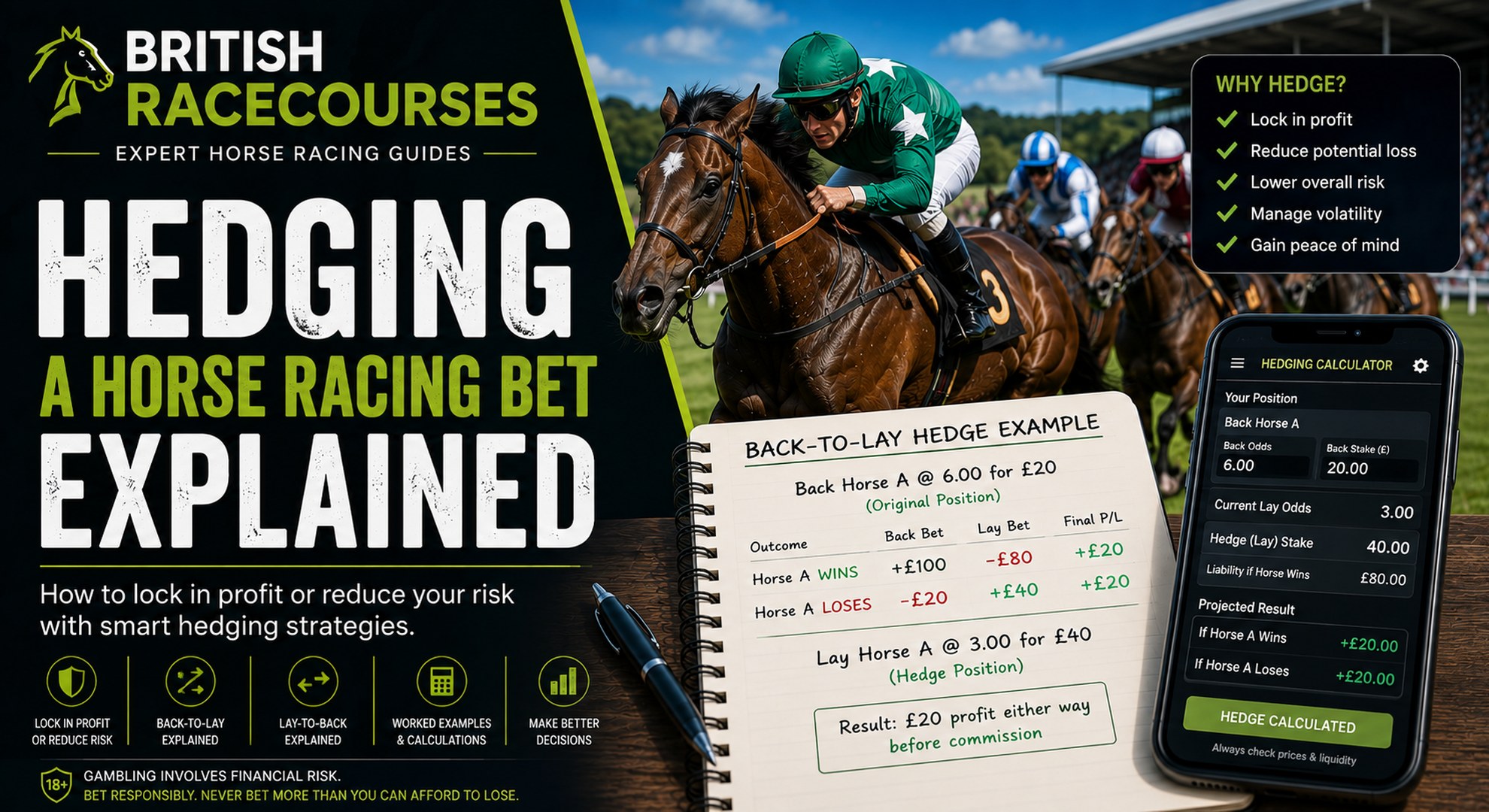
Hedging a horse racing bet means placing another bet that reduces or changes the financial exposure created by your original bet.
You might hedge to lock in a profit after a horse’s odds shorten, reduce a potential loss, recover some of your original stake or create a more balanced position across different outcomes.
Betting exchanges make this particularly straightforward because they allow bettors to both back and lay horses.
For example, you might back a horse at 6.00 before the race and later lay the same horse at 3.00.
If the stakes are calculated correctly, the difference between those prices can allow you to create a profit regardless of whether the horse subsequently wins or loses.
But hedging does not automatically guarantee a profit.
Sometimes a hedge locks in a profit. Sometimes it reduces a loss. Sometimes it simply reduces your exposure. A poorly calculated hedge can even leave you in a worse position than doing nothing.
The key is understanding the original bet, the new price, the hedge stake and the final profit or loss across every possible outcome.
What Is Hedging in Horse Racing?
Hedging means placing a second bet that offsets some or all of the risk created by an earlier bet.
The second bet normally takes the opposite position.
If you originally backed a horse, you might later lay it.
If you originally laid a horse, you might later back it.
This creates two common forms of horse racing hedging:
Back-to-lay
Back first, then lay later.
Lay-to-back
Lay first, then back later.
The purpose is to change the financial position created by the original bet.
Hedging is already defined briefly in our horse racing betting terms glossary. This page concentrates on how hedging actually works, including the calculations, exchange mechanics, advantages and disadvantages.
Why Do Bettors Hedge Horse Racing Bets?
There are several reasons.
A bettor may want to:
- lock in a profit after favourable odds movement
- reduce the risk of losing the full original stake
- reduce liability on an earlier lay bet
- secure some profit while retaining exposure to a larger win
- manage an ante-post position
- trade a horse’s changing price
- reduce overall betting variance
The objective should be clear before the hedge is placed.
Do not hedge simply because the option exists.
Hedging Does Not Always Mean Locking In Profit
This distinction matters.
Imagine you back a horse at:
6.00
The horse subsequently shortens to:
3.00
You are now in a potentially favourable hedging position because you backed at the bigger price and can lay at the shorter price.
It may be possible to create a profit whichever horse wins.
Now imagine the opposite.
You back at:
3.00
The horse drifts to:
6.00
You could still lay it.
But the hedge would normally be reducing or redistributing a potential loss rather than locking in a profit.
A hedge changes exposure.
Whether it creates profit depends on the prices and stakes involved.
Back-to-Lay Hedging Explained
Back-to-lay hedging starts with a conventional back bet.
You back a horse.
Its odds subsequently shorten.
You then lay the same horse at the lower price.
If the difference between the two prices is sufficient, you can potentially balance the stakes to produce the same gross profit whether the horse wins or loses.
Consider this example.
You back Horse A:
£20 at 6.00
Your original position is:
Horse wins:
£20 × (6 – 1)
= £100 profit
Horse loses:
£20 loss
The horse subsequently shortens to:
3.00
You can now consider laying it.
How to Calculate a Back-to-Lay Hedge
A commonly used equal-profit calculation is:
Lay Stake = (Back Odds × Back Stake) ÷ Lay Odds
Using:
Back odds = 6.00
Back stake = £20
Lay odds = 3.00
Calculation:
(6 × £20) ÷ 3
= £40 lay stake
Now calculate the final position.
If Horse A Wins
Original back bet profit:
£100
Lay liability:
(3 – 1) × £40
= £80
Final gross profit:
£100 – £80
= £20
If Horse A Loses
Original back bet:
-£20
Lay bet gross win:
+£40
Final gross profit:
£20
Before applicable exchange commission, the position has been equalised at approximately:
£20 profit whichever outcome occurs.
Why Did the Hedge Work?
You originally backed at:
6.00
You later laid at:
3.00
You effectively bought the position at the bigger price and sold it at the shorter one.
That favourable price movement created the opportunity.
The hedge did not manufacture the value.
The movement from 6.00 to 3.00 created it.
Back-to-Lay Hedging Example With £10
Suppose you back:
£10 at 8.00
The horse shortens to:
4.00
Equal-profit lay stake:
(8 × £10) ÷ 4
= £20
Lay:
£20 at 4.00
Horse Wins
Back profit:
£10 × 7
= £70
Lay liability:
£20 × 3
= £60
Final gross profit:
£10
Horse Loses
Back loss:
-£10
Lay win:
+£20
Final gross profit:
£10
Again, this ignores applicable commission for simplicity.
What Happens If the Price Does Not Shorten?
A back-to-lay strategy depends on favourable price movement.
Suppose you back:
£20 at 6.00
Instead of shortening, the horse drifts to:
8.00
You can still lay it, but you cannot use the price difference to create the same type of guaranteed gross profit.
If you fully equalise the position at the worse price, you would normally lock in a loss.
This is one of the most important facts about hedging.
The opportunity to hedge does not guarantee that the hedge will be profitable.
Lay-to-Back Hedging Explained
Lay-to-back works in reverse.
You start by laying a horse because you expect its price to drift.
If it does, you later back it at the larger odds.
Suppose you lay:
£20 at 4.00
Your liability is:
(4 – 1) × £20
= £60
Your initial position is:
Horse loses:
£20 gross profit
Horse wins:
£60 loss
The horse then drifts to:
6.00
You can now back it to reduce or balance your exposure.
How to Calculate a Lay-to-Back Hedge
A basic equal-profit formula is:
Back Stake = (Lay Odds × Lay Stake) ÷ Back Odds
Using:
Lay odds = 4.00
Lay stake = £20
Later back odds = 6.00
Calculation:
(4 × £20) ÷ 6
= approximately £13.33
Now examine both outcomes.
Horse Wins
Back profit:
£13.33 × 5
= approximately £66.65
Original lay liability:
£60
Approximate gross profit:
£6.65
Horse Loses
Original lay win:
£20
Back stake lost:
£13.33
Gross profit:
£6.67
The tiny difference comes from rounding.
The position has been balanced at approximately:
£6.67 gross profit either way.
Back-to-Lay Versus Lay-to-Back
The principle is the same.
With back-to-lay, you generally want:
the price to shorten
With lay-to-back, you generally want:
the price to drift
| Strategy | First Bet | Desired Price Movement | Second Bet |
|---|---|---|---|
| Back-to-lay | Back | Odds shorten | Lay |
| Lay-to-back | Lay | Odds drift | Back |
Both depend on obtaining favourable prices and successfully matching the second bet.
What Does Greening Up Mean?
Greening up is exchange terminology for balancing a position so the market displays a similar positive result across the relevant outcomes.
Suppose you have:
Horse wins: +£60
Horse loses: -£20
After hedging, you might turn that into:
Horse wins: +£15
Horse loses: +£15
You have sacrificed some of the maximum potential profit in return for removing the losing outcome.
This is often called creating a green book.
You Do Not Have to Hedge the Entire Position
A hedge can be partial.
Suppose you backed a horse at:
10.00
for:
£20
Potential profit:
£180
The horse shortens substantially.
Instead of fully equalising the position, you could lay only enough to recover your original £20 stake.
You might then have:
Horse wins: substantial profit
Horse loses: approximately break-even
This is different from greening the entire position.
Partial hedging allows you to choose how much risk and upside you retain.
Partial Hedging Explained
Imagine:
Back bet:
£20 at 10.00
The horse shortens to:
4.00
Your original potential return is:
£200
You could fully hedge using:
(10 × £20) ÷ 4
= £50 lay stake
That would produce approximately £30 gross profit across either outcome.
But you do not have to lay £50.
Suppose you lay only:
£20 at 4.00
Horse Loses
Original back:
-£20
Lay:
+£20
Net:
£0
Horse Wins
Back profit:
+£180
Lay liability:
-£60
Net:
£120
You have effectively removed the original £20 downside while retaining substantial upside if the horse wins.
This is one reason partial hedging can be useful.
Full Hedge Versus Partial Hedge
Neither approach is automatically better.
Full Hedge
Potential advantages:
- removes or greatly reduces outcome risk
- produces predictable settlement
- lowers variance
Potential disadvantage:
- sacrifices more upside
Partial Hedge
Potential advantages:
- reduces downside
- retains more potential profit
Potential disadvantage:
- leaves more outcome exposure
Your decision should depend on the prices and the value you believe remains in the original position.
Hedging Versus Cash Out
Cash Out and manual hedging are closely related but not identical.
A bookmaker or exchange Cash Out feature calculates an offer that allows you to settle or alter your position before the event finishes.
Manual hedging means placing the required opposing bet yourself.
Cash Out may be more convenient.
Manual hedging gives you greater control over:
- price
- stake
- timing
- how much of the position you hedge
Do not assume a Cash Out offer is automatically the mathematically best available hedge.
Check the prices first.
Is Cash Out Always Good Value?
No.
Cash Out is a convenience feature.
The amount offered depends on the operator’s calculation and the current market.
Suppose you can manually create a stronger position by laying your original selection on an exchange.
Accepting the Cash Out offer could sacrifice additional value.
Equally, manual hedging introduces:
- execution risk
- commission
- liquidity requirements
- calculation errors
- price movement
Compare the actual numbers rather than assuming one method is always superior.
Hedging Through a Betting Exchange
Betting exchanges are particularly useful for hedging because you can take both sides of the same market.
You can:
- back a horse
- lay a horse
- choose your requested price
- adjust your stake
- see available liquidity
Our guide to betting exchanges explains how exchange markets differ from traditional bookmaker betting.
Hedging requires you to understand both sides.
Why Lay Betting Matters for Hedging
If your original position is a back bet, the most common exchange hedge is a lay bet.
Our guide to lay betting in horse racing explains:
- lay stakes
- liability
- back and lay prices
- commission
- matched bets
- liquidity
Understanding liability is particularly important.
A hedge that looks correct based only on the lay stake can be misleading if you have not calculated the liability.
Hedge Bet Liability
Suppose you backed:
£50 at 5.00
The horse shortens to:
2.50
Equal-profit lay stake:
(5 × £50) ÷ 2.50
= £100
That £100 is the amount you stand to win gross from the lay if the horse loses.
But your liability is:
(2.50 – 1) × £100
= £150
If the horse wins:
Back profit = £200
Lay loss = £150
Net gross profit = £50
If it loses:
Back loss = £50
Lay gross win = £100
Net gross profit = £50
The liability is an essential part of the calculation.
Exchange Commission and Hedging
Commission can change the final result.
The examples above show gross positions for clarity.
An exchange may charge commission on net winnings according to its current terms.
Suppose your calculation creates:
£10 gross profit
across the market.
Your actual net profit may be lower after applicable commission.
This is particularly important when the theoretical hedge profit is small.
Always calculate:
net result after applicable costs
rather than relying entirely on the gross figures shown by a simple hedge formula.
Liquidity and Hedging
A hedge only works if the second bet can actually be matched.
Suppose you back:
£100 at 8.00
The horse shortens to:
3.00
Your calculator shows an attractive hedge.
But only £20 is available at 3.00.
You cannot necessarily hedge the full position at that price.
The rest may have to be matched at:
- 3.05
- 3.10
- 3.20
- or another price
That changes the calculation.
Displayed odds are not enough.
You also need sufficient market liquidity.
Partially Matched Hedge Bets
A hedge order can be partially matched.
Suppose your required lay stake is:
£60
but only:
£25
gets matched at your chosen price.
You have not completed the intended hedge.
Your remaining position could still contain substantial exposure.
Always check:
- matched stake
- unmatched stake
- average matched price
- final profit/loss across outcomes
before assuming the hedge is complete.
Price Movement While You Are Hedging
Horse racing markets can move quickly.
Imagine your calculation says:
Lay £40 at 3.00
By the time you place the order, the best available price is:
3.25
The original £40 hedge no longer produces exactly the same result.
Recalculate using the actual price.
This becomes especially important close to the off and during in-play betting.
Hedging Before the Race
Pre-race hedging can be used when prices move between your original bet and the start.
Suppose you back a horse early at:
8/1
Strong market support pushes it to:
4/1
before the race.
You now hold a much larger price than the current market.
You could:
- keep the original bet
- partially hedge
- fully hedge
- use Cash Out where available
The correct choice depends on the current prices and your updated view of the horse.
Hedging an Ante-Post Horse Racing Bet
Ante-post betting can create particularly interesting hedging decisions.
Suppose months before the Cheltenham Festival you back a horse at:
20/1
The horse then wins a major trial.
Its festival price shortens to:
5/1
You now have a valuable position relative to the current market.
You could retain the full bet.
Or you could hedge some or all of it.
But ante-post betting adds additional complications, including:
- non-runner risk
- target-race uncertainty
- changing field composition
- different bookmaker rules
- exchange liquidity
Do not treat an ante-post hedge exactly like a straightforward day-of-race hedge.
Hedging a Grand National Bet
The Grand National can produce large price movements between early markets and race day.
Suppose you back a horse several weeks before the race and its price contracts sharply after a strong preparation run.
A hedge might allow you to reduce the risk attached to the original bet.
However, check:
- whether the horse is confirmed to run
- the original bet terms
- the current exchange market
- available liquidity
- non-runner conditions
- commission
Major races can attract strong liquidity, but the position still needs to be calculated accurately.
Hedging After Best Odds Guaranteed
Best Odds Guaranteed can complicate the final value of a bookmaker position.
If your qualifying back bet can settle at a bigger starting price than the price originally taken, manually hedging against the original odds may not perfectly reflect the eventual bookmaker return.
The potential BOG upside should be considered before giving away too much of the original position.
Terms vary by bookmaker, so check the applicable conditions.
Rule 4 and Hedge Calculations
A late non-runner can affect bookmaker bets through Rule 4 deductions.
Exchange markets use their own non-runner and reduction-factor rules.
That creates a potential complication when:
- the original bet is with a bookmaker
- the hedge is on an exchange
A withdrawal could affect both sides differently.
Do not assume a hedge calculated before a non-runner will necessarily remain perfectly balanced afterwards.
Hedging and Dutching
Horse racing Dutching and hedging both involve multiple bets, but they serve different purposes.
Dutching usually starts by deliberately backing several horses in the same race.
Hedging starts with an existing position and adds another bet to alter the risk.
Example:
You initially back Horse A.
Later you lay Horse A.
That is hedging.
If you initially decide to back Horse A, Horse B and Horse C and split the stakes between them, that is Dutching.
The distinction matters because the betting objective is different.
Hedging Versus Laying a Favourite
Laying a favourite can be a standalone betting decision.
You believe the favourite’s price is too short, so you lay it.
Hedging is different.
The lay is placed because you already hold another position that you want to modify.
For example:
You backed a favourite at 4.00.
It shortens to 2.00.
You now lay it.
The lay is part of a hedge.
If you had never placed the original back bet and simply laid at 2.00 because you believed the horse was overpriced, that would be a conventional lay bet.
Hedging Versus Arbitrage
Hedging and arbitrage can sometimes produce similar-looking final positions, but they should not automatically be treated as the same thing.
Hedging normally starts with an existing exposure.
The second transaction reduces or redistributes that exposure.
Arbitrage attempts to exploit price differences to construct a positive result across all relevant outcomes from the outset.
A profitable hedge may resemble an arbitrage position after the second bet is placed, but the original objective and sequence are different.
Hedging Versus Each-Way Betting
An each-way bet does not hedge a win bet in the conventional exchange sense.
An each-way bet contains:
- a win component
- a place component
Our guide to each-way value in horse racing explains how those components interact.
Hedging normally means taking an opposing position against an existing exposure.
The two concepts should not be confused.
Hedging and Expected Value
This is where hedging becomes more interesting.
A hedge can reduce risk while also reducing expected value.
Suppose you backed:
£20 at 10.00
The horse has shortened to:
4.00
You still believe its true odds should be:
2.50
The market at 4.00 is still offering a bigger price than your fair assessment.
If your probabilities are accurate, fully laying the horse at 4.00 may mean giving away some of your remaining positive expected value.
You are reducing variance.
But you may also be sacrificing expected return.
Our guide to expected value in horse racing betting explains why risk reduction and value maximisation are not always the same objective.
Should You Always Hedge When You Can Lock In Profit?
No.
Imagine you have:
£100 profit available by letting the original bet run
or:
£20 guaranteed gross profit after hedging
The £20 may be preferable if reducing risk is your priority.
But it does not automatically maximise expected return.
You need to ask:
- what is the horse’s current true probability?
- what price can I lay?
- what commission applies?
- how important is reducing variance?
- how large is the position relative to my bankroll?
The phrase “you can’t go broke taking a profit” is not a mathematical betting strategy.
Sometimes taking profit is sensible.
Sometimes the hedge price is poor.
Calculate rather than relying on slogans.
When Hedging Can Reduce Expected Value
Suppose you backed a horse at:
8.00
You now estimate its true odds are:
3.00
The exchange lets you lay at:
4.50
You have an opportunity to lock in a positive result because the horse shortened.
But according to your current assessment, laying at 4.50 means taking the opposite side of a horse you believe should be only 3.00.
That lay may itself be poor value.
Fully hedging could therefore reduce your expected return.
This does not make hedging wrong.
It means you are paying a price to reduce uncertainty.
Hedging and Variance
Hedging can reduce horse racing betting variance.
An unhedged position might produce:
Horse wins: +£200
Horse loses: -£40
A hedge might change that to:
Horse wins: +£50
Horse loses: +£20
The range of potential outcomes has narrowed considerably.
For some bankrolls, that reduction in variance may be valuable.
For others, consistently hedging profitable positions too aggressively could reduce long-term returns.
Hedging and Bankroll Management
A hedge should be considered within your overall horse racing bankroll management plan.
Suppose a long-priced ante-post bet has become a disproportionately large part of your potential bankroll.
Even if you still believe the original horse offers value, reducing some exposure may be reasonable.
This is especially relevant when the potential payout has become large relative to the betting bank.
Risk management is not solely about maximising the expected value of every isolated transaction.
It is also about controlling total exposure.
Hedging Is Not the Same as Chasing Losses
A hedge is a calculated opposing position.
Chasing means increasing risk in an attempt to recover previous losses.
Suppose you back a horse and its price moves against you.
Placing another large bet simply because you are uncomfortable with the first one is not automatically sensible hedging.
Ask:
- what is my current position?
- what will the new bet change?
- what is the maximum loss after the hedge?
- what is the expected value?
- is the decision based on numbers or emotion?
Do not use the word “hedge” to justify an impulsive second bet.
Hedging and Closing Line Value
Closing line value can help assess the quality of your original price.
Suppose you repeatedly back horses at:
8.00
and later have the opportunity to lay them around:
5.00
That suggests you are consistently obtaining prices larger than the later market.
It does not guarantee profit.
But the price movement itself can provide useful evidence about your betting process.
A bettor who repeatedly needs to hedge after horses drift dramatically may want to investigate why the original prices are performing poorly against the market.
Hedging and Probability Calibration
Your decision to hedge should ideally use your current estimate of the horse’s probability.
Our horse racing probability calibration guide explains why probability estimates should be tested against actual outcomes.
Imagine you repeatedly refuse profitable hedges because your model says the horse remains excellent value.
If those probability estimates are systematically overconfident, the decision may be based on a flawed model.
Good hedging decisions require good probability estimates.
Hedging and Market Information
Odds movement can reflect new information.
A horse may shorten because of:
- strong betting support
- a rival becoming a non-runner
- changing weather
- revised going
- jockey changes
- market reassessment
- increased liquidity
- new information
A horse may drift for equally varied reasons.
Do not automatically hedge because a numerical price target has been reached.
Ask whether the information behind the movement has changed your assessment.
Hedging Drifting Horses
Suppose you back:
£20 at 4.00
The horse drifts to:
8.00
Your original potential profit was:
£60
But the market now considers the horse much less likely to win.
You could lay to reduce your remaining exposure.
However, because the lay price is now larger than your original back price, fully balancing the position will generally mean accepting a loss.
The question becomes:
Is accepting a smaller certain loss preferable to retaining the original risk?
That is a risk-management decision, not a guaranteed-profit strategy.
Hedging Steamers
A horse whose odds shorten significantly can create a more favourable hedge.
Suppose you back:
£20 at 12.00
The horse shortens to:
5.00
Your original £20 bet has become a valuable market position.
You could:
- let it run
- remove the £20 downside
- hedge part of the profit
- fully equalise the position
There is no universal correct choice.
Calculate each alternative.
Using a Betting Calculator for Hedging
A normal bet calculator can help establish the potential return from the original bet.
For exchange hedging, you also need to calculate:
- opposing stake
- liability
- gross profit by outcome
- commission
- net profit by outcome
Do not rely on mental arithmetic when the stakes are meaningful.
Small calculation errors can leave a supposedly balanced position exposed.
A Simple Hedge Calculation Table
Suppose:
Original bet:
Back £20 at 6.00
Current lay odds:
3.00
Equal-profit lay stake:
£40
| Outcome | Original Back | Hedge Lay | Gross Final Position |
|---|---|---|---|
| Horse wins | +£100 | -£80 | +£20 |
| Horse loses | -£20 | +£40 | +£20 |
This is the simplest way to check a hedge.
Calculate every possible outcome independently.
If the figures do not produce the result you intended, do not place the hedge until you understand why.
A Partial Hedge Calculation Table
Original:
Back £20 at 10.00
Current lay odds:
4.00
Partial lay:
£20
| Outcome | Original Back | Partial Lay | Gross Final Position |
|---|---|---|---|
| Horse wins | +£180 | -£60 | +£120 |
| Horse loses | -£20 | +£20 | £0 |
This structure removes the original downside while retaining substantial upside.
It is sometimes described informally as creating a “free bet” position.
Technically, you have used the second bet to redistribute the exposure created by the first.
Hedging Multiple Horses
Positions can become more complicated when you have backed several horses in the same race.
For example, you might have:
Horse A backed at 8.00
Horse B backed at 12.00
Horse C backed at 20.00
All three prices may have moved.
Hedging one horse changes your overall market exposure.
Before placing another bet, calculate your profit or loss for:
- Horse A wins
- Horse B wins
- Horse C wins
- any other horse wins
This is where keeping a complete market-level view becomes important.
Hedging a Dutch Bet
A Dutch bet can also be hedged.
Suppose you backed three runners and one subsequently shortens dramatically.
You may be able to lay that horse and change the return distribution across the entire Dutch.
But the calculation becomes more complex because you already hold several positions.
Do not treat the hedge in isolation.
Calculate the final outcome for every selection covered by the Dutch and for the rest of the field.
Hedging and In-Play Horse Racing
In-play markets can create dramatic hedging opportunities.
A horse backed at:
10.00
before the race might trade at:
2.00
after travelling strongly.
A bettor could potentially lay at the shorter price.
But in-play horse racing introduces substantial additional risks:
- broadcast delays
- rapidly changing prices
- limited time
- suspended markets
- unmatched orders
- sudden falls or interference
- liquidity changes
A horse can move from 2.00 to 20.00 in seconds.
A theoretical hedge is worthless if the second bet cannot be matched.
The Danger of Assuming You Can Always Trade Out
A common mistake is placing an original bet with the assumption:
“I’ll just trade out later.”
There may be no favourable opportunity.
The horse could:
- drift immediately
- miss the break
- make a jumping error
- become detached
- be hampered
- fail to shorten sufficiently
Even if the price does move favourably, your required stake might not be available at the desired odds.
Never make the first bet dependent on an assumed future hedge.
Hedging at Cheltenham
Markets at major events such as the Cheltenham Festival can attract substantial betting activity.
Ante-post prices can also move significantly as:
- trials are run
- targets become clearer
- horses are withdrawn
- ground forecasts change
- final declarations approach
This can create genuine hedging decisions for early bettors.
But the same principles apply.
Know your original position.
Check the current market.
Calculate the hedge.
Consider whether the new price still represents value.
Hedging at Royal Ascot
Royal Ascot markets can also develop substantially between early betting and the off.
Large international fields and changing declarations can alter prices.
If you hold a significantly bigger early price than the current exchange market, a hedge may become available.
But do not hedge simply because the horse shortened.
The relevant question is whether reducing the position improves your overall betting decision.
Hedging and Race Analysis
The decision to hedge should still be informed by the race itself.
Our guide to analysing a horse race like a professional covers the major factors involved in assessing runners.
Suppose your horse shortens from 8.00 to 4.00.
If your updated analysis says its true price should be 3.00, you may want to retain more exposure.
If new information means you now think its true price is 6.00, hedging becomes more attractive.
Price movement alone should not replace analysis.
Hedging and Pace
In-play hedging is particularly sensitive to race shape.
A front-runner may shorten rapidly after obtaining an uncontested lead.
A hold-up horse may drift significantly despite travelling perfectly well because it remains towards the rear.
Understanding horse racing pace can help explain why certain horses’ prices behave differently during races.
But predicting price movement is not the same as predicting the race result.
Hedging and Sectional Times
Historical sectional times can help identify horses that are likely to travel strongly or possess tactical speed.
That information may be relevant to a back-to-lay strategy.
However, a horse with impressive sectionals will not necessarily shorten enough during its next race to create a profitable trade.
Back-to-lay strategies should be tested as price-movement strategies, not simply as horse-selection systems.
Should You Hedge a Winning Position?
Sometimes.
A winning position on paper is not the same as realised profit.
Suppose you backed:
£50 at 10.00
and the horse now trades at:
2.00
You have an excellent position relative to the current market.
You can potentially hedge a substantial amount.
Whether you should depends on:
- current fair probability
- size of the potential payout
- bankroll
- current lay price
- commission
- your willingness to accept variance
There is no rule saying you must either hedge or let everything ride.
Partial hedging exists precisely because risk is not binary.
Should You Hedge a Losing Position?
Again, sometimes.
If new information materially reduces your assessment of the horse’s chance, accepting a smaller loss may be rational.
But avoid automatically hedging every adverse price movement.
If you continually:
- back at 4.00
- panic when the horse reaches 5.00
- hedge at a loss
you may repeatedly buy high and sell low.
Review whether the new information genuinely changes your original analysis.
Hedging and Emotional Decision-Making
Hedging can become an emotional safety mechanism.
A bettor sees a potential profit and becomes afraid of losing it.
Another sees a losing position and wants immediate relief.
Neither emotion tells you whether the hedge price is good.
Before placing the second bet, write down:
- current position
- hedge price
- required stake
- profit if horse wins
- profit/loss if horse loses
- applicable commission
- your current fair price
This turns an emotional decision into a measurable one.
Common Horse Racing Hedging Mistakes
Assuming Every Hedge Locks In Profit
It does not.
The price movement must support a profitable position.
Using the Wrong Lay Stake
A small calculation error can leave the outcomes unbalanced.
Forgetting Lay Liability
The displayed lay stake is not the full risk when laying at odds above 2.00.
Ignoring Commission
Gross and net profit can differ.
Ignoring Liquidity
A theoretical price may not support your required stake.
Assuming an Unmatched Bet Is a Hedge
An unmatched order has not completed the intended position.
Hedging Automatically After Every Shortener
Price movement alone does not determine the best decision.
Hedging Too Much
You can sacrifice substantial expected value by repeatedly removing good positions.
Refusing to Hedge Because the Original Bet Was Good
The market and information may have changed.
Chasing a Drifting Horse
A second bet should reduce calculated exposure, not disguise emotional chasing.
Using Cash Out Without Checking the Market
Convenience does not guarantee the strongest available price.
Forgetting Non-Runner Rules
Bookmaker and exchange adjustments can affect the two sides differently.
How to Record Hedged Bets
Hedged positions should be recorded as complete market positions.
Our guide to keeping horse racing betting records explains the broader record-keeping process.
For hedges, record:
- original selection
- original bet type
- original stake
- original odds
- hedge type
- hedge odds
- hedge stake
- lay liability where relevant
- commission
- final result
- gross profit/loss
- net profit/loss
- price movement
- reason for hedging
This makes it possible to determine whether your hedging decisions actually improve results.
How to Analyse Your Hedging Decisions
Do not only ask whether each hedge made money.
Compare:
Actual result after hedging
with:
What would have happened without hedging
Over a large sample, calculate:
- total profit with hedging
- hypothetical profit without hedging
- maximum drawdown
- variance
- average hedge cost
- percentage of positions fully hedged
- percentage partially hedged
- average price movement before hedge
You may discover that hedging reduces drawdowns but also reduces total profit.
That can still be acceptable.
The important point is understanding the trade-off.
Backtesting a Hedging Strategy
If you follow systematic rules, test them.
Our guide to backtesting horse racing betting systems explains why realistic assumptions matter.
A back-to-lay system might specify:
- qualifying horses
- original back price
- target lay price
- stop-loss rule
- total stake
- hedge percentage
- commission
- pre-race or in-play execution
But historical testing becomes difficult if you do not have reliable exchange price data.
Do not assume a horse that traded at 2.00 could necessarily have matched your entire intended stake at 2.00.
A Practical Horse Racing Hedging Process
1. Identify Your Original Position
Know:
- stake
- odds
- potential profit
- maximum loss
2. Check the Current Market
Find the real available opposing price.
3. Decide Your Objective
Do you want to:
- lock in equal profit?
- remove the original stake?
- reduce a loss?
- reduce liability?
- retain some upside?
4. Calculate the Required Hedge Stake
Use the appropriate back-to-lay or lay-to-back calculation.
5. Calculate Every Outcome
Never rely solely on the hedge stake.
6. Account for Commission
Think in net rather than gross returns.
7. Check Liquidity
Make sure the hedge can actually be executed.
8. Decide Whether the Hedge Price Is Good Enough
Risk reduction has a price.
9. Place and Confirm the Hedge
Check the matched amount.
10. Record the Final Position
Analyse the decision later.
Horse Racing Hedging Checklist
Before hedging, ask:
What was my original bet?
Know the exact exposure.
What is the current opposing price?
Use the real market, not an old screenshot or stale quote.
Has the price moved in my favour?
This determines whether a profitable hedge may be possible.
What is my hedge objective?
Full profit, partial profit, reduced loss or reduced liability?
What stake do I need?
Calculate it.
What is the lay liability?
Check it separately.
What happens if the horse wins?
Write down the number.
What happens if the horse loses?
Write down that number too.
What commission applies?
Calculate the likely net result.
Is there sufficient liquidity?
A hedge needs to be matched.
Does my current probability assessment still support the original bet?
Do not ignore new information.
Am I reducing risk for a rational reason?
Avoid making the decision from fear.
Frequently Asked Questions
What does hedging a horse racing bet mean?
Hedging means placing another bet that offsets some or all of the exposure created by an existing horse racing bet. This commonly involves backing a horse and later laying it, or laying first and backing later.
Can hedging guarantee a profit?
A correctly calculated hedge can lock in a gross profit across relevant outcomes when prices have moved sufficiently in your favour and the required bets are matched. Hedging can also lock in a loss or simply reduce exposure, so profit is not guaranteed.
What is back-to-lay betting?
Back-to-lay means backing a horse first and later laying the same horse, usually after its odds have shortened.
What is lay-to-back betting?
Lay-to-back means laying a horse first and later backing it, usually after its odds have drifted.
How do I calculate a back-to-lay hedge?
For a basic equal-profit hedge:
Lay Stake = (Back Odds × Back Stake) ÷ Lay Odds
You should then calculate the final result for both outcomes and account for commission.
What does greening up mean?
Greening up means adjusting an exchange position so that a positive result is created across the relevant outcomes.
Do I have to hedge the entire bet?
No. Partial hedging can reduce downside while retaining some of the original potential profit.
Can I hedge just enough to get my stake back?
Yes. Depending on the available prices, you can sometimes place an opposing bet that approximately covers your original stake if the horse loses while retaining a larger profit if it wins.
Is Cash Out the same as hedging?
Cash Out performs a similar risk-management function, but it is an operator-generated offer. Manual hedging allows you to choose the opposing price and stake yourself.
Is Cash Out always the best option?
No. Compare the Cash Out value with the position you could create manually using available market prices.
Can you hedge an ante-post horse racing bet?
Yes, where a suitable opposing market and sufficient liquidity are available. Ante-post rules and non-runner risk make these positions more complicated.
Can you hedge a bet with a different bookmaker?
In some situations, opposing prices elsewhere can be used to alter your overall exposure. However, different settlement rules, deductions and terms can prevent the positions from matching perfectly.
Does exchange commission affect a hedge?
Yes. Applicable commission can reduce the final net profit and should be included when assessing the hedge.
What happens if my hedge bet is unmatched?
The intended hedge has not been completed. Your original exposure remains to the extent that the opposing bet is unmatched.
Is hedging always a good idea?
No. Hedging reduces risk but can also reduce expected value. Whether it is sensible depends on the current prices, your probability assessment, bankroll and objectives.
Is hedging the same as Dutching?
No. Dutching normally involves backing several horses from the outset. Hedging involves adding an opposing bet to alter an existing position.
Is hedging the same as arbitrage?
No. Hedging generally manages an existing exposure. Arbitrage attempts to exploit price differences across all relevant outcomes to create a positive position from the outset.
Can I hedge an in-play horse racing bet?
Yes, where in-play exchange markets are available, but rapid price movement, broadcast delays, liquidity and unmatched bets create additional risks.
Summary
Hedging a horse racing bet means using another bet to change the risk created by your original position.
The most common approaches are:
Back-to-lay: back at a bigger price and later lay at a shorter price.
Lay-to-back: lay at a shorter price and later back at a bigger price.
When prices move sufficiently in your favour, accurate staking can create a positive result across the relevant outcomes.
For a simple back-to-lay equal-profit hedge:
Lay Stake = (Back Odds × Back Stake) ÷ Lay Odds
For a simple lay-to-back equal-profit hedge:
Back Stake = (Lay Odds × Lay Stake) ÷ Back Odds
But the formula is only the beginning.
You also need to consider:
- liability
- commission
- liquidity
- matched stakes
- price movement
- non-runners
- your current probability assessment
- bankroll exposure
- expected value
Hedging can lock in profit.
It can also reduce a loss, remove your original stake or simply lower variance.
Those are different objectives.
The strongest approach is to calculate your complete position before placing the second bet and understand exactly what you are giving up in exchange for reducing risk.
Do not hedge simply because a horse has shortened.
Do not refuse to hedge simply because you want the maximum possible payout.
Analyse the current price, calculate every outcome and make the decision that best fits the value and risk of the position.
18+. Gambling involves financial risk. Never bet more than you can afford to lose and never chase losses.