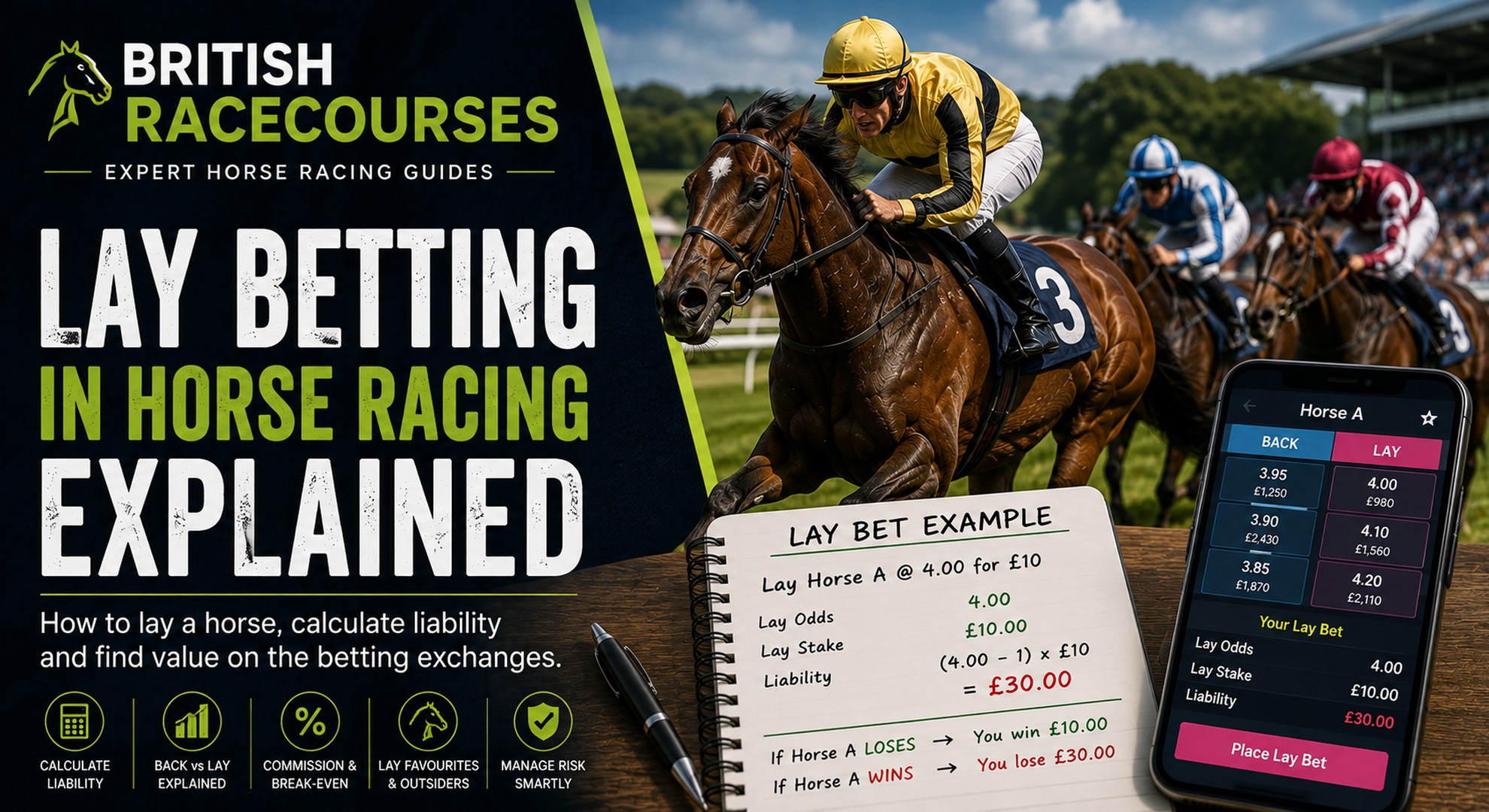
Lay betting allows you to bet that a horse will not win a race.
Instead of backing a runner to finish first, you take the opposite position. If the horse loses, your lay bet wins. If the horse wins, you pay the liability attached to the bet.
This makes lay betting fundamentally different from a conventional bookmaker bet.
If you back a horse at 4.00 with £10, you risk £10 to make £30 profit.
If you lay a horse at 4.00 for a £10 lay stake, you stand to win £10 before commission if the horse loses, but your liability is £30 if it wins.
Understanding that difference is essential.
Lay betting can be useful when you believe a horse’s price is too short, when you identify a vulnerable favourite or when you want to take a position against a runner rather than trying to identify the winner.
It does not make horse racing easier to beat.
The same principles of probability, price, value and bankroll management still apply.
What Is a Lay Bet in Horse Racing?
A lay bet is a bet against a horse winning.
Traditional horse racing betting normally involves backing a horse.
You choose a runner and win if it finishes first.
Lay betting reverses the position.
You choose a horse that you believe will not win.
If another horse wins the race, your lay bet succeeds.
If the horse you laid wins, you lose your liability.
Lay betting is primarily associated with betting exchanges, where customers bet against other customers rather than simply accepting fixed odds from a traditional bookmaker.
Back Betting Versus Lay Betting
The easiest way to understand laying is to compare it with backing.
Suppose Horse A trades at decimal odds of:
4.00
Back Horse A
You stake:
£10
If Horse A wins:
Profit = £30
If Horse A loses:
Loss = £10
Lay Horse A
You lay Horse A for:
£10
at:
4.00
If Horse A loses:
Gross profit = £10
If Horse A wins:
Loss = £30
That £30 potential loss is your liability.
The positions are effectively opposite sides of the same bet.
What Does Liability Mean in Lay Betting?
Liability is the amount you can lose if the horse you lay wins.
This is one of the most important concepts in exchange betting.
With a conventional back bet, your maximum loss is normally straightforward.
Stake £20.
Lose the bet.
Lose £20.
A lay bet works differently.
The amount at risk depends on:
- the lay stake
- the lay odds
The higher the odds, the greater the liability for the same lay stake.
How to Calculate Lay Bet Liability
The formula is:
Liability = (Lay Odds – 1) × Lay Stake
Suppose you lay a horse at:
3.00
for:
£10
Calculation:
(3.00 – 1) × £10
= 2 × £10
= £20 liability
If the horse loses:
You win £10 before applicable commission.
If the horse wins:
You lose £20.
Lay Betting Example at 2.00
Lay odds:
2.00
Lay stake:
£10
Liability:
(2.00 – 1) × £10
= £10
Your position is:
Horse loses = £10 gross profit
Horse wins = £10 loss
At decimal odds of 2.00, the potential gross win and liability are equal.
Lay Betting Example at 3.00
Lay odds:
3.00
Lay stake:
£10
Liability:
(3.00 – 1) × £10
= £20
Position:
Horse loses = £10 gross profit
Horse wins = £20 loss
Lay Betting Example at 5.00
Lay odds:
5.00
Lay stake:
£10
Liability:
(5.00 – 1) × £10
= £40
Position:
Horse loses = £10 gross profit
Horse wins = £40 loss
Lay Betting Example at 10.00
Lay odds:
10.00
Lay stake:
£10
Liability:
(10.00 – 1) × £10
= £90
Position:
Horse loses = £10 gross profit
Horse wins = £90 loss
This illustrates why blindly laying outsiders can be extremely dangerous.
You might win frequently.
One successful outsider can wipe out many previous winning lay bets.
Lay Betting Liability Table
| Lay Odds | Lay Stake | Gross Win if Horse Loses | Liability if Horse Wins |
|---|---|---|---|
| 1.50 | £10 | £10 | £5 |
| 2.00 | £10 | £10 | £10 |
| 3.00 | £10 | £10 | £20 |
| 4.00 | £10 | £10 | £30 |
| 5.00 | £10 | £10 | £40 |
| 8.00 | £10 | £10 | £70 |
| 10.00 | £10 | £10 | £90 |
| 15.00 | £10 | £10 | £140 |
The table demonstrates why liability rather than the displayed lay stake should dominate your risk management.
A £10 lay at 15.00 is not a £10 risk.
It is a £140 risk.
What Is the Lay Stake?
The terminology initially confuses many exchange users.
When you enter a £10 lay stake, £10 is generally the amount you stand to win before applicable commission if the selection loses.
It is not necessarily the amount you are risking.
Your risk is the liability.
At:
6.00
a £10 lay stake produces:
(6 – 1) × £10
= £50 liability
You are risking £50 to win £10 gross.
That distinction must be understood before placing a lay bet.
How Do Lay Odds Work?
Lay odds are the price at which you are prepared to take the opposing side of another customer’s back bet.
Imagine Horse A can be:
Backed at 4.80
Laid at 5.00
If you lay at 5.00, you are effectively offering another exchange customer the opportunity to back that horse at 5.00.
If £10 is matched:
The backer risks £10.
You accept the corresponding liability.
If the horse wins, the backer receives the winnings from your liability.
If the horse loses, you receive the backer’s £10 stake, subject to applicable exchange commission.
Why Are Back and Lay Prices Different?
Exchange markets normally display separate back and lay prices.
For example:
Best back price:
4.80
Best lay price:
5.00
The difference between them is the spread.
A liquid market may have a very small gap.
A less liquid market can have a much wider one.
This matters because the price at which you can actually get matched affects the value of the bet.
Do not assume that seeing a price on an exchange means you can automatically bet any amount at that price.
What Does Matched Mean?
An exchange bet needs another customer to take the opposite position.
If you lay £20 at 4.00 and another customer backs £20 at 4.00, the bet can be fully matched.
Once matched, the position is active according to the exchange’s rules.
An unmatched bet has not yet found someone willing to take the other side at your requested price.
What Is an Unmatched Lay Bet?
Suppose the market currently offers:
Lay: 3.50
You decide you only want to lay at:
3.20
You can request 3.20.
But another customer needs to be willing to back at that price.
Until that happens, your bet may remain unmatched.
The market could move away from you completely.
A requested price and an executed price are not the same thing.
This is particularly important close to the start of a horse race when prices can change quickly.
Can a Lay Bet Be Partially Matched?
Yes.
Imagine you try to lay:
£100 at 4.00
but only £40 is available to match at that price.
Part of the order can be matched while the remainder stays unmatched.
Your actual position is then based on the matched amount, not necessarily the £100 you originally intended.
Always check the matched stake before assuming your full lay has been executed.
Why Do Bettors Lay Horses?
There are several legitimate analytical reasons.
You Think the Horse Is Too Short
This is the most important.
Suppose a horse trades at:
2.00
The market price represents a 50% implied probability before considering the wider market structure.
Your analysis gives the horse only a:
35% chance of winning
You may conclude that the horse is too short.
Instead of trying to identify which opponent will beat it, you could lay the horse.
You Think the Favourite Is Vulnerable
A short-priced favourite can dominate the market despite having significant weaknesses.
Those could involve:
- unsuitable going
- poor course fit
- difficult draw
- pace pressure
- stamina concerns
- jumping concerns
- an unfavourable handicap mark
- questionable current form
Laying lets you oppose that runner without having to identify one specific alternative.
You Want to Trade a Price
Some exchange users lay and back the same horse at different prices.
This is trading rather than simply holding the lay until settlement.
You Want to Hedge an Existing Position
A lay bet can sometimes reduce exposure created by an earlier back bet.
Again, this is different from selecting a horse purely because you expect it to lose.
The Biggest Advantage of Lay Betting
A back bettor normally needs to identify the winner.
A layer of one horse only needs that particular horse not to win.
Suppose you lay one horse in a 12-runner race.
Eleven other horses can potentially produce the successful outcome for your lay.
That sounds attractive.
But the odds already account for the horse’s estimated chance of winning.
You do not gain an automatic mathematical advantage simply because there are more losing outcomes than winning outcomes.
Price remains fundamental.
Why Lay Betting Is Not Automatically Easier Than Backing
Consider a horse trading at:
10.00
It might lose nine races out of ten and still be fairly priced.
If you repeatedly lay genuine 10.00 chances at 10.00, a high lay strike rate does not automatically translate into a profitable edge.
The occasional winner creates a large liability loss.
This is similar to the mistake of believing a high win rate automatically makes a betting system profitable.
The relationship between:
probability + price + return
matters more than strike rate alone.
Lay Betting and Implied Probability
Decimal odds can be converted into implied probability using:
1 ÷ decimal odds × 100
At:
2.00
implied probability = 50%
At:
3.00
implied probability = 33.33%
At:
4.00
implied probability = 25%
At:
5.00
implied probability = 20%
At:
10.00
implied probability = 10%
When laying, you are effectively taking the view that the selection’s true winning probability is lower than the probability justified by the price after accounting properly for commission and market mechanics.
Finding Value in a Lay Bet
Suppose a horse is available to lay at:
2.50
The raw implied probability is:
1 ÷ 2.50
= 40%
Your own analysis estimates:
30%
You believe the market is overestimating the horse.
That creates the basis for considering a lay.
But suppose you assess its true probability as:
47%
Laying at 2.50 would be unattractive according to your estimate.
The fact that you personally dislike the horse is irrelevant.
The question is whether the price is wrong.
This is the same principle discussed in our guide to finding value bets in horse racing.
Expected Value of a Lay Bet
Expected value can be applied to laying.
Ignore commission temporarily.
Suppose you lay:
£10 at 3.00
Liability:
£20
Your estimated probability that the horse wins:
25%
Probability it loses:
75%
If it loses:
You win £10.
If it wins:
You lose £20.
Expected value:
(0.75 × £10) – (0.25 × £20)
= £7.50 – £5
= +£2.50
According to your probability estimate, the lay has positive expected value before commission.
Now suppose you think the horse has a:
40% chance of winning
Probability it loses:
60%
Expected value:
(0.60 × £10) – (0.40 × £20)
= £6 – £8
= -£2
Same horse.
Same lay odds.
Same stake.
Different probability estimate.
Completely different betting decision.
Our expected value guide explains why the relationship between price and probability is more important than whether a bet eventually wins or loses.
Exchange Commission Matters
Exchange commission can reduce the net return from successful markets.
If your gross winning lay produces:
£10
you should not automatically record £10 as your final profit if exchange commission applies.
The relevant commission structure depends on the exchange and account terms.
This matters particularly for short-priced lays because you may be accepting meaningful liability for a relatively small gross reward.
When assessing value, use the expected net return, not merely the headline lay stake.
Commission Can Change a Marginal Bet
Imagine your calculations suggest a very small theoretical edge before commission.
Once exchange charges are incorporated, that edge may disappear.
This is why exchange prices cannot always be compared directly with bookmaker prices without adjustment.
A better-looking headline price is not necessarily the better net proposition.
Laying Favourites
Favourite laying is one of the most common lay-betting ideas.
The attraction is obvious.
A favourite may trade at relatively short odds, meaning liability is more manageable compared with laying an outsider.
Suppose you lay:
£20 at 2.20
Liability:
(2.20 – 1) × £20
= £24
You risk £24 to win £20 gross.
Compare that with laying:
£20 at 10.00
Liability:
£180
The risk profiles are completely different.
However, favourites win more often than outsiders.
A low liability does not automatically make a favourite a good lay.
When Might a Favourite Be a Lay Candidate?
A favourite becomes interesting to oppose when your analysis indicates its winning chance is materially lower than the market price suggests.
Possible factors include:
Unsuitable Going
A horse may have produced its best form on good ground but now faces deep conditions.
Our horse racing going guide explains how ground conditions can change the demands of a race.
Poor Draw
A strongly fancied Flat runner could face an unfavourable stall.
The importance of that depends heavily on course, distance, field size and race shape.
Our horse racing draw guide explains how to assess draw effects rather than treating every historical bias as permanent.
Unfavourable Pace Setup
A front-running favourite could face several other horses competing for the lead.
That may increase the chance of an unsustainable early pace.
Use a horse racing pace map to assess likely positioning.
Handicap Mark
A horse may be favourite because of impressive recent wins but now face a significantly higher rating.
Course Suitability
Not every strong horse is equally effective at every track.
Distinctive courses can expose weaknesses that conventional form figures hide.
Questionable Price
Sometimes there is nothing fundamentally wrong with the horse.
It is simply too short.
That alone can be enough.
Laying Odds-On Favourites
Odds-on horses produce lower liability relative to the amount you are trying to win.
Lay:
£20 at 1.50
Liability:
£10
The horse losing generates £20 gross.
The horse winning costs £10.
That may look highly attractive.
But a genuine 1.50 chance has a raw implied win probability of approximately:
66.67%
You should expect correctly priced odds-on horses to win frequently.
A low liability-to-stake ratio does not create an edge.
Laying Outsiders
Laying outsiders creates the opposite profile.
You may record many successful bets because most outsiders lose.
But your liability can be very large.
Suppose you repeatedly lay horses at:
11.00
for:
£10
Each loser produces:
£10 gross
Each winner costs:
£100
Ten successful lays produce:
£100 gross
One losing lay costs:
£100
Before commission, that one winner can erase ten £10 successes.
This is why lay strike rate can be extremely misleading.
The Danger of High Lay Strike Rates
Imagine somebody advertises:
90% winning lay bets
That sounds exceptional.
It may be meaningless without the average odds and liability.
Strategy A:
90% winners
Average liability: £10
Strategy B:
90% winners
Average liability: £100
These are radically different systems.
When assessing laying performance, track:
- profit
- liability
- return on liability
- average lay odds
- commission
- maximum drawdown
Do not focus only on winning percentage.
Stake Versus Liability Staking
There are two ways bettors commonly think about lay staking.
Fixed Lay Stake
You might always lay:
£10
But liability changes with the odds.
At 2.00:
Liability = £10
At 5.00:
Liability = £40
At 10.00:
Liability = £90
Your actual risk varies dramatically.
Fixed Liability
Alternatively, you could decide:
I will risk no more than £20 on each lay.
Then the lay stake changes according to the odds.
This can produce much more consistent race-level exposure.
How to Calculate Lay Stake From Fixed Liability
If you know the maximum liability you want, use:
Lay Stake = Liability ÷ (Lay Odds – 1)
Suppose maximum liability is:
£20
At odds of:
3.00
Lay stake:
£20 ÷ (3 – 1)
= £10
At odds of:
5.00
Lay stake:
£20 ÷ 4
= £5
At odds of:
11.00
Lay stake:
£20 ÷ 10
= £2
The amount you can win falls as the lay odds increase, but your maximum liability remains £20.
Fixed Liability Example
Assume you use:
£25 maximum liability per bet
| Lay Odds | Lay Stake | Liability |
|---|---|---|
| 1.50 | £50.00 | £25 |
| 2.00 | £25.00 | £25 |
| 3.00 | £12.50 | £25 |
| 5.00 | £6.25 | £25 |
| 6.00 | £5.00 | £25 |
| 11.00 | £2.50 | £25 |
Fixed liability can make risk easier to understand.
It does not make the selections profitable.
You still need an edge.
Lay Betting and Bankroll Management
Liability should be the central number when managing a lay-betting bankroll.
Suppose your betting bank is:
£1,000
You place a £20 lay at:
15.00
Liability:
(15 – 1) × £20
= £280
You have risked:
28% of your entire betting bank
on one horse.
Calling it a “£20 bet” disguises the real exposure.
Our horse racing bankroll management guide explains why stake sizing should reflect the amount genuinely at risk.
Lay Betting and the Kelly Criterion
The Kelly Criterion can theoretically be adapted to exchange positions.
But the calculations need to account correctly for:
- probability
- liability
- net return
- commission
- available price
Do not apply a standard back-bet Kelly calculation directly to the displayed lay stake and assume the result is valid.
The payoff structure is different.
Conservative staking is particularly important when your probability estimates are uncertain.
Lay Betting and Bookmaker Overround
A bookmaker’s overround represents margin incorporated across its prices.
Exchange markets work differently because customers provide prices to one another.
Back and lay prices create a visible market spread, and commission can apply to net winnings.
This makes exchange markets useful for analysing market opinion.
But a tight exchange market does not mean every horse is perfectly priced.
Value still depends on whether your probability assessment is better than the available price.
Lay Betting and Favourite-Longshot Bias
The favourite-longshot bias is particularly relevant to laying.
If longshots are systematically priced differently from favourites in certain markets, blindly applying the same lay rules across the entire odds range can produce misleading results.
A laying strategy should therefore be analysed by price bands.
For example:
- below 2.00
- 2.00 to 3.99
- 4.00 to 6.99
- 7.00 to 9.99
- 10.00+
This can reveal whether apparent profitability comes from one specific part of the market.
Lay Betting and Drifting Horses
Some bettors like to lay horses whose odds are drifting in the betting market.
The reasoning is that weakening market support may signal reduced confidence.
But a drifting horse is not automatically a good lay.
If a horse moves from:
4.00
to:
6.00
the new lay price creates much greater liability for the same lay stake.
It also means the market already considers the horse less likely to win.
You need to determine whether the new price still overstates the horse’s chance.
Following movement without considering price can lead to laying after the value has disappeared.
Lay Betting and Steamers
The opposite situation occurs when a horse shortens significantly.
A horse moving from:
6.00
to:
3.50
might look too short to you.
That can create a potential lay opportunity.
But strong market support should not automatically be opposed either.
Ask why the price moved.
New information may have changed the horse’s true probability.
Market movement is evidence.
It is not a betting system.
Lay Betting and Closing Line Value
Closing line analysis works differently for layers.
Suppose you lay a horse at:
3.00
and it later drifts to:
4.00
You laid at the shorter price.
That is generally favourable for a layer because you accepted less liability relative to the same lay stake than someone laying later at the bigger price.
If instead you lay at:
4.00
and the horse shortens to:
2.75
the later market considers the horse substantially more likely to win than when you laid it.
Tracking these movements can help assess whether you consistently obtain strong prices.
Our closing line value guide discusses exchange closing prices and the importance of accounting for commission.
Lay Betting and Probability Calibration
A successful lay strategy requires accurate probability estimates just as much as a backing strategy.
Suppose you repeatedly identify horses you estimate have:
20% win probability
If those horses actually win 30% of the time, your probabilities are badly calibrated.
That can be particularly costly when laying because a relatively small number of winners can create significant liability losses.
Our probability calibration guide explains how to compare forecast probabilities with actual outcomes over meaningful samples.
Lay Betting and Race Analysis
Do not start race analysis by asking:
Which horse can I lay?
Analyse the race first.
Assess:
- form
- class
- ratings
- pace
- draw
- going
- distance
- course suitability
- trainer
- jockey
- fitness
- likely improvement
- market price
Then create your probability assessment.
Our professional race analysis guide provides a structured framework.
If the market then offers a horse at a lay price that appears too short, consider the bet.
This prevents the strategy from becoming a search for reasons to oppose horses.
Using Form to Find Potential Lays
A short-priced horse can look strong on basic form figures while having weaknesses beneath the result.
Perhaps it:
- enjoyed a perfect pace setup last time
- beat weaker opposition
- received weight from key rivals
- benefited from a favourable draw
- recorded a flattering finishing position
- now runs from a higher handicap mark
Learning how to read horse racing form can help distinguish genuine strength from potentially misleading results.
Lay Betting and Horses That Ran Better Than the Result
The reverse can also matter.
A horse may look like a lay because its recent finishing position appears poor.
But deeper analysis may show that the horse ran better than the result.
It could have:
- raced against the pace bias
- been trapped wide
- met traffic
- jumped poorly at a crucial stage
- finished strongly from an impossible position
Laying based purely on finishing positions can therefore be dangerous.
Course-Specific Lay Betting
Different racecourses create different analytical challenges.
At Chester, position and draw can have considerable importance in appropriate races.
At Cheltenham, jumping, stamina, course configuration and the demands of the finish can matter.
At Newmarket, straight-course pace and draw interactions can create completely different questions.
A horse should not be laid simply because it is favourite.
Ask whether its chance is being overestimated under the exact conditions it faces.
Lay Betting in Small Fields
Small fields can appear attractive for laying because there are fewer horses to analyse.
But a short-priced favourite may have fewer credible opponents.
Suppose a four-runner race contains:
- one high-class favourite
- two exposed rivals
- one outsider
The fact that three horses can beat your lay selection does not mean they have a strong combined probability of doing so.
Always think in probabilities rather than runner counts.
Lay Betting in Large Fields
Large fields offer more potential ways for a laid horse to lose.
But the market knows that.
A favourite in a 20-runner handicap may trade at a much bigger price than a favourite in a four-runner conditions race.
Large fields can also introduce:
- traffic problems
- draw effects
- pace uncertainty
- greater variance
These factors can make probability estimation more difficult.
Laying in Handicaps
Handicaps can produce potential lay candidates when a horse appears overbet following recent success.
A runner may have won impressively but now face:
- a higher handicap mark
- stronger opposition
- different going
- a different track
- an unfavourable pace setup
However, progressive horses can continue improving faster than the handicapper raises them.
Never assume a higher mark automatically makes a recent winner a lay.
Laying in Novice and Maiden Races
These races can contain much greater uncertainty.
Lightly raced horses may improve dramatically.
Debutants can be difficult to assess.
Market leaders may be based partly on:
- pedigree
- stable reputation
- private expectations
- previous sectional performance
- limited public evidence
Laying purely because a horse “looks too short” without accounting for uncertainty can be dangerous.
The less reliable your probability estimate, the less confidence you should place in a small apparent edge.
Laying at Major Racing Festivals
Major meetings such as the Cheltenham Festival and Royal Ascot attract highly liquid betting markets.
Greater liquidity can make exchange execution easier and prices more competitive.
But highly liquid markets can also be difficult to beat because large amounts of information are incorporated into prices.
A famous horse being short does not automatically make it a lay.
Likewise, a heavily backed festival favourite is not guaranteed to win.
The decision remains:
What probability does the price imply, and what probability do I estimate?
Lay Betting and Betfair Starting Price
Betfair Starting Price, commonly called BSP, provides an exchange-generated starting price around the off.
BSP can be useful when:
- analysing historical results
- comparing prices
- measuring market movement
- developing systematic approaches
If you test a lay strategy against BSP, make sure your calculations properly reflect the way the relevant historical price and commission are applied.
Do not backtest using a price you could not realistically have obtained.
Lay Betting and In-Play Racing
Horse racing prices can change dramatically after the race starts.
A horse that travels strongly may shorten.
A horse under pressure may drift.
In-play laying therefore creates additional risks involving:
- speed of information
- broadcast delays
- rapidly moving prices
- liquidity
- partial matching
- execution
Watching pictures at home does not necessarily mean you are seeing events at exactly the same moment as every other market participant.
In-play exchange betting should not be treated as risk-free trading.
Back-to-Lay Trading
A back-to-lay trade starts by backing a horse at a bigger price and later laying it at a shorter price.
Example:
Back at:
6.00
Horse shortens during the race to:
3.00
You may then be able to lay at the shorter price to alter your position.
Depending on the stakes, this can:
- reduce risk
- secure profit across outcomes
- leave a free bet-style position
- redistribute profit
But the horse has to shorten enough and the lay bet must actually be matched.
There is no guarantee that either will happen.
Lay-to-Back Trading
The reverse is also possible.
You lay first at a shorter price because you expect the horse to drift.
Later, you back at a larger price.
Example:
Lay:
3.00
Later back:
5.00
If the required bets are matched at the intended stakes, you may be able to improve or balance your position.
Again, this is trading rather than a simple lay-to-settlement strategy.
What Is Greening Up?
Greening up means adjusting your exchange position so that you have a similar positive result across all relevant outcomes.
The term comes from exchange interfaces historically displaying profitable positions in green.
A bettor might:
- back a horse
- watch its price shorten
- lay at the lower price
- redistribute the potential profit
Or take the reverse route after laying first.
The important point is that the second bet has to be available and matched.
A theoretical green-up opportunity is not guaranteed.
Lay Betting Versus Dutching
Horse racing Dutching involves backing multiple runners and dividing your stake between them.
Lay betting normally means opposing one runner.
Suppose you dislike a favourite.
You could:
- lay the favourite
- Dutch several of its opponents
The positions can look similar but are not necessarily financially identical.
Dutching can leave some opponents uncovered.
A simple win-market lay of one horse succeeds if any other valid runner wins, subject to the exchange’s settlement rules.
Price, commission and staking determine which approach offers the stronger proposition.
Lay Betting Versus Each-Way Betting
An each-way bet normally backs a horse across win and place components.
A conventional win-market lay only opposes the horse winning.
The horse could finish:
- second
- third
- fourth
- last
and the win lay can still succeed.
Exchange place markets are separate markets with their own prices and rules.
Always check exactly which market you are betting into.
Can You Lay a Horse to Place?
Betting exchanges can offer place markets where customers can back or lay a horse to place.
A place lay means you are betting that the horse will not finish within the specified qualifying places.
This is very different from laying it in the win market.
A horse finishing second:
- loses a win back bet
- wins a win lay bet
- may win a place back bet
- may lose a place lay bet
depending on the market’s place terms.
Never confuse win and place lay markets.
Non-Runners and Lay Bets
Non-runner rules are particularly important on exchanges.
Settlement can depend on:
- whether the market is ante-post
- whether the market is day-of-race
- the exchange’s reduction-factor rules
- when the runner was withdrawn
- the exact market rules
Do not assume bookmaker Rule 4 procedures apply identically to exchange bets.
Check the rules of the specific market before betting.
What Happens When You Lay the Winner?
If the horse you lay wins the relevant market, you lose your liability.
Suppose:
Lay odds = 6.00
Lay stake = £20
Liability:
(6 – 1) × £20
= £100
If the horse wins:
You lose £100.
This is why the liability figure must be checked before confirming the bet.
What Happens When Your Lay Horse Loses?
If the horse loses the win market, your lay bet wins.
Using:
Lay stake = £20
your gross market win from that lay is:
£20
Applicable exchange commission can then affect the final net profit according to the operator’s terms.
Common Lay Betting Mistakes
Confusing Lay Stake With Liability
This is the biggest beginner mistake.
A £10 lay does not necessarily mean £10 is at risk.
Laying Horses Simply Because They Are Short Prices
Short odds do not automatically mean bad odds.
Laying Outsiders for an Easy High Strike Rate
Large liabilities can overwhelm many small wins.
Ignoring Commission
Gross profit is not always net profit.
Ignoring Liquidity
The displayed price may not have enough money available for your desired stake.
Assuming an Unmatched Bet Is Active
Only the matched portion creates the intended position.
Increasing Stakes After Losses
Large liability losses can tempt bettors to chase.
Do not increase the next lay simply to recover the previous loss.
Judging Performance by Strike Rate
Lay systems can win very frequently and still lose money.
Following Drifters Blindly
A horse that has already drifted substantially may no longer be a good lay.
Ignoring Race Conditions
Price alone does not tell you whether a horse is vulnerable.
Using Poor Probability Estimates
A lay strategy ultimately depends on estimating winning probabilities better than the market after costs.
How to Record Lay Bets
A lay-betting record should contain more information than a conventional win-bet record.
Useful fields include:
- date
- racecourse
- race
- horse
- lay odds
- lay stake
- liability
- estimated win probability
- estimated fair lay price
- exchange
- commission
- closing price
- result
- gross profit/loss
- net profit/loss
Our guide to keeping and analysing horse racing betting records explains why consistent records matter.
Return on Liability
For lay bettors, return on liability can be more informative than measuring profit against the displayed lay stake.
Suppose:
Liability = £50
Net profit = £10
Return on liability:
£10 ÷ £50 × 100
= 20%
Now suppose another bet has:
Lay stake = £10
Liability = £150
Net profit = £10
The displayed lay stake is identical.
The capital exposed is completely different.
Return on liability makes that difference visible.
Backtesting a Lay Betting Strategy
A systematic laying strategy should be tested using realistic historical assumptions.
Our horse racing backtesting guide explains the broader process.
For laying, make sure you account for:
- historical lay prices
- realistic liquidity
- commission
- liability
- non-runners
- selection rules
- race exclusions
- price cut-offs
Avoid designing rules after looking at which horses won.
For example:
Lay every favourite that subsequently lost
is not a strategy.
You need rules that could genuinely have identified the selection before the race.
Lay Betting Variance
Lay betting can create deceptive periods of stability.
A strategy laying bigger-priced horses may record:
win
win
win
win
win
win
win
win
and appear exceptionally consistent.
Then one horse wins and produces a large liability loss.
Our guide to betting variance in horse racing explains why short-term results can misrepresent the quality of a strategy.
Assess a sufficiently large sample.
Is Lay Betting Better Than Back Betting?
Neither is inherently better.
Backing can be preferable when:
- you believe a horse is underpriced by the market
- you want defined stake-based downside
- the bookmaker offers attractive terms
- you have identified a clear selection
Laying can be preferable when:
- you believe a horse is overpriced in probability terms
- you want to oppose one runner rather than select the winner
- exchange liquidity is sufficient
- the liability fits your bankroll
- the net price provides value
The best decision depends on the price.
Is Lay Betting Profitable?
Lay betting can be profitable if you consistently take positions where the available lay odds underestimate the true chance of the horse losing after accounting for costs.
That is difficult.
There is no simple category of horses that can be laid automatically for guaranteed profit.
Favourites can win.
Outsiders can win.
Drifters can win.
Poorly drawn horses can win.
Horses carrying more weight can win.
The objective is not to find horses that cannot win.
The objective is to identify cases where the market probability appears wrong.
A Practical Lay Betting Process
1. Analyse the Race
Assess the entire field rather than searching immediately for a lay.
2. Estimate Probabilities
Assign your own winning probability to the relevant runners.
3. Convert Probability Into Fair Odds
Probability:
25%
Fair decimal odds:
1 ÷ 0.25
= 4.00
4. Check the Exchange
Compare your fair price with the available lay price.
5. Account for Commission
Assess the net proposition.
6. Calculate Liability
Never confirm the bet without knowing the maximum loss.
7. Check Liquidity
Make sure your intended stake can actually be matched.
8. Set the Stake From Your Bankroll
Do not let the exchange interface determine how much risk you take.
9. Confirm the Matched Amount
Check whether the bet is fully or partially matched.
10. Record the Bet
Include price, liability and closing price.
11. Review Over a Large Sample
Judge the process rather than one result.
Lay Betting Checklist
Before laying a horse, ask:
What is the lay price?
Know the exact odds.
What probability does that price represent?
Convert the odds.
What is my estimated probability that the horse wins?
You need your own view.
Why is my probability different from the market?
Identify the evidence.
What is my liability?
Calculate the maximum loss.
Does that liability fit my betting bank?
Do not judge risk from lay stake alone.
What commission applies?
Think in net returns.
Is there enough liquidity?
Check what can actually be matched.
Has the price moved?
Make sure your original reasoning still applies at the current price.
Is my bet fully matched?
Verify execution.
Am I laying because the horse is bad or because the price is bad?
Only the second is a strong betting argument.
Frequently Asked Questions
What does laying a horse mean?
Laying a horse means betting that it will not win the relevant market. If another horse wins, your win-market lay succeeds. If the horse you laid wins, you lose your liability.
How do you calculate liability on a lay bet?
Use:
(Lay Odds – 1) × Lay Stake
A £10 lay at 5.00 creates £40 liability.
If I lay £10, can I only lose £10?
No. The amount you can lose is the liability. A £10 lay at 10.00 creates £90 liability.
What do I win from a £10 lay bet?
If the horse loses, the gross win is generally the £10 opposing stake. Applicable exchange commission can reduce the final net market profit.
Can you lay a favourite?
Yes. Favourites can be laid just like other selections. The important question is whether the lay price represents value relative to your assessment of the horse’s true winning probability.
Is it better to lay favourites or outsiders?
Neither group is automatically better. Favourites produce lower liability at short prices but win more frequently. Outsiders lose more often but create much larger liability for the same lay stake.
Can you lay a horse to place?
Yes, where an exchange offers a suitable place market. You are then betting that the horse will not finish within the qualifying places under that market’s rules.
What is a matched lay bet?
A matched lay bet has found another exchange customer willing to take the opposite side at the agreed price and stake.
What is an unmatched lay bet?
An unmatched bet is an order that has not yet found another customer to take the other side at your requested price.
What is a partially matched lay bet?
Only part of your requested stake has been accepted by another customer. Your exposure applies to the matched amount.
What is fixed-liability lay betting?
Fixed-liability staking sets the maximum amount you are prepared to lose and adjusts the lay stake according to the odds.
Do betting exchanges charge commission?
Exchange operators can charge commission according to their current terms. Always check the operator’s applicable commission structure when calculating net returns.
Is laying the same as Dutching?
No. Laying normally opposes a selection. Dutching backs multiple selections and divides the total stake between them.
Is lay betting guaranteed to make money?
No. If the horse you lay wins, you lose the liability. No lay-betting strategy guarantees long-term profit.
Can I make money by laying every favourite?
There is no reason to assume automatically laying every favourite will be profitable. The market already incorporates the favourite’s expected winning chance into its price.
Why is liability so important?
Liability is the amount actually at risk. A small displayed lay stake can create a large potential loss when the odds are high.
Summary
Lay betting reverses the conventional horse racing bet.
Instead of backing a horse to win, you bet against it winning.
That creates two key figures:
Lay stake: the amount you stand to win before applicable commission if the horse loses.
Liability: the amount you stand to lose if the horse wins.
The liability formula is:
(Lay Odds – 1) × Lay Stake
Understanding that calculation is essential.
A £10 lay at 2.00 creates £10 liability.
A £10 lay at 5.00 creates £40 liability.
A £10 lay at 15.00 creates £140 liability.
This is why lay betting should never be judged by strike rate alone.
Repeatedly laying outsiders can produce many successful bets followed by a single large loss. Laying favourites can keep liability lower, but favourites win more frequently.
Neither approach automatically creates value.
The core question remains the same as it is with conventional backing:
Is the available price wrong relative to the horse’s true probability?
Analyse the race.
Create your probability.
Compare it with the market.
Account for commission.
Calculate the liability.
Control your exposure.
Then decide whether the lay price offers sufficient value to justify the risk.
18+. Gambling involves financial risk. Never bet more than you can afford to lose and never chase losses.