
The best Placepot betting site for most UK horse racing bettors is the Tote itself, because the Placepot is a Tote pool bet rather than a conventional fixed-odds bookmaker bet.
Several bookmakers also provide access to Tote pools, which means you do not necessarily need a separate Tote account to place a Placepot.
That distinction matters.
A Placepot does not work like a six-fold accumulator. You select at least one horse to place in each of six specified races, normally the first six races at a meeting. Successful stakes share the remaining pool after the applicable deduction rather than being settled at fixed odds selected when the bet was placed.
British Racecourses therefore assesses Placepot betting differently from conventional horse racing bookmakers.
Best Placepot Betting Sites in 2026
Our current Placepot shortlist is:
- Tote
- bet365
- William Hill
- Betfred
- Paddy Power
- Ladbrokes
- Betfair
- Coral
- BoyleSports
- Sky Bet
The Tote deserves a separate position at the top because it operates the underlying pool. The bookmakers listed beneath it provide customers with access to Tote betting products rather than operating an independent Placepot pool of their own.
Availability and individual bookmaker Tote products can change, so check that the Placepot is currently offered through your chosen operator before depositing specifically to use it.
1. Tote Placepot
Tote is our first choice for dedicated Placepot betting.
The Placepot is one of the Tote’s core horse racing pool bets and is available across British meetings.
Going directly to the Tote also makes sense for bettors who regularly use other pool products rather than conventional fixed-odds bets.
The key difference is that Tote does not quote a fixed Placepot price when you place the bet.
Your eventual return depends on factors including:
- Total Money Entering The Pool
- Applicable Pool Deductions
- Number Of Successful Stakes
- Your Unit Stake
- Any Applicable Direct-Tote Enhancement
That creates a fundamentally different betting proposition from placing a £10 accumulator at fixed odds.
Our complete Tote Placepot guide explains the bet itself in greater detail.
2. bet365 Placepot
bet365 provides extensive horse racing coverage and access to Tote betting products alongside its conventional sportsbook.
That can be useful for customers who already use bet365 for fixed-odds racing and do not want to open another account purely to place an occasional Placepot.
The important distinction is that a Placepot placed through a bookmaker still enters the relevant Tote pool.
You are not taking a six-race fixed price from bet365.
That also means the final Placepot dividend is determined by the pool rather than the conventional prices displayed beside the individual horses.
3. William Hill Placepot
William Hill is another established bookmaker through which customers can access Tote betting.
This gives regular racing customers the option of combining conventional betting and Tote pools within the same broader account relationship.
Do not confuse a Placepot with William Hill’s ordinary multiple bets.
A Placepot is settled according to the Tote pool rules.
A conventional six-fold accumulator requires all six fixed-odds selections to win.
The Placepot generally requires one of your selections to achieve a qualifying place in each of the six legs.
4. Betfred Placepot
Betfred has a longstanding relationship with British horse racing and offers Tote betting alongside its conventional racing markets.
This can suit bettors who want access to:
- Fixed-Odds Horse Racing
- Each-Way Betting
- Tote Pools
- Placepots
- Other Racing Markets
The Placepot itself remains a pool product.
That distinction should be clear when comparing it with a bookmaker’s normal multiples.
5. Paddy Power Placepot
Paddy Power customers can access Tote betting products alongside the bookmaker’s standard horse racing markets where currently available.
For occasional Placepot bettors, convenience can be a legitimate consideration.
Someone already using a bookmaker may prefer to place a pool bet through the same account rather than maintaining a separate Tote balance.
Regular Placepot players should still compare direct Tote access and the current terms that apply.
6. Ladbrokes Placepot
Ladbrokes provides Tote pool betting alongside its conventional sportsbook.
The same principle applies here.
The bookmaker acts as a route into the pool rather than setting independent Placepot odds.
Customers should check the current Tote menu and any applicable minimum stakes or account conditions before placing the bet.
7. Betfair Placepot
Betfair provides Tote pool access in addition to its better-known Sportsbook and Exchange products.
These should not be confused.
Betfair Sportsbook offers conventional fixed-odds bets.
Betfair Exchange allows customers to back and lay against other exchange users.
Tote betting through Betfair gives access to pool products such as the Placepot.
Our betting exchange guide explains how exchange betting differs from both bookmaker and pool betting.
8. Coral Placepot
Coral provides another established bookmaker route into Tote betting.
As with Ladbrokes, the Placepot sits alongside conventional horse racing markets but operates according to Tote pool rules.
The ability to use an existing bookmaker account can be convenient, but convenience should not be confused with receiving a different Placepot dividend.
Check current terms and product availability when comparing where to place the bet.
9. BoyleSports Placepot
BoyleSports provides broad British and Irish horse racing coverage and access to Tote products where available.
Irish racing bettors should pay particular attention to the pool being offered because Placepots can also operate on Irish meetings.
The mechanics remain based on successfully negotiating each qualifying leg rather than backing six winners.
10. Sky Bet Placepot
Sky Bet completes our current list.
As with the other conventional bookmakers here, its main attraction is giving existing customers another route to Tote pool betting alongside normal fixed-odds horse racing.
Regular Placepot bettors should still compare the direct Tote proposition rather than assuming every route into the same pool provides identical ancillary benefits.
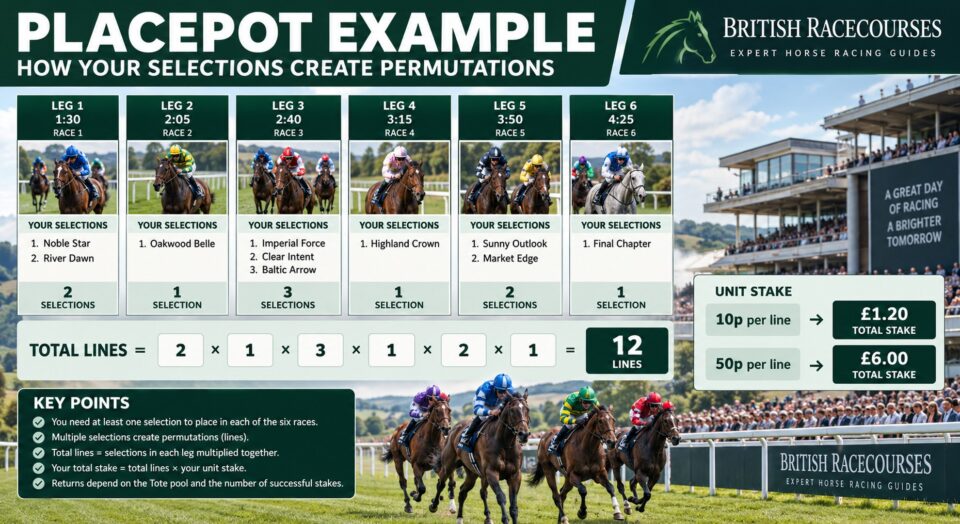
What Is a Placepot Bet?
A Placepot requires you to select at least one horse to achieve a qualifying place in each of six specified races.
At a standard British meeting, these will normally be the first six races.
Imagine a racecard beginning:
| Leg | Race |
|---|---|
| Leg 1 | 1:30 |
| Leg 2 | 2:05 |
| Leg 3 | 2:40 |
| Leg 4 | 3:15 |
| Leg 5 | 3:50 |
| Leg 6 | 4:25 |
You need at least one surviving selection in every leg.
If your only selection finishes outside the qualifying places in Leg 3, your Placepot ends there.
If you have two selections in Leg 3 and one qualifies, the bet remains alive.
That ability to use multiple selections is one of the defining features of Placepot strategy.
How Many Places Count In A Placepot?
The standard Tote rules use the number of runners and race type to determine qualifying places.
| Race | Standard Placepot Places |
|---|---|
| 2-4 Runners | 1st |
| 5-7 Runners | 1st and 2nd |
| 8-15 Runners | 1st, 2nd and 3rd |
| Non-Handicap, 16+ Runners | 1st, 2nd and 3rd |
| Handicap, 16+ Runners | 1st, 2nd, 3rd and 4th |
Always check the relevant pool information because special pools or circumstances can differ.
The important point is that “place” does not always mean finishing in the first three.
Field size and race type matter.
How Does A Placepot Work?
A simple Placepot could contain one horse in each race:
Leg 1: Horse A
Leg 2: Horse B
Leg 3: Horse C
Leg 4: Horse D
Leg 5: Horse E
Leg 6: Horse F
This produces one line.
Every selection must achieve a qualifying place for that line to succeed.
You do not need any of the six horses to win unless the conditions of a particular leg mean only the winner qualifies.
That is the main reason the Placepot should not be described as an accumulator.
What Is A Placepot Perm?
A Placepot perm, short for permutation, contains multiple combinations.
You can select more than one horse in one or more legs.
For example:
| Leg | Number Of Selections |
|---|---|
| Leg 1 | 2 |
| Leg 2 | 1 |
| Leg 3 | 3 |
| Leg 4 | 1 |
| Leg 5 | 2 |
| Leg 6 | 1 |
The number of lines is:
2 × 1 × 3 × 1 × 2 × 1 = 12 lines
If you stake 50p per line:
12 × £0.50 = £6 total stake
This calculation is one of the most important things to understand before building a Placepot.
Adding one extra selection can multiply the total stake considerably.
Placepot Perm Calculator Examples
Consider three different structures.
| Selections Per Leg | Lines | At 10p Per Line | At 50p Per Line |
|---|---|---|---|
| 1 × 1 × 1 × 1 × 1 × 1 | 1 | £0.10 | £0.50 |
| 2 × 1 × 2 × 1 × 2 × 1 | 8 | £0.80 | £4.00 |
| 2 × 2 × 2 × 2 × 2 × 2 | 64 | £6.40 | £32.00 |
| 3 × 2 × 3 × 2 × 3 × 2 | 216 | £21.60 | £108.00 |
The final two examples show why randomly adding extra horses is poor Placepot construction.
A ticket can become expensive very quickly.
What Is A Placepot Banker?
A banker is a leg in which you use only one selection.
Suppose your ticket is:
2 × 2 × 1 × 3 × 1 × 2
Legs 3 and 5 contain bankers.
The advantage is cost.
Without those bankers, using two horses in every leg would create:
2 × 2 × 2 × 2 × 2 × 2 = 64 lines
The original ticket creates:
2 × 2 × 1 × 3 × 1 × 2 = 24 lines
Bankers therefore allow you to concentrate additional selections in races you consider more difficult.
The obvious risk is equally important.
If your banker fails to place, every line containing it is eliminated.
Should You Always Bank On The Favourite?
No.
A short-priced favourite may be an obvious banker because the market considers it highly likely to place.
But the Placepot is a pool bet.
If almost everybody uses the same favourite and it places, many tickets survive.
If an odds-on favourite is vulnerable and fails to place, a large proportion of the pool can be eliminated at once.
The decision therefore involves two questions:
How likely is this horse to place?
and
How popular is this selection likely to be within the pool?
The second question is one of the important differences between Placepot strategy and simply trying to identify the most likely horse in every race.
How Are Placepot Dividends Calculated?
Placepot payouts come from a pool.
Bettors’ stakes are combined and the applicable deduction is made.
The remaining pool is then distributed according to successful stakes under the Tote rules.
The standard Placepot pool deduction is currently 27%, meaning the net pool is 73% of the gross pool before the winning stakes are used to calculate the dividend.
The dividend is declared to a £1 stake.
Your return therefore depends on your successful unit stake.
For example, if the declared dividend were hypothetically:
£600 to £1
a successful:
£1 unit would return £600.
A successful:
50p unit would return £300.
A successful:
10p unit would return £60.
The £600 figure is illustrative. Actual Placepot dividends are determined by the pool.
Why Do Placepot Dividends Vary So Much?
Two meetings can produce very different dividends even when both have six fairly competitive races.
The final return depends heavily on how many units survive.
A sequence containing several well-backed favourites can leave many tickets intact.
If one or two heavily selected horses fail to place, thousands of combinations can disappear from the pool.
That can increase the value of the remaining successful units substantially.
This creates an unusual strategic element.
You are not simply trying to find six horses likely to place.
You are trying to construct a ticket that gives you a realistic chance of surviving while retaining enough differentiation to make the potential dividend worthwhile.
What Is Tote+ On A Placepot?
Tote+ is an enhancement available on eligible bets placed directly through Tote channels where the relevant pool displays Tote+.
The old version of this page described Placepot Tote+ as providing 10% higher payouts.
That is not an accurate general description.
Tote’s published structure distinguishes between Win/Place pools and other eligible pools. Placepot falls into the latter category, where the enhancement has been 5% above the standard dividend on qualifying Tote+ pools, subject to the current terms.
Because promotions and product terms can change, check the Tote+ symbol and current conditions when placing the bet rather than assuming every Placepot automatically receives an enhancement.
This is one reason direct Tote betting can differ from accessing the underlying pool through another bookmaker.
Tote Placepot Versus Bookmaker Placepot
The underlying Placepot pool is the central point in both cases.
The main differences concern how you access it and what additional terms or functionality apply.
| Feature | Direct Tote | Through A Bookmaker |
|---|---|---|
| Underlying Pool | Tote | Tote |
| Placepot Available | Yes | Where Supported |
| Fixed Odds | No | No |
| Tote+ Eligibility | Where Applicable Under Tote Terms | Do Not Assume It Applies |
| Single Account With Fixed-Odds Sportsbook | Tote Has Separate Sportsbook Functionality | Usually Yes |
| Other Tote Pools | Broad Direct Access | Depends On Bookmaker |
| Account Convenience | Best For Regular Tote Users | Useful For Existing Bookmaker Customers |
The best route therefore depends on how regularly you use Tote products and the current terms attached to the bet.
Is A Placepot The Same As An Accumulator?
No.
They are fundamentally different bets.
Placepot
You normally need a horse to place in each of six races.
Returns come from a pool.
Multiple selections can be used in each leg.
The eventual dividend is not known when the bet is placed.
Accumulator
Every selection normally needs to win.
The bookmaker provides odds for each selection.
The prices are multiplied together.
Your potential fixed-odds return can normally be calculated when the bet is placed.
A Placepot is therefore closer to solving six consecutive place problems within a pool than building a conventional six-fold accumulator.
Placepot Versus Lucky 15
A Lucky 15 contains four selections and 15 separate fixed-odds bets:
- Four Singles
- Six Doubles
- Four Trebles
- One Four-Fold Accumulator
A Placepot has a completely different structure.
It covers six race legs and requires at least one qualifying selection to place in each leg.
The two bets should not be compared purely on the number of selections because their settlement methods are entirely different.
Placepot Versus Yankee
A Yankee contains 11 fixed-odds bets across four selections:
- Six Doubles
- Four Trebles
- One Four-Fold
Again, this differs fundamentally from a six-leg pool bet.
Understanding the difference helps prevent one of the most common mistakes among people placing a Placepot for the first time.
How To Build A Placepot
There is no universally correct Placepot structure.
A disciplined process is more useful than automatically taking the favourite in six races.
1. Analyse All Six Races Before Selecting Horses
Do not start building the ticket after studying only Leg 1.
Look across the entire six-race sequence first.
Identify:
- Strong Banker Opportunities
- Competitive Handicaps
- Races With Vulnerable Favourites
- Races Where Two Selections Give Strong Coverage
- Legs Where You May Need Three Or More Horses
This lets you decide where your stake is best concentrated.
2. Identify Potential Bankers
A good banker reduces the cost of the entire permutation.
The ideal banker is not necessarily the shortest-priced horse.
Look for a runner with a strong probability of making the required places based on:
- Form
- Race Class
- Going
- Distance
- Course Suitability
- Draw Where Relevant
- Pace
- Field Size
- Reliability
Our guide to reading horse racing form provides a useful starting point.
3. Find The Difficult Legs
Large-field handicaps often require more coverage than small conditions races.
A 16-runner handicap could justify several selections.
A six-runner race containing a strong favourite might require only one.
Do not allocate the same number of horses to every race simply for symmetry.
4. Calculate The Cost Before Confirming The Bet
Always multiply the selections across all six legs.
A ticket containing:
2 × 3 × 2 × 2 × 3 × 2
creates:
144 lines
At 50p per line, that costs:
£72
At 10p per line:
£14.40
The structure, not merely the unit stake, determines the total cost.
5. Decide Where To Take A Position
Covering every obvious horse can increase the chance of survival while reducing the potential value of the ticket.
Sometimes the strongest Placepot decision is to oppose a vulnerable popular selection.
That carries greater risk.
It can also eliminate many rival tickets if the judgement proves correct.
6. Keep The Total Stake Sensible
Permutations make it easy to create a much larger bet than intended.
Set the maximum total stake before adding extra selections.
Then build the ticket within that limit.
A Worked Placepot Example
Consider this fictional six-race meeting.
Leg 1
You identify a strong favourite with reliable course form.
Selections: 1
Leg 2
An open handicap contains two horses you strongly favour.
Selections: 2
Leg 3
The race looks difficult and you want three runners covered.
Selections: 3
Leg 4
Another strong banker.
Selections: 1
Leg 5
A competitive sprint requires two selections.
Selections: 2
Leg 6
You finish with two horses.
Selections: 2
The ticket is:
1 × 2 × 3 × 1 × 2 × 2
Total:
24 lines
At 25p per line:
£6 total stake
At 50p per line:
£12 total stake
This is far more useful than simply saying you have selected 11 horses.
The permutation tells you how many actual combinations you are buying.
Can A Placepot Be Won With One Selection In Every Race?
Yes.
Six single selections create one Placepot line.
If all six achieve the required places, the line succeeds.
This is the cheapest and most aggressive way to play.
It also provides no protection.
One selection failing in any leg eliminates the ticket.
Can You Pick More Than One Horse In Every Race?
Yes.
Placepot permutation betting allows multiple selections.
Using two horses in all six legs produces:
2 × 2 × 2 × 2 × 2 × 2 = 64 lines
Using three in every leg produces:
3 × 3 × 3 × 3 × 3 × 3 = 729 lines
That second example shows why indiscriminate coverage quickly becomes expensive.
What Happens To A Non-Runner In A Placepot?
A non-runner is not simply treated as a void selection under standard Tote Placepot rules.
For UK Placepots, a non-runner is generally replaced by the Starting Price favourite.
Where there are joint or co-favourites, the Tote rules use the runner with the lowest racecard number.
There are further provisions covering situations where the favourite is withdrawn too late for the SP market to be reformed.
This is important because your Placepot can remain active even when one of your original selections does not run.
Can You Select The Favourite Instead Of A Named Horse?
Yes.
A Placepot can allow a favourite selection.
That means your selection is determined according to the applicable Tote favourite rules rather than being tied to one named runner.
This can be useful, but understand the substitution rules before using it.
What Happens In A Placepot Dead Heat?
If horses dead-heat for a position that constitutes a qualifying place, Tote rules treat the dead-heating horses as fully placed for that leg.
That differs from some conventional fixed-odds settlement calculations where dead-heat rules can reduce the winning portion of a stake.
What Happens If A Placepot Race Is Abandoned?
If a Placepot leg is a walkover, void, abandoned or has no official result and is not rerun that day, the pool can be settled on the remaining legs.
Selections in the affected leg are treated as successful, provided at least one Placepot leg takes place.
If none of the legs take place, the pool is void and stakes are refunded according to the rules.
What Happens If There Are Not Enough Finishers?
If fewer horses finish than the standard number of qualifying places, only the actual finishers count as placed.
If no horse finishes a leg, the pool can be settled on the remaining legs under the Tote rules.
Do Placepot Places Follow Bookmaker Each-Way Terms?
No.
This is important at large meetings.
A bookmaker may advertise extra places on an ordinary each-way market.
That does not mean the Placepot suddenly pays the same additional positions.
Placepot qualification follows the applicable pool rules.
For conventional bookmaker place concessions, see our extra-place betting sites comparison.
Does Best Odds Guaranteed Apply To A Placepot?
No in the conventional sense.
Best Odds Guaranteed concerns qualifying fixed-odds horse racing bets.
A Placepot has no fixed price when you enter the pool.
The final dividend is determined after the relevant pool has been calculated.
BOG therefore does not work as it does on an ordinary win or each-way horse racing bet.
Should You Use Favourites In A Placepot?
Favourites can be excellent Placepot selections because the objective is survival rather than necessarily finding winners.
A strong favourite with a high probability of placing can make an effective banker.
But automatically selecting every favourite has weaknesses.
Popular favourites are likely to appear on many rival tickets.
If all six place, many units can survive.
A bigger dividend often requires at least one result that removes a significant proportion of the pool.
The goal is therefore not to oppose favourites for the sake of it.
It is to identify occasions where the market’s obvious selection may be more vulnerable than its popularity suggests.
Which Races Are Hardest For A Placepot?
Large-field handicaps can be particularly difficult because more runners have realistic chances.
But they can also offer more qualifying places.
A 16-runner handicap normally pays four Placepot positions under standard rules.
A small field may appear easier, but with four or fewer runners only the winner qualifies.
Race difficulty therefore depends on more than field size.
Analyse:
- Number Of Qualifying Places
- Strength Of Favourite
- Depth Of Opposition
- Handicap Competitiveness
- Going
- Draw
- Pace
- Course
- Distance
For handicap legs, our handicap horse racing guide explains how ratings and weights affect the race.
Does The Draw Matter In A Placepot?
It can.
The Placepot changes the required finishing position, not the underlying mechanics of the race.
If a draw bias materially affects a sprint, it matters just as much when selecting a horse to place as it does when considering a win bet.
The same applies to pace.
A horse with a strong chance on ability can still be compromised by a poor tactical setup.
Does The Going Matter?
Yes.
Placepot selections still need to perform under the actual race conditions.
A short-priced runner with poor evidence on heavy ground can be a weak banker even if it has the best overall form.
Our horse racing going guide explains the different official descriptions and how ground can influence races.
Are Placepot Tips Useful?
Tips can provide another opinion, but a Placepot ticket should be assessed as a complete structure.
A tipster might identify six sensible selections individually.
That does not automatically produce a well-constructed Placepot.
You still need to consider:
- Which Legs Need A Banker
- Where Additional Coverage Is Needed
- Total Number Of Lines
- Unit Stake
- Overall Cost
- Popularity Of Selections
- Potential Pool Value
British Racecourses publishes today’s Tote Placepot tips as a separate daily service.
Keeping the daily selections separate from this evergreen betting-site page also prevents the two URLs competing for the same search intent.
How To Place A Placepot Online
The exact interface varies, but the process normally follows the same structure.
- Choose The Meeting
- Open The Placepot Pool
- Check The Six Legs
- Select One Or More Horses In Each Leg
- Review The Number Of Lines
- Choose The Unit Stake
- Check The Total Cost
- Confirm The Bet
Never confirm the bet without checking the final number of lines.
One extra selection can multiply several existing combinations.
Our Tote betting slips guide shows examples of Placepot and other Tote betting slips.
Placepot Betting Online Versus On-Course
Placepots can be placed online and at British racecourses.
The mechanics remain based on the Tote pool, but minimum stakes and available features can differ by channel.
Online betting makes the permutation calculation easier because the bet slip automatically displays the number of lines and total cost.
On-course Placepots remain popular because the bet can provide an interest across much of the day’s card.
For visitors unfamiliar with racing, our beginner’s racecard guide helps explain the information used to assess each leg.
Is The Placepot Good For A Day At The Races?
It can suit racegoers particularly well.
A single bet creates an interest across six consecutive races without requiring six winners.
That makes it fundamentally different from placing separate win bets throughout the afternoon.
The main drawback is psychological.
Surviving the first five legs can make the final race feel far more important than the original stake suggests.
The decision about whether to hedge, place another bet or simply let the Placepot run should still be based on the numbers rather than the excitement of reaching Leg 6.
Can You Hedge A Placepot?
There is no standard cash-out mechanism inherent to the Tote Placepot pool itself that turns the ticket into a conventional fixed-odds cash-out bet.
But a bettor reaching the final leg can sometimes use other betting markets to reduce exposure.
Suppose your Placepot is alive going into Leg 6 with one horse.
You could potentially back alternative horses in conventional markets or use an exchange position.
That does not alter the Placepot.
It creates separate bets designed to change the overall financial outcome.
Hedging can become expensive and should be calculated rather than improvised.
Our horse racing hedging guide covers the wider principle.
How To Compare Placepot Betting Sites
We would assess Placepot access differently from an ordinary bookmaker ranking.
Access To Tote Pools
The operator needs to provide the Placepot product reliably.
Ease Of Building Permutations
Adding and removing selections should be straightforward.
Clear Stake Information
The interface should show the number of lines and total cost before confirmation.
Mobile Usability
A six-leg permutation can become cumbersome on a small screen if the interface is poor.
Direct Tote Benefits
If betting directly with Tote, check whether the relevant pool currently qualifies for Tote+ or another applicable feature.
Wider Horse Racing Account
Someone who only places occasional Placepots may prefer access through a bookmaker they already use for conventional racing.
Regular pool bettors may prefer direct Tote access.
For our broader bookmaker assessment, see the best horse racing betting sites comparison.
Placepot Betting On Mobile
Mobile betting suits Placepots because the entire bet can be built from the racecard without completing a physical coupon.
The main usability requirement is clarity.
You should be able to see:
- All Six Legs
- Selected Horses
- Number Of Combinations
- Unit Stake
- Total Stake
before confirming the bet.
For a wider comparison of mobile racing products, see our best horse racing betting apps page.
Placepot Offers And Free Bets
Placepot-specific promotions change.
They can include direct Tote enhancements, insurance-style promotions or occasional free Placepot offers.
These should not be hard-coded into an evergreen guide unless they are being actively maintained.
The old BR content contains promotional claims that can become outdated quickly.
We therefore recommend keeping live Placepot promotions in a separate commercial module that can be updated independently from the educational copy.
For conventional bookmaker promotions, use our horse racing free bets comparison.
Can You Win A Large Amount From A Small Placepot Stake?
Yes, but large dividends generally require a combination of a sizeable pool and relatively few surviving units.
The Placepot structure means a small unit stake can participate in the same pool as larger stakes.
That does not make a large return likely.
Competitive races and unexpected results can produce bigger dividends precisely because they eliminate many tickets.
A sensible strategy should therefore focus on the quality of the selections and construction of the ticket rather than chasing exceptional historical payouts.
Common Placepot Mistakes
Using Too Many Horses
Adding selections feels safer, but the number of lines multiplies quickly.
Calculate the total cost after every significant change.
Automatically Banking On The Shortest Favourite
Price is useful information, but race conditions and pool popularity also matter.
Ignoring The Place Terms
The number of qualifying positions varies according to the field and race type.
Confusing Placepot With Each-Way Betting
Bookmaker extra places do not automatically alter Tote Placepot settlement.
Ignoring Non-Runner Rules
A non-runner can be substituted by the applicable favourite rather than simply voided.
Focusing Only On Survival
A ticket containing every obvious popular selection may survive but still produce an unattractive dividend.
Chasing A Large Historical Dividend
Previous Placepot payouts tell you what happened in previous pools, not what today’s ticket is worth.
Building The Ticket Before Setting A Budget
Set the maximum total stake first. Permutations can otherwise increase the cost unexpectedly.
Is A Placepot Worth Betting?
A Placepot can be an interesting option for bettors who enjoy analysing an entire racecard rather than a single race.
Its strengths include:
- Six-Race Involvement
- Ability To Use Multiple Selections
- Pool-Based Returns
- No Need To Find Six Winners
- Scope For Strategic Bankers And Permutations
Its weaknesses include:
- One Failed Leg Can Eliminate The Entire Ticket
- Permutations Can Become Expensive
- Final Dividend Is Unknown When Betting
- Popular Results Can Produce Lower Returns
- Pool Deductions Affect The Amount Distributed
The bet is most suitable for someone who understands those trade-offs and enjoys analysing the relationship between probability, ticket construction and pool popularity.
Frequently Asked Questions
What Is The Best Placepot Betting Site?
We rank Tote first because it operates the underlying Placepot pool and provides direct access to its pool products. Several major bookmakers also provide Tote betting access.
What Is A Tote Placepot?
A Tote Placepot requires at least one of your selections to achieve a qualifying place in each of six specified races, normally the first six races at a meeting.
Do All Six Placepot Horses Have To Win?
No.
They need to meet the qualifying place requirements for their respective legs.
In small fields, only the winner may count.
How Many Races Are In A Placepot?
A standard Placepot contains six legs.
These normally correspond to the first six races of a meeting unless otherwise stated.
Can I Pick More Than One Horse In A Placepot Race?
Yes.
Selecting multiple horses creates permutations and increases the number of lines.
How Do I Calculate A Placepot Perm?
Multiply the number of selections in each leg.
For:
2 × 1 × 3 × 1 × 2 × 1
you have:
12 lines.
Multiply the 12 lines by your unit stake to calculate the total cost.
What Is A Placepot Banker?
A banker is a leg containing only one selection.
If that horse qualifies, all combinations remain alive. If it fails, every line is eliminated.
What Happens If My Placepot Horse Is A Non-Runner?
Under standard UK Tote rules, a non-runner is generally replaced by the Starting Price favourite, with further rules determining the substitute where there are joint favourites or unusual circumstances.
What Happens In A Dead Heat?
Horses dead-heating for a position that counts as a Placepot place are treated as fully placed for that leg.
Does Best Odds Guaranteed Apply To Placepots?
No in the normal fixed-odds sense.
A Placepot return comes from a pool dividend rather than an early fixed price.
Do Bookmaker Extra Places Count In The Placepot?
No.
Placepot qualifying positions follow the relevant Tote pool rules rather than a bookmaker’s promotional each-way terms.
Is The Tote+ Placepot Enhancement 10%?
The old version of this page stated that Placepot bettors received a 10% Tote+ enhancement.
That should not be used as a blanket claim.
Published Tote+ terms distinguish Win/Place pools from other eligible pools, with qualifying Placepot-type pools historically receiving a different enhancement. Always check the current Tote+ terms and symbol before betting.
Can I Place A Placepot Through A Bookmaker?
Yes, several bookmakers provide access to Tote pools. Product availability can vary, so check the operator’s current Tote offering.
Is A Placepot An Accumulator?
No.
An accumulator is a fixed-odds multiple. The Placepot is a pool bet based on selections placing across six legs.
Can I Place A Placepot At The Racecourse?
Yes.
Placepots are available on-course as well as through online Tote channels, although minimum stakes and features can differ.
Does Every UK Meeting Have A Placepot?
The standard Placepot is operated across British meetings, with Tote also offering Placepot pools on Irish and selected international racing.
Can I Follow Placepot Tips?
Yes. British Racecourses publishes Tote Placepot tips separately from this betting-site comparison.

Summary
The Tote is our number one Placepot betting site because the Placepot is fundamentally a Tote pool product.
Major bookmakers can provide convenient alternative access to the same type of pool for customers who already use those accounts.
The mechanics matter more than the logo used to enter the bet.
A Placepot normally requires at least one selection to achieve a qualifying place in each of six races.
Multiple selections create permutations.
The number of lines is calculated by multiplying the selections in each leg, and the total stake is the number of lines multiplied by the chosen unit stake.
A strong Placepot ticket balances survival, cost and potential pool value.
That means identifying sensible bankers, increasing coverage in genuinely difficult legs, understanding the qualifying places and avoiding unnecessary combinations.
For regular Placepot bettors, direct Tote access deserves serious consideration. For occasional pool bettors, accessing the Placepot through an existing bookmaker account can be convenient.
Whichever route you use, check the current pool rules and terms before betting rather than relying on old promotional claims.