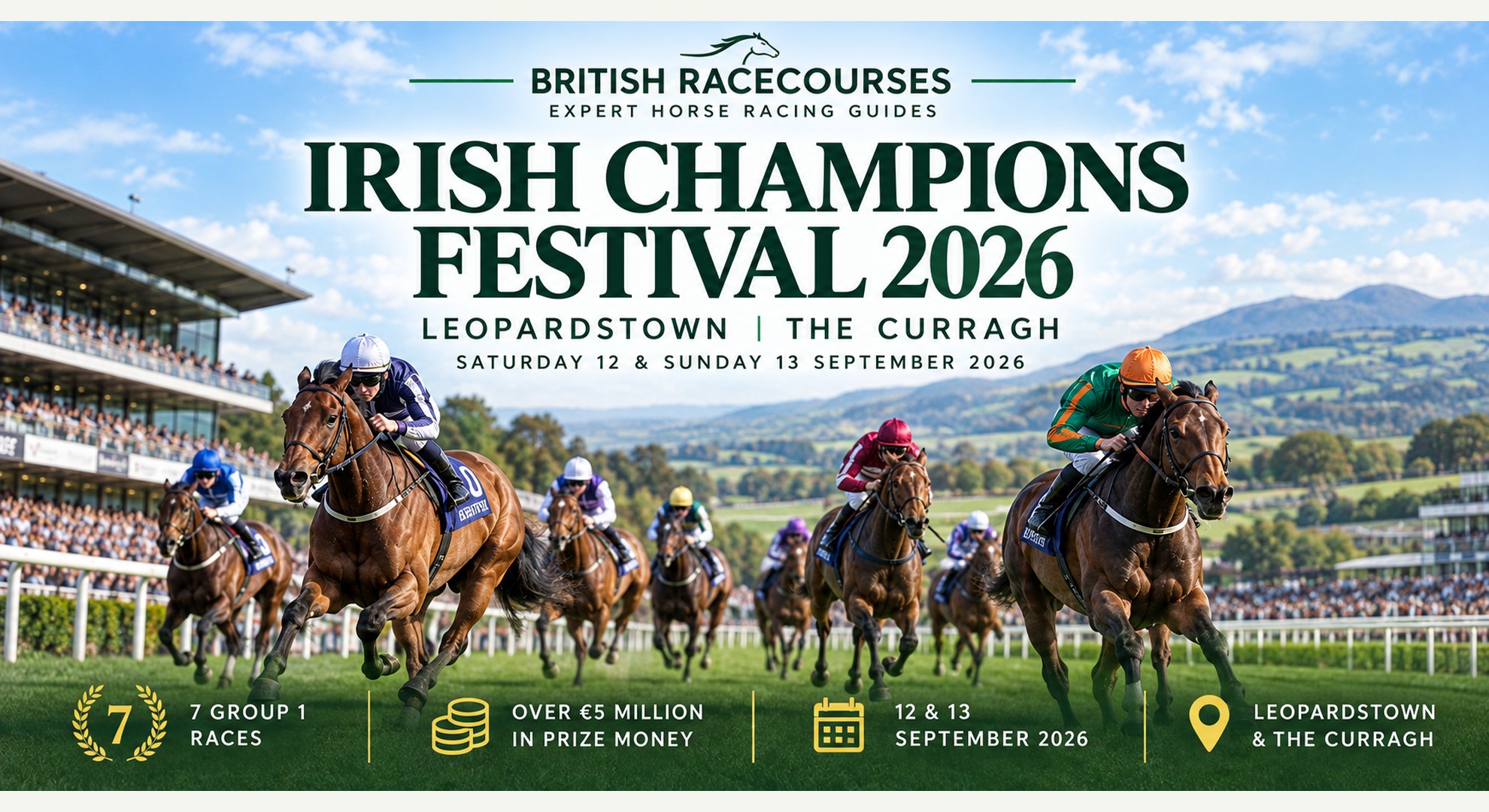
Irish Champions Festival brings two of Ireland’s best Flat cards together at Leopardstown and the Curragh on Saturday 12 and Sunday 13 September 2026.
This year’s meeting has an extra Group 1. The Golden Fleece Stakes has been promoted from Group 2 level, taking the festival total to seven Group 1 races for the first time.
More than €5 million in prize money is available across the weekend.
Leopardstown opens the meeting on Saturday with the Irish Champion Stakes, Matron Stakes and the newly promoted Golden Fleece. Racing switches to the Curragh on Sunday for four Group 1s covering sprinters, two-year-olds and stayers.
For British racing followers, the timing is particularly useful. Horses arriving from Royal Ascot, Goodwood and York meet leading Irish runners before the European season moves towards the major autumn targets.
Irish Champions Festival 2026 Dates
| Day | Racecourse | Date | Main Race |
|---|---|---|---|
| Day 1 | Leopardstown | Saturday 12 September | Irish Champion Stakes |
| Day 2 | Curragh | Sunday 13 September | Irish St Leger |
The festival is unusual because moving racecourse changes the type of racing considerably.
Leopardstown’s left-handed circuit puts an emphasis on position, balance and how efficiently a horse negotiates the bends. The Curragh provides a more galloping examination, including its straight-course races and demanding finish.
A performance should therefore be judged in the context of the track rather than simply the Group status attached to the race.
Seven Group 1 Races in 2026
The Group 1 programme has expanded from six races to seven.
Saturday at Leopardstown
Sunday at the Curragh
The programme covers very different sections of the Flat season. There are five-furlong sprinters at one end and established stayers at the other, with leading juveniles, milers and middle-distance horses in between.
Saturday 12 September: Leopardstown
Saturday’s nine-race card is headed by three Group 1s.
The current scheduled running order is:
| Time | Race | Class |
|---|---|---|
| 1:40 | Ballylinch Stud Irish EBF Ingabelle Stakes | Listed |
| 2:15 | Sovereign Path Premier Handicap | Premier Handicap |
| 2:50 | Golden Fleece Stakes | Group 1 |
| 3:20 | Kilternan Stakes | Group 3 |
| 3:55 | Matron Stakes | Group 1 |
| 4:25 | Solonaway Stakes | Group 2 |
| 5:00 | Irish Champion Stakes | Group 1 |
| 5:35 | Petingo Premier Handicap | Premier Handicap |
| 6:10 | Autumn Fillies Premier Handicap | Premier Handicap |
Race times can change, so check the final card before travelling or betting.
Irish Champion Stakes
The Irish Champion Stakes remains Saturday’s defining race.
Run over approximately a mile and a quarter, it has been won by horses including Sea The Stars, Golden Horn, Roaring Lion, Magical and Auguste Rodin.
The race regularly creates one of the most interesting clashes of the late Flat season because three-year-olds can meet established older middle-distance horses after the major summer festivals.
The initial 2026 entry was exceptionally strong. Forever Young, Calandagan and reigning Arc winner Daryz were among the international names entered.
An entry is only the starting point. Travel plans, ground, alternative targets and a horse’s condition can change considerably before declarations.
For that reason, we will judge the race on the field that actually assembles at Leopardstown rather than build the analysis around names that may never reach the start.
What Matters at Leopardstown?
The bare finishing positions from a horse’s previous race are rarely enough.
A runner coming from York, Goodwood or France may have encountered a completely different pace and track configuration.
Look at:
- the strength of the previous opposition;
- how the race developed;
- where the horse was positioned;
- the ground;
- whether its finishing effort was better or worse than the result suggests.
Our guide to analysing a horse race covers this process in more detail.
Leopardstown can punish a horse that wastes energy or finds itself poorly positioned. Tactical speed matters alongside raw ability.
Matron Stakes
The Matron Stakes gives the leading fillies and mares their own Group 1 target over a mile.
The race can bring together two quite different profiles.
Older mares often arrive with an established level of Group 1 form. Three-year-old fillies receive the opportunity to show how far they have progressed since the spring Classics.
That distinction is more useful than simply comparing official ratings.
A three-year-old can still be improving quickly in September, while an older mare may bring a larger body of evidence about the conditions under which she performs best.
British-trained runners also regularly strengthen the race. Blue Bolt, for example, earned another major success at Deauville during the summer with Leopardstown identified as an autumn objective.
Final declarations will show how much of that international strength survives.
Golden Fleece Stakes: A New Group 1
The Golden Fleece Stakes is one of the biggest changes to Irish Champions Festival in 2026.
Previously run as the Champions Juvenile Stakes at Group 2 level, the race has been upgraded to Group 1 and extended to nine furlongs.
That gives Ireland another top-level juvenile race and creates an early examination of two-year-olds expected to develop into middle-distance horses at three.
The previous version has already produced significant horses. Auguste Rodin won in 2022 before going on to win six Group 1 races, while 2025 winner Benvenuto Cellini subsequently became an Irish Derby winner.
The Golden Fleece should therefore be viewed partly through a 2027 lens.
A juvenile capable of performing strongly over nine furlongs at Leopardstown in September immediately becomes relevant to the following season’s Classic picture.
The Supporting Leopardstown Races Matter
The three Group 1s will dominate attention, but ignoring the supporting races can be a mistake.
The Group 2 Solonaway Stakes provides another quality test, while the Premier Handicaps can contain horses whose form remains relevant well beyond this meeting.
They also give bettors evidence about the track before the Irish Champion Stakes.
Watch how the earlier races unfold.
Are horses struggling to make ground from the rear?
Is one part of the course riding better?
Are leaders conserving more energy than expected?
One result proves very little. A repeated pattern deserves attention.
Our guides to horse racing pace bias and track bias explain how we separate useful evidence from coincidence.
Sunday 13 September: The Curragh
The festival moves to the Curragh on Sunday.
Four Group 1 races form the centre of the card:
Flying Five Stakes
Moyglare Stud Stakes
Vincent O’Brien National Stakes
Irish St Leger
Nearly €2.5 million in prize money is attached to the Curragh card.
The variety is one of Sunday’s strengths. The Group 1 programme moves from raw sprinting speed through two juvenile championships to the final Irish Classic of the season.
Flying Five Stakes
The Flying Five Stakes is Ireland’s premier five-furlong Group 1.
Five furlongs leaves little time to recover from a poor start, an unfavourable position or being attached to the wrong group.
That makes the market only part of the analysis.
The draw needs to be considered alongside pace. A theoretically favourable stall becomes less useful if the horse is isolated from the main concentration of early speed.
Earlier straight-course races can provide valuable clues about how the Curragh is riding.
The aim isn’t to declare a draw bias after one winner. We want repeated evidence that horses in a particular area are travelling or finishing more effectively.
Vincent O’Brien National Stakes
The Vincent O’Brien National Stakes is one of Europe’s important juvenile races.
This is a stage of the season where improvement can be more significant than the number beside a horse’s name.
Two-year-olds can progress rapidly between starts. Some arrive with several races of evidence; another may have raced only once or twice and still be learning.
That makes previous-race analysis particularly valuable.
Did the horse settle?
How did it respond when asked to quicken?
Did it finish through the line?
Was the opposition stronger than it appeared at the time?
Have horses from the same race improved subsequently?
Our guides to race replay analysis and form lines are useful when assessing those questions.
The result will also feed directly into the early picture for the 2027 Classics.
Moyglare Stud Stakes
The Moyglare Stud Stakes provides the equivalent Group 1 test for two-year-old fillies.
Royal Ascot form, Irish summer form and lightly raced improvers can meet here.
That makes certainty dangerous.
A filly with several strong performances provides more evidence, but the less exposed runner may have considerably more improvement left.
The important question is not simply which filly has achieved the highest rating. It is whether that rating represents her likely level on Sunday.
That distinction becomes particularly important with juveniles.
Irish St Leger
The Irish St Leger closes the Irish Classic season and gives established stayers a major Group 1 target over a mile and six furlongs.
The early entry contained considerable depth, including defending champion Al Riffa, Scandinavia, Ethical Diamond, Jan Breughel and other established staying performers.
Constitution Hill was also included at the initial entry stage, creating considerable interest following his switch to Flat racing.
That is now an outdated angle.
His subsequent route took him to the September Stakes at Kempton, effectively removing the Curragh from his immediate programme. He should therefore not be treated as a likely Irish St Leger runner simply because his name remains associated with the original entry list.
This is exactly why festival previews need updating as the meeting approaches.
The horses that matter are those still heading towards the race.
Stamina Is More Than Distance
The Irish St Leger distance naturally focuses attention on stamina, but a horse’s ability to stay cannot be judged solely by the longest trip it has previously attempted.
Pace changes the test.
A slowly run staying race can place greater emphasis on acceleration. A sustained gallop asks a much harder stamina question.
Ground can magnify the difference.
That is why we combine distance evidence with likely pace and conditions rather than applying a simple “has won over the trip” rule.
Seven Group 1s Strengthen the Festival
The Golden Fleece upgrade matters beyond a change in classification.
Irish Champions Festival can now stage seven Group 1s over two days without relying on a single type of horse.
Leopardstown covers juveniles, milers and middle-distance performers.
The Curragh covers sprinters, juveniles and stayers.
Ireland’s importance to British form also makes those races particularly relevant to readers of British Racecourses.
Horses regularly move between the two countries. British-trained runners travel to Ireland, Irish horses contest Britain’s biggest meetings, and the same form lines reappear at Ascot, Newmarket, York, Goodwood, Doncaster and elsewhere.
Our guide to Irish Group 1 horse races places the seven festival races within the wider Irish programme.
Aidan O’Brien and Ballydoyle
Aidan O’Brien’s strength means Ballydoyle is likely to be represented across several divisions rather than concentrating on one headline race.
That creates a familiar betting problem.
Trainer reputation is useful information, but it should not replace assessment of the individual horse.
A short-priced Ballydoyle runner still needs to justify its price through form, suitability, likely improvement and the strength of the opposition.
This is particularly important in the juvenile races, where the stable can field horses with different levels of experience and development.
British Challengers
Irish Champions Festival has become an obvious target for British trainers because of its place in the calendar and the range of races available.
British-trained horses can arrive from York, Goodwood, Newmarket or Deauville before moving on to autumn targets.
The form also flows in the opposite direction.
Performances at Leopardstown and the Curragh can become directly relevant when the same horses appear at British Champions Day or in late-season Newmarket races.
Following Irish racing closely therefore improves analysis of British races rather than distracting from it.
How We Analyse Irish Champions Festival Races
Big festival fields encourage bettors to look for shortcuts. We prefer a consistent process.
Start With the Final Field
Entries are useful for understanding the possible strength of a race. Declarations tell us what we can actually bet on.
Do not build a strong opinion around a horse whose participation remains uncertain.
Assess the Form in Context
A Group 1 placing can be stronger than a win at the same nominal level.
Look at who competed and how the race unfolded.
Our horse racing classes guide explains the formal hierarchy, but the quality within each level still varies.
Check the Ground
September weather can materially change both days.
A horse that needs fast ground should not be assessed in the same way after sustained rain.
Our horse racing going guide explains the main going descriptions and how conditions affect races.
Map the Pace
Identify the likely leaders and horses that prefer to race prominently or be held up.
The important question is what happens when those running styles meet.
Our pace maps guide explains the process.
Consider the Draw in Context
A stall number has no value in isolation.
Distance, field size, pace and the way the course is riding determine how much it matters.
Compare the Price With the Chance
Finding the horse most likely to win and finding the best bet are different exercises.
A favourite can be the likeliest winner and still be too short.
That distinction becomes important at championship meetings, where recognisable horses often attract heavy public support.
Leopardstown and Curragh Betting Tips
Our festival article covers the meeting, major races and wider form.
The tipping pages serve a different purpose.
Once declarations, ground and prices are available, our Leopardstown betting tips and Curragh betting tips provide the current race-day selections.
Keeping those roles separate prevents an early festival preview from presenting speculative opinions as current tips.
Betting Sites for Irish Champions Festival
Price comparison becomes particularly useful across a weekend containing seven Group 1 races and several competitive supporting contests.
Bookmakers can differ on:
- win prices;
- each-way terms;
- extra places;
- Best Odds Guaranteed eligibility;
- live streaming;
- festival promotions.
The bookmaker with the strongest price on one race may not have it on the next.
Our best horse racing betting sites page compares the main options for racing bettors.
Check the actual terms and prices before placing a bet rather than relying on a promotion described earlier in the week.
Going to Irish Champions Festival
Leopardstown opens its gates at 11:40am on Saturday under the current schedule.
The racecourse is around six miles south of central Dublin. The LUAS runs from the city towards Sandyford, with a complimentary racecourse shuttle scheduled from Sandyford LUAS stop for the meeting.
Our Leopardstown Racecourse guide has more information about the track and travelling to the course.
Sunday moves outside Dublin to the Curragh in County Kildare.
The current plan has gates opening at 11:00am. Free parking is available, while public transport options include race-day bus services from Dublin.
See our Curragh Racecourse guide before travelling.
Race times and transport arrangements can change, so check the latest information before setting off.
What to Watch Across the Weekend
Several questions should become clearer once the racing begins.
How strong is the Irish middle-distance division?
The Irish Champion Stakes provides one of its toughest examinations.
Does the new Golden Fleece identify a 2027 Classic horse?
Nine furlongs at Group 1 level is a significant juvenile test.
Which two-year-olds progress at the Curragh?
The National Stakes and Moyglare can reshape the following year’s Classic markets.
Can the international sprinters beat the Irish and British speed horses?
The Flying Five provides a direct comparison.
Which stayer finishes the season on top?
The Irish St Leger brings the specialist staying division back into focus.
Those are more useful questions than trying to manufacture selections before the final fields are known.
Irish Champions Festival and the Autumn Programme
The meeting sits at a point where summer form starts feeding into the major autumn races.
A strong Leopardstown performance can influence expectations for the Prix de l’Arc de Triomphe or British Champions Day.
The juvenile races begin to shape winter discussion around the 2027 Classics.
Stayers can have international targets later in the year.
None of those connections should be treated automatically.
Leopardstown is not Longchamp. The Curragh is not Ascot. Race shape, distance and ground can change.
The useful information comes from understanding how a horse performed rather than assuming a win or defeat will be repeated under different conditions.
Irish Champions Festival 2026 FAQs
When is Irish Champions Festival 2026?
Irish Champions Festival takes place on Saturday 12 September and Sunday 13 September 2026.
Where is Irish Champions Festival held?
Saturday takes place at Leopardstown Racecourse in Dublin. Sunday’s racing is staged at the Curragh in County Kildare.
How many Group 1 races are there in 2026?
There are seven Group 1 races across the two days, the highest number in the festival’s history.
Why are there seven Group 1 races this year?
The Golden Fleece Stakes has been upgraded from Group 2 to Group 1 for 2026.
What are Saturday’s Group 1 races?
Leopardstown stages the Golden Fleece Stakes, Matron Stakes and Irish Champion Stakes.
What are Sunday’s Group 1 races?
The Curragh stages the Flying Five Stakes, Moyglare Stud Stakes, Vincent O’Brien National Stakes and Irish St Leger.
What is the main race at Leopardstown?
The Group 1 Irish Champion Stakes is Saturday’s feature and is run over approximately a mile and a quarter.
What is the main race at the Curragh?
The Irish St Leger is the final Irish Classic of the season and the headline staying race on Sunday.
Is Constitution Hill running in the Irish St Leger?
Constitution Hill was included among the early entries, but his subsequent September Stakes route at Kempton effectively ruled out an Irish St Leger appearance. Bettors should use the latest declarations rather than the original entry list.
Where can I find Leopardstown tips?
Current selections are available on our Leopardstown betting tips page when racing takes place.
Where can I find Curragh tips?
Our Curragh betting tips page carries the latest selections for the course.
How much prize money is available at Irish Champions Festival?
The 2026 festival offers more than €5 million in prize money across the two days.
Can children attend Irish Champions Festival?
Yes. Current festival information states that children aged 14 and under enter free at Leopardstown. Under-18s can enter free at the Curragh when accompanied by an adult, subject to the racecourse’s admission conditions.
Is there parking at Leopardstown and the Curragh?
Free parking is currently advertised at both racecourses for the festival.
Summary
Irish Champions Festival takes place at Leopardstown on Saturday 12 September and the Curragh on Sunday 13 September 2026.
The promotion of the Golden Fleece Stakes gives the meeting seven Group 1 races for the first time.
Saturday concentrates on elite juvenile, mile and middle-distance racing. Sunday moves from five-furlong speed through two major juvenile races to the Irish St Leger.
The next important information will come from declarations, weather and ground conditions.
Those details will determine the final fields and change the betting picture considerably.
For British racing followers, the value of the meeting extends beyond the weekend itself. Irish Champions Festival brings together form from Britain, Ireland and the wider international Flat season before many of the same horses move towards the major autumn races.
That makes Leopardstown and the Curragh important pieces of the British and Irish racing season rather than two isolated days in September.