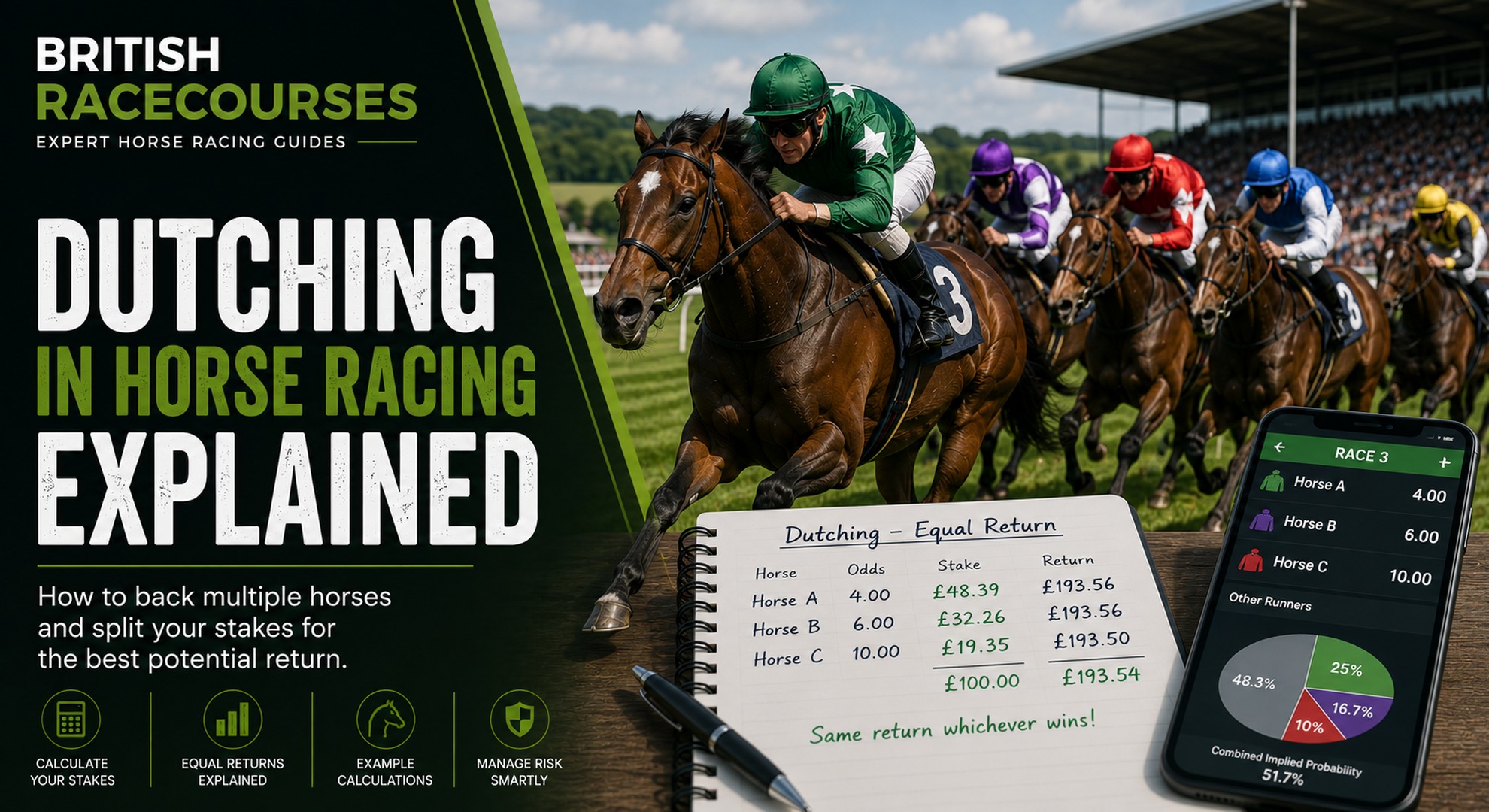
Dutching in horse racing means backing two or more horses in the same race and dividing your total stake between them.
Instead of relying on one selection, you cover several runners that you believe collectively offer a worthwhile betting proposition.
The stakes can be divided so that each selected horse produces approximately the same return if it wins.
For example, you might identify three horses that you believe account for most of the value in a competitive handicap. Rather than choosing one, you could back all three and adjust the individual stakes according to their odds.
Dutching increases the number of horses running for you, but it does not remove betting risk.
If none of your selections wins, you lose the stakes placed across all of them.
More importantly, backing several horses does not automatically create value. The combined prices still need to justify the probability of one of your selections winning.
That distinction separates calculated Dutching from simply backing several horses because you cannot decide between them.
What Is Dutching in Horse Racing?
Dutching is a staking method where you back multiple outcomes in the same market.
In horse racing, that usually means backing two or more horses to win the same race.
The total stake is divided according to the odds so that the potential return is balanced between the selections.
Suppose you want to cover:
- Horse A at 3/1
- Horse B at 5/1
Simply staking £10 on each would produce different returns.
A winning £10 bet at 3/1 returns:
£40
A winning £10 bet at 5/1 returns:
£60
Proper Dutching adjusts the individual stakes so the returns are much closer.
British Racecourses already defines Dutching briefly in our horse racing betting terms glossary. This page concentrates on the mathematics, staking and practical application of the method.
Why Do Horse Racing Bettors Use Dutching?
Dutching is most useful when your race analysis identifies several runners at attractive prices rather than one obvious selection.
Imagine a 12-runner handicap.
After assessing:
- form
- pace
- draw
- going
- handicap marks
- course suitability
- current odds
you conclude that three horses are significantly more interesting than the rest.
You could choose one.
Alternatively, you could divide your stake across all three.
The advantage is straightforward.
You have more than one potential winning outcome.
The disadvantage is equally important.
Your return from each individual winner will be lower than if you had placed the entire stake on that horse alone.
Dutching therefore exchanges some potential upside for greater coverage.
Dutching Does Not Guarantee a Profit
This is the most important principle.
Dutching is sometimes described as a way of guaranteeing profit.
That description is incomplete.
A correctly calculated Dutch can produce the same profit if one of the horses you backed wins and the prices support a profitable structure.
It does not guarantee that one of your horses will win.
Suppose you Dutch three horses in a ten-runner race.
You have covered three outcomes.
Seven horses remain uncovered.
If one of those seven wins, every bet in your Dutch loses.
Dutching changes how your stake is distributed.
It does not remove the uncertainty of horse racing.
Equal Stakes Versus Dutching
Backing several horses with equal stakes is not the same as equal-return Dutching.
Suppose you have £30 and want to back three horses:
Horse A: 3.00
Horse B: 5.00
Horse C: 8.00
If you simply stake £10 on each:
| Horse | Odds | Stake | Return if Winner |
|---|---|---|---|
| Horse A | 3.00 | £10 | £30 |
| Horse B | 5.00 | £10 | £50 |
| Horse C | 8.00 | £10 | £80 |
Your return depends heavily on which horse wins.
Dutching redistributes the £30 so the potential returns are balanced.
That means more money is normally placed on the shorter-priced horse and less on the bigger-priced selections.
The Dutching Formula
For equal-return Dutching, start by calculating the implied probability represented by each decimal price.
The basic calculation is:
1 ÷ decimal odds
Suppose your selections are:
Horse A: 4.00
Horse B: 6.00
Horse C: 10.00
Their inverse odds are:
Horse A:
1 ÷ 4.00 = 0.25
Horse B:
1 ÷ 6.00 = 0.1667
Horse C:
1 ÷ 10.00 = 0.10
Add them together:
0.25 + 0.1667 + 0.10
= 0.5167
This figure becomes the basis for distributing your total stake.
How to Calculate the Stake on Each Horse
The formula for each individual stake is:
Individual stake = total stake × (1 ÷ selection odds) ÷ sum of inverse odds
Using our previous example:
Horse A: 4.00
Horse B: 6.00
Horse C: 10.00
Total stake:
£100
Combined inverse odds:
0.5167
Horse A
£100 × 0.25 ÷ 0.5167
= approximately £48.39
Horse B
£100 × 0.1667 ÷ 0.5167
= approximately £32.26
Horse C
£100 × 0.10 ÷ 0.5167
= approximately £19.35
Total:
£100
Now check the returns.
Horse A:
£48.39 × 4.00 = £193.56
Horse B:
£32.26 × 6.00 = £193.56
Horse C:
£19.35 × 10.00 = £193.50
Rounding produces a few pennies of difference.
Whichever selection wins, the return is approximately:
£193.50
Against the £100 total stake, the profit is approximately:
£93.50
But remember what happens if another horse wins:
the entire £100 Dutch loses.
Why Does the Dutch Produce the Same Return?
The shorter-priced horse receives the largest stake.
The bigger-priced horse receives the smallest.
That balances the payout.
A 3/1 horse does not need as much odds leverage as a 9/1 horse, so more of the total stake has to be allocated to the shorter selection to produce the same final return.
Dutching therefore works backwards from the desired return rather than simply giving every horse an equal stake.
A Simple Two-Horse Dutching Example
Suppose you have narrowed a race to two horses.
Horse A:
3.00
Horse B:
5.00
Total stake:
£50
Calculate the inverse odds:
Horse A:
1 ÷ 3 = 0.3333
Horse B:
1 ÷ 5 = 0.20
Combined:
0.5333
Horse A stake:
£50 × 0.3333 ÷ 0.5333
= approximately £31.25
Horse B stake:
£50 × 0.20 ÷ 0.5333
= approximately £18.75
Returns:
Horse A:
£31.25 × 3 = £93.75
Horse B:
£18.75 × 5 = £93.75
Potential profit:
£43.75
provided one of the two selected horses wins.
A Three-Horse Dutching Example
Now consider a more competitive race.
You identify:
Horse A at 7/2
Horse B at 5/1
Horse C at 8/1
Convert to decimal odds:
Horse A: 4.50
Horse B: 6.00
Horse C: 9.00
Assume a total stake of:
£60
Inverse odds:
1 ÷ 4.50 = 0.2222
1 ÷ 6.00 = 0.1667
1 ÷ 9.00 = 0.1111
Combined:
0.50
Stake distribution:
Horse A:
£60 × 0.2222 ÷ 0.50
= approximately £26.67
Horse B:
£60 × 0.1667 ÷ 0.50
= approximately £20
Horse C:
£60 × 0.1111 ÷ 0.50
= approximately £13.33
Potential returns are approximately:
£120
from any winning selection.
Total stake:
£60
Approximate profit if one of your three wins:
£60
The calculation is attractive.
The unanswered question is whether those three horses collectively have a sufficiently strong chance of winning.
That is where probability and value become more important than the staking formula itself.
Dutching and Combined Implied Probability
The inverse-odds calculation also tells you something useful about the prices.
Take:
4.50
6.00
9.00
Their implied probabilities are approximately:
22.22%
16.67%
11.11%
Combined:
50%
The prices therefore imply that the three selections collectively account for approximately half of the market probability before considering how bookmaker margin is distributed.
This does not prove they have a true 50% chance of producing the winner.
Bookmaker odds contain margin.
Your own assessment may also differ substantially from the market.
Understanding bookmaker overround is therefore useful when analysing a Dutch.
Dutching Is Really a Probability Decision
The staking calculation is mechanical.
The difficult part is deciding which horses deserve to be included.
Suppose three available prices imply a combined probability of:
45%
Your own analysis suggests the horses actually have a combined:
58% chance of winning
That difference could indicate value.
Now imagine the same prices imply:
45%
but you assess the combined chance at:
38%
Balancing the stakes perfectly does not improve the proposition.
You have simply distributed money efficiently across a group of selections you believe are collectively overpriced.
The quality of the probabilities matters more than the elegance of the staking formula.
Dutching and Fair Prices
A strong Dutch starts with identifying value.
Suppose your analysis gives:
Horse A: 30%
Horse B: 20%
Horse C: 15%
Combined true probability according to your assessment:
65%
Their fair decimal odds individually would be:
Horse A:
1 ÷ 0.30 = 3.33
Horse B:
1 ÷ 0.20 = 5.00
Horse C:
1 ÷ 0.15 = 6.67
You can then compare those fair prices with the odds available from bookmakers.
This is why Dutching fits naturally with learning how to price a horse race.
You should identify value first.
The Dutching calculation comes afterwards.
Dutching Versus Backing One Horse
Suppose you have £50 available.
You like:
Horse A at 4/1
Horse B at 6/1
You could put the full £50 on Horse A.
If it wins:
Return = £250
Profit = £200
Alternatively, you could Dutch A and B.
Your return if either wins will be lower than £250.
But you now have two possible winning outcomes.
Neither option is inherently superior.
The correct choice depends on:
- your estimated probabilities
- the prices
- your confidence in each assessment
- your staking plan
- your tolerance for variance
Dutching should not be used merely because choosing one horse feels uncomfortable.
Dutching Versus Each-Way Betting
Dutching and each-way betting both provide more than one route to a return, but they work very differently.
An each-way bet covers:
one horse across two outcomes
The horse can win or place.
A Dutch normally covers:
multiple horses across one outcome
Any selected horse can win.
Our guide to each-way value in horse racing explains how to calculate whether the win and place portions justify the total stake.
A bettor might prefer Dutching when several runners appear overpriced to win.
Each-way betting may be more appropriate when one horse has an attractive probability of reaching the places.
Dutching Versus a Forecast
A forecast bet requires you to predict horses finishing first and second.
Dutching does not.
If you Dutch three runners in the win market, you simply need one of those three to win.
Their finishing order behind the winner is irrelevant.
The two bets therefore serve very different purposes.
Dutching Versus a Placepot
The Tote Placepot requires selections to place across a sequence of races.
Dutching normally concerns several selections within a single market.
A Placepot bettor can use multiple selections in individual legs, but that creates combinations across several races rather than a conventional equal-return Dutch.
The mathematical structure is different.
Dutching Versus Laying a Horse
There is an interesting relationship between Dutching and lay betting.
Suppose a five-runner race contains a short-priced favourite you strongly oppose.
One approach is to lay the favourite on a betting exchange.
Another is to back several of its opponents.
Backing all realistic alternatives can produce an economic position that resembles betting against the favourite.
But the two methods are not identical.
Exchange commission, liquidity, unmatched bets, bookmaker odds and the number of runners covered all matter.
Dutching should therefore be analysed as its own position rather than casually described as the same thing as laying.
Why Best Price Matters When Dutching
Price comparison becomes particularly important when backing several runners.
Suppose you want to Dutch three horses.
Bookmaker A offers the best price on Horse 1.
Bookmaker B offers the best price on Horse 2.
Bookmaker C offers the best price on Horse 3.
Taking all three from one bookmaker because it is convenient can weaken the entire Dutch.
Better odds reduce the amount of stake required to achieve a given return.
That can materially improve the combined proposition.
Our guide to comparing horse racing bookmakers explains why shopping for the best price matters.
Dutching Across Multiple Bookmakers
You do not have to place every component of a Dutch with the same bookmaker.
Using different bookmakers can allow you to take the strongest available price on each horse.
This is one practical reason some bettors maintain multiple bookmaker accounts.
Suppose the best available prices are:
Horse A: 4.00 with Bookmaker 1
Horse B: 6.50 with Bookmaker 2
Horse C: 10.00 with Bookmaker 3
Compare those with one bookmaker offering:
3.50
5.50
8.00
The stronger combined prices can materially improve the Dutch.
Always consider account terms, settlement rules and applicable promotions separately.
Dutching and Betting Apps
Using several horse racing betting apps makes price comparison faster.
But speed should not replace calculation.
Before confirming the bets:
- check every price
- calculate every stake
- confirm the total stake
- check the potential return
- account for any price movement
- make sure the individual bets have actually been accepted
A partially placed Dutch can leave you with a very different position from the one you intended.
Price Movement Is a Practical Dutching Risk
Suppose you calculate a three-horse Dutch at:
4.00
6.00
10.00
You place the first two bets.
Before placing the third, its price shortens from:
10.00
to:
8.00
Your original stake distribution is no longer balanced.
You now have three choices:
- recalculate the entire position
- adjust the remaining stake
- abandon the final component and accept a different risk profile
This is one reason theoretical calculations and real betting execution are not always identical.
Dutching on a Betting Exchange
Betting exchanges can also be used for Dutching.
Exchange markets often provide:
- decimal odds
- rapidly changing prices
- the ability to back multiple runners
- visible liquidity
However, exchange commission must be considered.
A gross equal return is not necessarily an equal net return after commission.
Liquidity matters too.
A displayed price is useful only if enough money is available at that price for the stake you want to place.
Commission and Dutching
Suppose your Dutch generates:
£20 gross profit
if any selected horse wins.
If an exchange charges commission on net market winnings under its applicable terms, your final profit will be lower.
The precise calculation depends on the exchange and your commission rate.
Do not compare:
£20 bookmaker profit
with:
£20 exchange gross profit
as though they are automatically identical.
Compare the final net position.
Best Odds Guaranteed and Dutching
Best Odds Guaranteed can affect the eventual return from qualifying bookmaker bets.
Suppose you Dutch three horses using early prices.
One wins at a larger starting price.
If that bet qualifies for BOG, your return can exceed the equal return originally calculated.
That is favourable, but it means the final returns are no longer perfectly balanced.
This is not a problem.
Equal-return Dutching is a staking structure, not a requirement that every eventual settlement must remain identical after bookmaker concessions.
Rule 4 and Dutching
Non-runners can complicate a Dutch.
Suppose you have backed three horses and another runner is withdrawn.
Your bets may be subject to a Rule 4 deduction, depending on when the bets were placed and the bookmaker’s rules.
The remaining market will also change.
A Dutch calculated before the withdrawal may therefore no longer produce the expected returns.
Check deductions and revised prices carefully.
What Happens If One of Your Dutched Horses Is a Non-Runner?
If one of your selected horses becomes a non-runner, that individual stake will normally be handled according to the bookmaker’s rules, while deductions can affect remaining bets where applicable.
Your original Dutch is no longer the position you calculated.
Do not automatically redistribute the returned stake without reassessing the new market.
The withdrawal may have materially changed the chances and prices of every remaining horse.
Dutching and Expected Value
Expected value remains fundamental.
Imagine you have identified three horses.
The bookmaker prices suggest their combined chance is approximately:
50%
Your analysis suggests:
65%
If your probabilities are accurate, that discrepancy is important.
Now reverse the situation.
The market implies:
60%
Your assessment gives them:
48%
Dutching the horses does not create value.
It simply combines several negative-value propositions.
Staking cannot manufacture an edge that is absent from the prices.
Dutching and Probability Calibration
This is why bettors who create their own probabilities should test them.
If your horses assessed at 30% historically win only 20% of the time, your Dutching calculations will systematically overstate your advantage.
Our guide to horse racing probability calibration explains how to compare predicted probabilities with observed outcomes.
Dutching relies heavily on the combined probability of your chosen group.
Poor probabilities produce poor Dutching decisions.
Dutching and the Favourite-Longshot Bias
The favourite-longshot bias also deserves consideration.
Bookmaker margin is not necessarily distributed evenly across every horse.
Blindly Dutching several outsiders because their headline odds appear attractive can therefore be misleading.
You need to assess whether those prices genuinely underestimate the horses’ chances.
Bigger odds do not automatically mean better value.
Dutching a Vulnerable Favourite Race
One common use of Dutching is when you believe a short-priced favourite is vulnerable.
Imagine an eight-runner handicap.
Favourite:
2.25
You believe its true chance is closer to:
35%
rather than the roughly 44% implied by its price.
You identify three opponents whose combined chance you rate significantly higher than the market does.
Rather than laying the favourite, you might Dutch those three alternatives.
This can be a logical structure.
But there is an important trap.
The other four runners still exist.
If one of those wins, your entire Dutch loses.
Opposing one horse and correctly identifying the winner are not the same thing.
Dutching in Competitive Handicaps
Handicaps can produce attractive Dutching situations because several horses may have credible winning chances.
Large handicaps at tracks such as York or Newmarket can contain multiple runners that your analysis identifies as interesting.
However, bigger fields also increase the number of horses capable of beating your selected group.
Covering three horses in an eight-runner race is very different from covering three in a 24-runner handicap.
Always assess the uncovered portion of the field.
Dutching and the Draw
The horse racing draw can help narrow a field.
Suppose historical evidence and current conditions suggest a strong advantage to one part of the track.
Several horses within that draw zone may interest you.
Dutching them purely because of their stalls would still be too simplistic.
You need to consider:
- ability
- form
- pace
- going
- current mark
- field position
- odds
The draw should inform your probabilities rather than automatically determine the selections.
Dutching and Pace
Race shape can also produce groups of interesting horses.
A horse racing pace map might show that only three runners are likely to obtain favourable prominent positions.
That information can strengthen their cases.
But again, Dutching all three is justified only if their available prices collectively offer sufficient value.
A useful angle is not automatically a useful bet.
Dutching and Going
Ground conditions can dramatically reshape a race.
Our guide to horse racing going explains how surface conditions affect performance.
If several leading market horses have doubts on soft ground while two or three alternatives have proven form under those conditions, the race may become interesting from a Dutching perspective.
The key is to convert that analysis into probabilities.
Do not simply back every horse with a soft-ground win in its form.
Dutching at Distinctive Racecourses
Course configuration can help identify races where several runners deserve upgrading or downgrading.
At Chester, for example, track position and draw can matter considerably in some races.
At Newmarket, the demands are completely different.
At Cheltenham, jumping, stamina and course configuration introduce another set of variables.
Dutching works best as the final staking decision after course-specific analysis, not as a replacement for that analysis.
Should You Dutch Favourites?
You can.
Dutching is not restricted to outsiders.
Suppose a race appears dominated by the first two horses in the betting.
You may decide their combined probability of winning is greater than the available prices suggest.
A two-horse Dutch could then be considered.
The problem is that short prices can leave relatively little margin for error.
Always calculate the actual combined proposition.
Should You Dutch Outsiders?
Again, you can.
But covering several outsiders does not automatically create value.
Suppose you Dutch:
12/1
16/1
20/1
The potential return may look attractive.
But if the true combined probability of those horses winning is lower than their combined price implies, the bet remains poor.
Do not confuse:
large payout
with:
good value.
How Many Horses Should You Dutch?
There is no universal correct number.
Two or three is common because the calculations remain manageable and you retain meaningful potential returns.
As you add selections:
- your coverage increases
- more of your bankroll is distributed
- the return from each winning outcome generally falls
- you may begin including weaker value propositions simply to cover more of the field
The correct number is determined by the race and the prices.
Do not set a rule such as:
“I always Dutch three horses.”
Some races may justify two.
Some may justify four.
Many justify none.
When Should You Not Dutch a Race?
Avoid forcing the strategy.
A race may be unsuitable when:
- you strongly prefer one horse
- the available prices are poor
- your shortlisted runners account for too little true probability
- the market is moving too quickly to execute accurately
- you are adding horses purely to increase coverage
- you cannot estimate the probabilities confidently
- one selection is available at a significantly inferior price
- the total stake is larger than your normal risk allowance
The fact that a race contains several plausible winners does not mean you need to bet it.
Dutching and Your Betting Bank
A £100 Dutch should be treated as:
£100 at risk
not as several small independent bets.
If you place:
£45 on Horse A
£35 on Horse B
£20 on Horse C
your total exposure to the race is:
£100
If another horse wins, you lose £100.
Your horse racing bankroll management should therefore consider the total Dutch as the betting unit.
This prevents the strategy from quietly increasing your risk.
Dutching and Level Stakes
Suppose your standard win bet is:
£20
You decide to Dutch three horses.
It would be a mistake to automatically stake:
£20 + £20 + £20
and then claim you are still betting £20 per race.
Your actual exposure is:
£60
If you want to retain a £20 race-level stake, the £20 should normally be divided between the selections.
The Dutch changes the allocation.
It should not automatically triple your intended exposure.
Dutching and the Kelly Criterion
The Kelly Criterion for horse racing is designed around the relationship between estimated edge and bankroll growth.
Applying Kelly concepts to several correlated selections in the same race is more complicated than calculating a simple single-selection Kelly stake.
Only one horse can win.
The outcomes are mutually exclusive.
Do not calculate a full independent Kelly stake for each horse and simply add them together without accounting for the combined race-level exposure.
For most recreational bettors, a conservative fixed total stake is easier to control.
Recording Dutch Bets
Dutching should be recorded as a complete race-level position as well as individual bets.
Useful fields include:
- date
- race
- racecourse
- horses selected
- odds taken
- bookmaker or exchange
- individual stakes
- total stake
- expected return
- actual return
- combined estimated probability
- combined market probability
- closing prices
- result
- profit or loss
Our guide to keeping horse racing betting records explains how to analyse betting performance systematically.
How to Assess Dutching Results
Do not judge the method solely by strike rate.
Dutching naturally increases your chance of backing the winner because you are backing several horses.
A higher strike rate therefore proves very little on its own.
Measure:
- profit and loss
- ROI
- average total stake
- average return
- closing line value
- combined predicted probability
- actual winning frequency
- maximum drawdown
- longest losing run
A Dutching strategy can produce a high strike rate and still lose money if the prices are poor.
Backtesting a Dutching Strategy
If you develop rules for identifying Dutching races, test them historically.
For example:
- field sizes of 6-10
- oppose favourites below a specified price
- select the next two or three horses meeting defined criteria
- require a minimum calculated edge
- use realistic historical odds
- apply consistent staking
Our guide to backtesting horse racing betting systems explains why historical testing needs strict rules.
Do not alter the Dutch retrospectively after seeing which horse won.
That introduces hindsight bias.
Dutching and Closing Line Value
Suppose your three selections were:
4.00
6.00
10.00
when you placed the bets.
Near the off they trade at:
3.50
5.00
8.00
All three shortened.
That does not guarantee the Dutch will win.
But consistently obtaining larger prices than the later market can provide useful information about your selection and timing.
Our closing line value guide explains why the relationship between the price taken and the later market can be useful over a large sample.
Common Dutching Mistakes
Backing Several Horses Because You Cannot Decide
Uncertainty is not value.
If you cannot separate three horses, that does not mean all three should be backed.
Using Equal Stakes Without Checking Returns
Equal stakes create different returns when the odds differ.
Ignoring the Rest of the Field
Your Dutch loses if an uncovered horse wins.
Adding Too Many Horses
More selections increase coverage but can destroy the potential value of the position.
Ignoring Price Comparison
Inferior prices weaken the entire calculation.
Forgetting Commission
Exchange profits should be assessed after applicable commission.
Increasing the Total Stake Accidentally
Three £20 bets mean £60 is at risk.
Ignoring Rule 4
Withdrawals can change returns and the structure of the market.
Assuming Equal Profit Means Guaranteed Profit
Equal profit applies only to the outcomes you covered.
Dutching Negative-Value Selections
Perfect stake allocation cannot rescue bad prices.
Chasing After a Losing Dutch
A losing race does not justify increasing the next stake.
Judging the Strategy by Strike Rate
Backing more horses naturally increases strike rate.
Profitability depends on price and probability.
A Practical Dutching Checklist
Before Dutching a horse race, ask:
Have I identified two or more genuinely attractive selections?
Do not Dutch simply because the race looks difficult.
What probability do I assign to each horse?
Write it down.
What is their combined probability?
Assess the group.
What prices are available?
Compare bookmakers.
Are those prices bigger than my fair prices?
Look for value.
What is the total stake?
Set it before calculating individual bets.
What stake belongs on each horse?
Use the equal-return formula if that is your objective.
What happens if an uncovered horse wins?
Know your full downside.
Could commission affect the return?
Check exchange costs.
Could Rule 4 affect the bets?
Consider withdrawals.
Does the total exposure fit my bankroll plan?
Treat the Dutch as one race-level position.
Am I betting because the numbers justify it?
If not, leave the race alone.
Frequently Asked Questions
What does Dutching mean in horse racing?
Dutching means backing two or more horses in the same race and dividing your total stake between them. Stakes are often calculated so each selected horse produces approximately the same return if it wins.
Does Dutching guarantee a profit?
No. You lose the entire Dutch if none of your selected horses wins. Equal-profit Dutching only balances the return across the outcomes you have covered.
How do you calculate a Dutch bet?
Convert each selection’s decimal odds into inverse odds using 1 divided by the price. Add the results together and distribute the total stake proportionally using those inverse odds.
Can you Dutch two horses?
Yes. A two-horse Dutch is one of the simplest versions. Your total stake is divided between both horses so the return is approximately equal whichever one wins.
Can you Dutch three or more horses?
Yes. The same principle can be applied to three or more selections, although calculations and execution become more complicated as additional horses are included.
Is Dutching better than betting each way?
Neither is automatically better. Dutching normally covers several horses to win, while an each-way bet covers one horse to win or place. The correct option depends on probabilities, prices and place terms.
Can I Dutch horses with different bookmakers?
Yes. Taking the best available price for each selection can improve the overall proposition, although you need to calculate stakes carefully and account for any differences in settlement terms.
Can you Dutch on Betfair or another exchange?
Dutching can be used on betting exchanges. Account for commission, available liquidity and changing prices when calculating the final position.
What happens if one of my Dutch selections is a non-runner?
The bookmaker or exchange’s non-runner rules apply. Remaining bets may also be affected by deductions or repricing, so the original Dutch may no longer produce the calculated return.
How many horses should I Dutch?
There is no fixed number. The correct number depends on which runners offer value. Adding horses purely to increase coverage can weaken the bet.
Is Dutching profitable long term?
Dutching is only a staking method. Long-term results depend primarily on whether the bettor identifies selections whose available odds offer sufficient value relative to their true probabilities.
Is Dutching the same as arbitrage?
No. Dutching usually covers several selected outcomes while leaving other outcomes uncovered. Arbitrage aims to cover every relevant outcome at prices that create a profit regardless of the result.
Is Dutching the same as laying a favourite?
No. Backing several opponents can sometimes create a similar view to opposing the favourite, but uncovered horses, bookmaker prices, exchange commission and liquidity make the positions different.
Do I need a Dutching calculator?
No, but a calculator reduces the chance of arithmetic and rounding errors, particularly when backing three or more selections.
Summary
Dutching allows you to back several horses in the same race while distributing your stake to balance the potential return.
The mathematics is straightforward.
The betting decision is harder.
You still need to determine:
- which horses deserve to be included
- their true probabilities
- whether the available prices represent value
- how much of your bankroll should be risked
- whether another horse outside your Dutch can realistically beat them
Backing more horses increases your chance of holding the winning ticket.
It also reduces the return you would have received from putting the entire stake on the eventual winner.
That trade-off only makes sense when the prices justify it.
The strongest Dutching approach therefore begins with race analysis and fair probabilities, followed by price comparison and finally stake allocation.
Do not start with the staking formula and search for horses to fit it.
Find the value first.
Then decide whether Dutching is the most efficient way to bet it.
18+. Gambling involves financial risk. Never bet more than you can afford to lose and never chase losses.