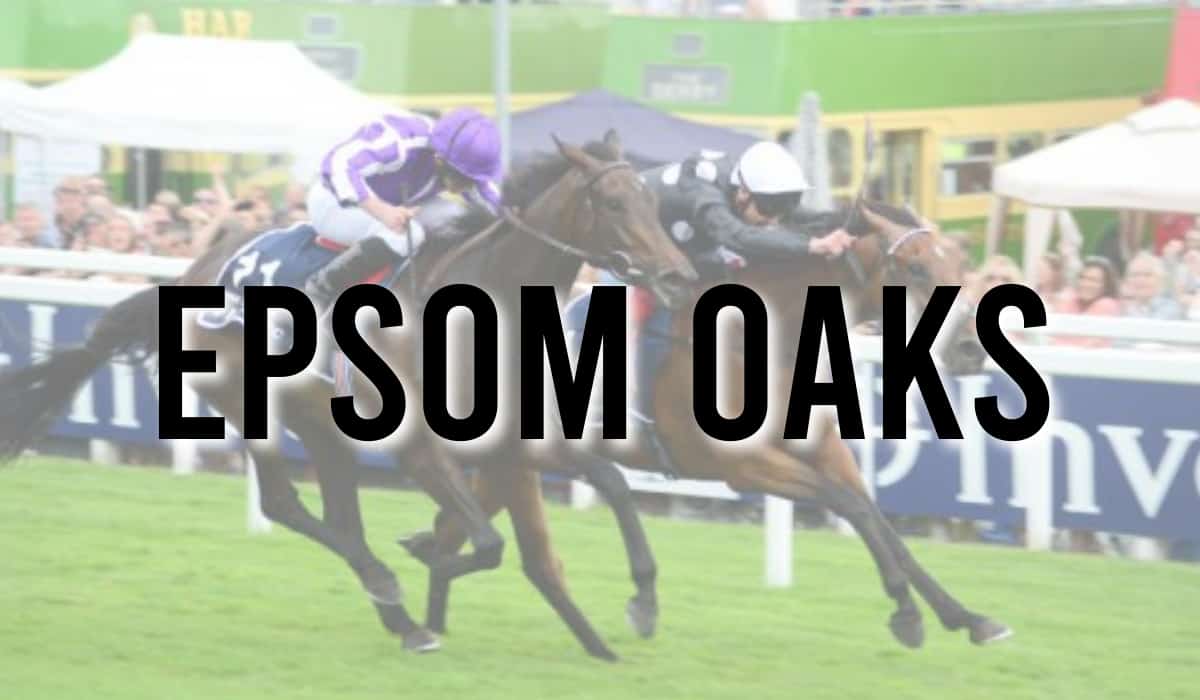
The Epsom Oaks is one of the five British Classics and one of the most important races in the world for three-year-old fillies.
Run over approximately a mile and a half at Epsom Downs Racecourse, the Oaks tests stamina, balance and the ability to cope with one of Britain’s most unusual Flat tracks.
The race was first staged in 1779, making it older than the Derby itself. Winners include Pretty Polly, Petite Etoile, Oh So Sharp, Ouija Board, Enable, Snowfall and Minnie Hauk.
The latest addition to that list is Thundering On, who won the 2026 Oaks for trainer Joseph O’Brien and jockey Dylan Browne McMonagle.
Epsom Oaks 2026 Result
Thundering On won the 2026 Epsom Oaks at Epsom Downs on Friday 5 June.
The Frankel filly was trained by Joseph O’Brien and ridden by Dylan Browne McMonagle.
She started at 5/1 and defeated Legacy Link by 3¾ lengths, with Sugar Island finishing third.
The result was particularly significant for McMonagle, who was riding his first British Classic winner.
Thundering On travelled towards the rear during the early stages before making smooth progress through the field. She moved alongside Legacy Link approaching the final furlong and then pulled clear.
The race was run on good-to-soft ground.
What Is the Epsom Oaks?
The Oaks is a Group 1 Flat race restricted to three-year-old fillies.
It takes place during the two-day Epsom Derby Festival and is traditionally the feature race on the Friday, with the Derby following on Saturday.
The Oaks is one of Britain’s five Classic races alongside the:
- 2000 Guineas
- 1000 Guineas
- Epsom Derby
- St Leger
- Epsom Oaks
The Oaks is the second fillies’ Classic of the season following the 1000 Guineas at Newmarket.
It also forms the middle leg of the Fillies’ Triple Crown.
A filly must win the 1000 Guineas, Oaks and St Leger in the same season to complete that achievement.
Oh So Sharp was the last filly to complete the treble, in 1985.
When Is the Epsom Oaks?
The Oaks takes place during the Epsom Derby Festival in early June.
The 2026 Oaks was run on Friday 5 June, with the Derby following on Saturday 6 June.
This is important because several older British Racecourses pages still contain historic festival dates. Use our Epsom Racecourse guide and current horse racing fixtures coverage when planning a visit.
Where Is the Oaks Run?
The Oaks is run at Epsom Downs in Surrey.
Epsom is one of the most distinctive racecourses in Britain.
The course contains significant gradients, a long downhill section, Tattenham Corner and a cambered home straight.
These features make the Oaks a very different test from a conventional mile-and-a-half race on a flatter, more galloping course.
Our full Epsom Downs Racecourse guide covers the track, fixtures, facilities and visitor information.
How Far Is the Epsom Oaks?
The Oaks is run over approximately one mile and four furlongs.
That makes stamina an important part of the race, particularly because many leading contenders arrive after competing over shorter distances.
A filly coming from the one-mile 1000 Guineas, for example, is being asked to race around half a mile further at Epsom.
Pedigree, previous performances and how the horse finishes its races can all help when assessing whether that extra distance will suit.
Why Is Epsom Such a Difficult Course?
The distance alone does not explain the difficulty of the Oaks.
Epsom places several demands on a young three-year-old filly.
The runners must handle changes in elevation before descending towards Tattenham Corner. They then have to negotiate the turn before meeting the camber in the home straight.
A horse can possess enough stamina for a mile and a half but still struggle to produce its best form at Epsom.
Balance matters.
Positioning matters.
The ability to travel comfortably downhill matters.
A filly also needs enough stamina left to finish after dealing with those earlier demands.
This is why course configuration should form part of your analysis rather than treating every race over the same distance as an identical test.
Our guide to course and distance form explains how previous track and distance evidence can be assessed.
Does Draw Matter in the Epsom Oaks?
Draw analysis at Epsom needs context.
The Oaks is not comparable with a large-field sprint where a strong stall bias can dominate the race.
The field has time to establish positions before reaching the most important stages, and race shape, ability and how efficiently each filly handles the course can matter more than the stall number alone.
Field size also changes the relevance of historical draw data.
A stall that looks advantageous across a small sample can easily reflect the quality of the horses drawn there rather than a persistent structural advantage.
The draw should therefore be considered alongside pace and likely position.
Our horse racing draw guide explains how to separate meaningful draw evidence from misleading raw statistics.
Pace in the Epsom Oaks
Pace can have a major effect on how the Oaks develops.
A steadily run race can place more emphasis on tactical speed and positioning.
A strong early pace can expose fillies with doubts about stamina.
The downhill sections of Epsom add another complication because a horse racing too freely can use valuable energy before reaching the home straight.
Before the race, identify the likely leaders, prominent racers and hold-up horses.
Then consider which runners are most likely to receive the race shape they need.
Our pace maps guide explains how to forecast a race’s likely shape, while our pace bias page looks at how running style can interact with the course.
Does the Going Matter?
Yes.
Ground conditions affect both stamina and how comfortably a filly handles Epsom.
Fast ground can place greater emphasis on balance and speed.
Softer conditions can make the mile-and-a-half trip considerably more demanding.
The 2026 Oaks, for example, was run on good-to-soft ground.
Do not simply look for a previous win with the same official going description.
Examine how the horse travelled, where the race took place, the distance and the strength of opposition.
Our horse racing going guide explains the main going descriptions and how conditions affect races.
Epsom Oaks History
The Oaks was first run in 1779.
Its origins are closely linked to the history of the Derby.
The race took its name from The Oaks, an estate associated with the 12th Earl of Derby near Epsom. The idea for a race for three-year-old fillies emerged from a gathering there.
The inaugural running took place in 1779, with Bridget becoming the first winner.
The Derby followed one year later in 1780.
Both races subsequently became internationally influential, with versions of the Derby and Oaks established in racing jurisdictions around the world.
The Oaks remains one of Britain’s five Classics and one of the defining races of the Flat season.
Famous Epsom Oaks Winners
The Oaks roll of honour contains some exceptional fillies.
Sceptre – 1902
Sceptre won four British Classics during a remarkable three-year-old campaign.
She won the 2000 Guineas and 1000 Guineas before taking the Oaks and later adding the St Leger.
Her Classic record remains one of the outstanding achievements in British racing history.
Pretty Polly – 1904
Pretty Polly completed the Fillies’ Triple Crown by winning the 1000 Guineas, Oaks and St Leger.
She became one of the dominant racehorses of her era and remains an important name in the history of the British Classics.
Petite Etoile – 1959
Petite Etoile arrived at Epsom after winning the 1000 Guineas.
She added the Oaks and remained unbeaten during her three-year-old season.
Her later achievements included consecutive victories in the Coronation Cup at Epsom.
Dunfermline – 1977
Dunfermline won the Oaks for Queen Elizabeth II.
She subsequently won the St Leger at Doncaster, defeating Alleged, who would later become a dual Prix de l’Arc de Triomphe winner.
Sun Princess – 1983
Sun Princess produced one of the outstanding Oaks performances when winning by 12 lengths.
She later won the St Leger and finished second in the Prix de l’Arc de Triomphe.
Oh So Sharp – 1985
Oh So Sharp won the 1000 Guineas before taking the Oaks.
She later won the St Leger to complete the Fillies’ Triple Crown.
No filly has completed the treble since.
Ouija Board – 2004
Ouija Board won the Oaks for owner Lord Derby and trainer Ed Dunlop.
Her career subsequently became international, with major victories including two Breeders’ Cup Filly & Mare Turfs.
Enable – 2017
Enable won the Oaks by five lengths before developing into one of the outstanding racehorses of the modern era.
Her later victories included two Prix de l’Arc de Triomphes, three King George VI and Queen Elizabeth Stakes and the Breeders’ Cup Turf.
Snowfall – 2021
Snowfall produced one of the widest-margin victories in Oaks history when dominating the 2021 renewal.
She subsequently won the Irish Oaks and Yorkshire Oaks.
Minnie Hauk – 2025
Minnie Hauk gave Aidan O’Brien another Oaks success in 2025.
Her victory became the trainer’s eleventh in the race.
Thundering On – 2026
Thundering On became the latest Oaks winner when producing an impressive performance for Joseph O’Brien in 2026.
Ridden by Dylan Browne McMonagle, she beat Legacy Link by 3¾ lengths after travelling powerfully into contention.
She started at 5/1.
Recent Epsom Oaks Winners
| Year | Winner | Jockey | Trainer |
|---|---|---|---|
| 2013 | Talent | Richard Hughes | Ralph Beckett |
| 2014 | Taghrooda | Paul Hanagan | John Gosden |
| 2015 | Qualify | Colm O’Donoghue | Aidan O’Brien |
| 2016 | Minding | Ryan Moore | Aidan O’Brien |
| 2017 | Enable | Frankie Dettori | John Gosden |
| 2018 | Forever Together | Donnacha O’Brien | Aidan O’Brien |
| 2019 | Anapurna | Frankie Dettori | John Gosden |
| 2020 | Love | Ryan Moore | Aidan O’Brien |
| 2021 | Snowfall | Frankie Dettori | Aidan O’Brien |
| 2022 | Tuesday | Ryan Moore | Aidan O’Brien |
| 2023 | Soul Sister | Frankie Dettori | John & Thady Gosden |
| 2024 | Ezeliya | Chris Hayes | Dermot Weld |
| 2025 | Minnie Hauk | Ryan Moore | Aidan O’Brien |
| 2026 | Thundering On | Dylan Browne McMonagle | Joseph O’Brien |
The recent winners show why long-term trends need regular updating.
The old version of this page focused heavily on results up to 2020. Six further renewals have materially changed the recent evidence.
Which Trainers Have the Best Epsom Oaks Record?
Aidan O’Brien has been the dominant modern Oaks trainer.
His winners include:
- Shahtoush – 1998
- Imagine – 2001
- Alexandrova – 2006
- Was – 2012
- Qualify – 2015
- Minding – 2016
- Forever Together – 2018
- Love – 2020
- Snowfall – 2021
- Tuesday – 2022
- Minnie Hauk – 2025
That took O’Brien to 11 Oaks victories.
John Gosden has also had a major influence on the modern race through Taghrooda, Enable and Anapurna, with John and Thady Gosden subsequently winning with Soul Sister in 2023.
The 2026 result added another O’Brien surname to the roll of honour, but this time it was Joseph O’Brien, rather than his father Aidan, who trained the winner.
Trainer records deserve attention, but they should not be used mechanically.
A leading trainer often has multiple Oaks candidates during the spring. The task is still to identify which filly has the ability, stamina and course suitability required for that year’s race.
Which Jockeys Have Strong Oaks Records?
Frank Buckle holds the historic riding record with nine Oaks victories between 1797 and 1823.
Frankie Dettori became one of the most successful modern Oaks jockeys.
His winners included Balanchine, Moonshell, Kazzia, Enable, Anapurna, Snowfall and Soul Sister.
Ryan Moore has also built an outstanding Oaks record, with victories including Was, Minding, Love, Tuesday and Minnie Hauk.
Dylan Browne McMonagle joined the list of winning Oaks jockeys aboard Thundering On in 2026, gaining his first British Classic victory.
Key Epsom Oaks Trials
The Oaks picture develops through several important spring races.
No single trial produces the winner every year, and the best route can change according to the individual filly.
1000 Guineas
The 1000 Guineas is the first fillies’ Classic and an obvious starting point.
It is run over a mile at Newmarket, so an Oaks contender coming from the Guineas needs to prove she can handle a substantial increase in distance.
Minding and Love are modern examples of fillies who won both races.
The Guineas can also identify Oaks contenders that were beaten at Newmarket but shaped as though a longer distance would suit.
Do not judge those horses solely on finishing position.
Look at how they finished the race and whether the mile appeared too sharp.
Musidora Stakes
The Musidora Stakes at York Racecourse is one of the established Oaks trials.
Run over an extended mile and a quarter, it provides more direct evidence about stamina than a one-mile Guineas.
York and Epsom are very different courses, however.
A strong Musidora performance confirms ability and stamina potential but does not prove that the filly will handle Epsom.
Lingfield Oaks Trial
The Lingfield Oaks Trial is particularly interesting because Lingfield provides a more unusual and undulating test than many conventional Flat courses.
Lady Carla, Ramruma and Anapurna are among the fillies to have completed the Lingfield-Epsom double.
A filly handling Lingfield efficiently can provide useful evidence about balance, although Epsom remains a unique challenge.
See our Lingfield Racecourse guide for more on the course.
Pretty Polly Stakes
The Pretty Polly Stakes at Newmarket has also produced Oaks winners.
Ouija Board, Talent and Taghrooda all won the race before succeeding at Epsom.
The race is run over ten furlongs, giving potential Oaks fillies the opportunity to show that they can progress beyond a mile.
Cheshire Oaks
The Cheshire Oaks at Chester Racecourse provides another recognised route.
Chester’s tight turns and unusual configuration make it a useful test of balance, although its characteristics differ significantly from Epsom.
When assessing any Oaks trial, concentrate on the performance rather than simply asking whether the filly won.
A beaten horse can produce the stronger Oaks trial if the race shape, ground or distance worked against her.
How Important Is the 1000 Guineas?
The 1000 Guineas matters because it establishes the early Classic hierarchy among the leading three-year-old fillies.
It does not automatically identify the best Oaks horse.
The races test different attributes.
The Guineas is run over a straight mile at Newmarket.
The Oaks is approximately a mile and a half around Epsom.
A filly with enough speed to excel at Newmarket may not stay the Oaks distance.
Another may lack the speed to win the Guineas but improve significantly when stepped up in trip.
This is why pedigree and race shape matter when interpreting Guineas form.
How Important Is Pedigree for the Oaks?
Pedigree becomes particularly relevant when a filly has never raced over anything close to the Oaks distance.
Most three-year-olds arrive at Epsom with limited evidence over a mile and a half.
Breeding can provide clues about whether the extra distance is likely to suit.
Look at the sire, dam and close relatives, but avoid reducing pedigree analysis to a simple label.
A sire associated with stamina does not guarantee that every offspring will stay.
The filly’s own racing style, physical development and previous performances provide equally important evidence.
Does Previous Course Form Matter?
Most Oaks runners will not have raced at Epsom before.
That makes direct course form less useful than it is in races for older horses.
Instead, look for evidence that the filly can handle the attributes Epsom demands.
Has she raced effectively on an undulating track?
Does she change leads smoothly?
Can she settle when racing downhill?
Has she shown enough tactical speed to hold a position?
Does she stay balanced under pressure?
These clues can be more useful than simply searching for previous Epsom experience.
Epsom Oaks Betting Trends
Historical trends can help describe the type of horse that has won the Oaks.
They should not become rigid betting rules.
The old version of this page stated that favourites had struggled because only two favourites won between 2010 and 2020.
That sample is now outdated.
More recent renewals need to be included before drawing conclusions about the performance of market leaders.
The race has produced both strongly fancied winners and major upsets.
Qualify famously won at 50/1 in 2015.
Look Here had previously won at 33/1 in 2008.
At the other end of the market, outstanding fillies such as Minding, Love and Snowfall started at much shorter prices.
The lesson is not that favourites should be backed or opposed.
Price must be judged against the chance of winning.
What Should You Look for When Analysing the Oaks?
The strongest Oaks analysis combines several factors.
- Ability: Has the filly already produced form good enough to compete at Group 1 level?
- Stamina: Is there evidence from form or pedigree that she will stay approximately a mile and a half?
- Balance: Has she shown the ability to handle turns, gradients or undulating courses?
- Going: Do her best performances support today’s ground conditions?
- Pace: Is the expected race shape likely to suit her running style?
- Trial Form: What did she actually achieve in her preparation race?
- Form Lines: How has the form worked out through horses she has already faced?
- Improvement: Is she still progressing rapidly enough to improve on her known rating?
- Price: Are the available odds bigger or shorter than her chance appears to justify?
Our horse race analysis guide explains how to combine these factors without allowing one statistic to dominate the decision.
Official Ratings and the Oaks
Official Ratings provide a useful reference point when comparing runners, but the Oaks is a race for developing three-year-olds.
A filly can improve significantly between her spring trial and Epsom.
Another may have achieved a high rating over a mile but fail to reproduce that level when asked to race over a mile and a half.
Use ratings as evidence of what a horse has already achieved rather than a fixed ceiling on what she can achieve next.
Our horse racing handicap ratings guide explains how Official Ratings work.
Reading Oaks Form
Finishing position alone rarely tells the full story.
A filly finishing third in a trial may have encountered traffic, raced against an unsuitable pace or shaped strongly over a distance short of her optimum.
Another may win a weak trial after receiving an ideal trip.
Look beyond the number beside the horse’s name.
Check:
- Race Class
- Opposition
- Winning or Beaten Distance
- Race Pace
- Going
- Distance
- Position in Running
- How Strongly the Horse Finished
Our horse racing form guide explains the basic form figures and abbreviations, while form lines can help compare performances through common opponents.
Speed Ratings and the Oaks
Speed ratings can help identify performances that were stronger than the bare finishing position suggests.
They are particularly useful when comparing horses arriving through different trials.
Do not simply back the horse with the highest figure.
A speed rating needs to be interpreted alongside distance, ground, pace and the horse’s stage of development.
A figure achieved over a mile on fast ground may not transfer directly to a mile and a half around Epsom.
Our horse racing speed ratings page explains how time-based ratings should be used.
Sectional Times
Sectional times can reveal how a trial was run.
A filly that finishes quickly after a slowly run race may have shown considerable speed without answering the stamina question.
A horse that sustains a strong gallop over a longer distance may provide more convincing evidence for Epsom.
Sectionals can also help explain apparently disappointing performances.
Our sectional times guide explains how individual race segments can improve form analysis.
Should You Follow Market Movers in the Oaks?
Market movement deserves attention but should not replace analysis.
A filly shortening sharply before the Oaks may be attracting significant support.
That tells you the market has changed.
It does not tell you that the new price is still attractive.
A horse backed from 10/1 into 5/1 has become considerably shorter.
Someone who backed at 10/1 has obtained a much stronger price than someone considering the same horse at 5/1.
Our Starting Price guide explains shortening, drifting and beating SP, while Closing Line Value looks at comparing the price taken with the later market.
Finding Value in the Oaks
Finding the winner and finding a good bet are different problems.
You may believe the favourite is the most likely winner but still consider the price too short.
Another filly may have a lower chance of winning but be available at odds greater than your own assessment suggests.
This is the basis of value betting.
Suppose you believe a filly has a 20% chance of winning.
That equates to fair odds of 4/1.
If the market offers 7/1, your assessment suggests value.
If the market offers 2/1, it does not.
Your probability estimate may still be wrong, but this approach forces the betting decision to consider price rather than simply trying to identify the most likely winner.
See our guides to finding value bets and pricing a horse race for the full process.
Each-Way Betting on the Oaks
Do not assume the Oaks is automatically a strong each-way race because it has produced big-priced winners.
Each-way value depends on:
- Number of Runners
- Places Offered
- Place Fraction
- Win Price
- Your Estimate of the Horse’s Place Chance
The Oaks does not always attract a large field, so standard place terms can be less generous than those available in major handicaps.
Some bookmakers may offer additional places, but the headline number of places should still be compared with the price and place fraction.
Our each-way betting and each-way value guides explain the calculation.
Ante-Post Betting on the Oaks
Oaks markets are available well before final declarations.
Ante-post prices can be attractive if you identify a leading contender before the wider market does.
They also carry additional risk.
Under traditional ante-post rules, your stake can be lost if the horse does not run.
This matters particularly with three-year-old fillies because plans can change quickly after spring trials.
A filly may fail to stay in a trial, encounter a setback or be redirected towards another race.
Non-Runner No Bet terms can remove some of that risk when they become available, although the prices may differ from earlier ante-post markets.
Our ante-post betting guide explains the distinction.
Comparing Oaks Betting Odds
Prices can differ between bookmakers.
If you have decided that a horse represents a bet, compare the available odds rather than automatically using the same bookmaker.
The difference between 5/1 and 6/1 looks small but has a meaningful effect on long-term returns.
Best Odds Guaranteed can also matter for eligible bets placed under qualifying terms.
Our horse racing betting sites comparison focuses specifically on bookmakers from a racing perspective, while our horse racing betting apps page covers the mobile experience.
Best Odds Guaranteed and the Oaks
Best Odds Guaranteed can be useful in a race where the market changes significantly before the off.
Suppose you take 6/1 about an Oaks runner.
The horse wins at 9/1 SP.
If your bet qualifies for BOG under the bookmaker’s terms, it may be settled at the bigger 9/1 Starting Price.
If the horse instead shortens to 7/2, you retain the qualifying 6/1 price originally taken.
BOG terms vary between bookmakers and can depend on when the bet was placed.
Our Best Odds Guaranteed page covers the feature in more detail.
Epsom Oaks and the Fillies’ Triple Crown
The Oaks is the middle leg of the Fillies’ Triple Crown.
The three races are:
- 1000 Guineas at Newmarket
- Oaks at Epsom
- St Leger at Doncaster
The challenge comes from the different distances and course demands.
The 1000 Guineas requires enough speed for a straight mile.
The Oaks extends the test to around a mile and a half at Epsom.
The St Leger at Doncaster requires still greater stamina later in the season.
Oh So Sharp in 1985 remains the most recent filly to win all three.
Oaks vs Derby
The Oaks and Epsom Derby are run over the same famous Epsom course and approximately the same mile-and-a-half distance.
The key difference is eligibility.
The Oaks is restricted to three-year-old fillies.
The Derby is open to three-year-old colts and fillies, although fillies rarely contest it in the modern era.
The Oaks takes place on Friday and the Derby follows on Saturday during the Derby Festival.
Together they form the centrepiece of Epsom’s racing season.
Epsom Oaks FAQs
What is the Epsom Oaks?
The Epsom Oaks is a Group 1 Flat race for three-year-old fillies. It is one of the five British Classics and is run over approximately one mile and four furlongs at Epsom Downs.
Who won the 2026 Epsom Oaks?
Thundering On won the 2026 Epsom Oaks for trainer Joseph O’Brien and jockey Dylan Browne McMonagle. She started at 5/1 and beat Legacy Link by 3¾ lengths.
Who won the 2025 Epsom Oaks?
Minnie Hauk won the 2025 Oaks for trainer Aidan O’Brien and jockey Ryan Moore.
When was the first Epsom Oaks?
The first Oaks was run in 1779, one year before the inaugural Derby.
Who won the first Epsom Oaks?
Bridget won the inaugural Oaks in 1779.
Why is the race called the Oaks?
The race takes its name from The Oaks, an estate near Epsom associated with the 12th Earl of Derby. The idea for the race developed from a gathering at the estate.
How far is the Oaks?
The Oaks is run over approximately one mile and four furlongs at Epsom Downs.
What age horses can run in the Oaks?
The Oaks is restricted to three-year-old fillies.
Is the Oaks a Classic?
Yes. The Oaks is one of the five British Classics alongside the 1000 Guineas, 2000 Guineas, Derby and St Leger.
What is the Fillies’ Triple Crown?
The Fillies’ Triple Crown consists of the 1000 Guineas, Oaks and St Leger. A filly must win all three in the same season to complete the Triple Crown.
Who was the last Fillies’ Triple Crown winner?
Oh So Sharp completed the Fillies’ Triple Crown in 1985.
Which trainer has won the most Epsom Oaks?
Robert Robson holds the historic training record with 13 Oaks victories. Aidan O’Brien has become the dominant modern trainer and reached 11 victories with Minnie Hauk in 2025.
How many Oaks has Aidan O’Brien won?
Aidan O’Brien has trained 11 Epsom Oaks winners, from Shahtoush in 1998 through to Minnie Hauk in 2025.
Who won the Oaks by 12 lengths?
Sun Princess won the 1983 Oaks by 12 lengths.
Did Enable win the Oaks?
Yes. Enable won the Oaks in 2017 before going on to win major races including two Prix de l’Arc de Triomphes and three King George VI and Queen Elizabeth Stakes.
Did Snowfall win the Oaks?
Yes. Snowfall won the 2021 Oaks by a huge margin before adding the Irish Oaks and Yorkshire Oaks.
Is the Oaks run before the Derby?
Yes. The Oaks is the feature race on Friday at the Derby Festival. The Derby takes place on Saturday.
Does the draw matter in the Oaks?
The draw can form part of the analysis, but it should not be treated in isolation. Field size, pace, positioning and the quality of horses occupying particular stalls can all affect historical draw statistics.
What are the main Oaks trials?
Important routes include the 1000 Guineas, Musidora Stakes, Lingfield Oaks Trial, Pretty Polly Stakes and Cheshire Oaks.
Can you bet ante-post on the Oaks?
Yes. Ante-post markets can open well before the race. Traditional ante-post bets normally lose if the selected horse does not run, unless qualifying Non-Runner No Bet terms apply.
Where can I find Epsom racecards?
Use our today’s racecards section when racing is taking place. Racecards provide runners, form, weights, jockeys, trainers and other information needed for race analysis.
Summary
The Epsom Oaks has been a central part of British Flat racing since 1779.
It is one of the five Classics, the middle leg of the Fillies’ Triple Crown and one of the defining tests for a three-year-old filly.
Epsom makes the race particularly demanding.
A contender needs the class to compete at Group 1 level, enough stamina for approximately a mile and a half and the balance to negotiate the gradients, Tattenham Corner and cambered home straight.
The latest winner is Thundering On, who took the 2026 Oaks at 5/1 for Joseph O’Brien and Dylan Browne McMonagle.
She joins a roll of honour containing some of racing’s outstanding fillies, including Pretty Polly, Petite Etoile, Oh So Sharp, Ouija Board, Enable and Snowfall.
For visitors, our Epsom Downs Racecourse and Derby Festival pages cover the wider meeting.
For bettors, start with the race itself. Assess form, stamina, course suitability, ground, pace and the quality of the trials before comparing your view with the available price.