
The Grand National has 16 physical fences, with horses jumping 30 obstacles over two circuits of Aintree’s Grand National course. Fourteen fences are jumped twice. The Chair and the Water Jump are jumped only on the first circuit.
The race covers approximately four miles and two and a half furlongs, with a maximum field of 34 runners. Its spruce-covered fences, long distance and changing race conditions make it a demanding test of jumping, stamina and race management.
Becher’s Brook, the Canal Turn, Valentine’s Brook, Foinavon and The Chair are among the best-known obstacles in British horse racing. Each presents a different challenge, from changes in ground level to sharp turns and wide open ditches.
This Grand National course guide explains the fences in jumping order, their dimensions, their history and what they demand from horses and jockeys.
Grand National Course Video
Keep the existing Grand National course flyover video here.
Our Grand National course video follows the route around Aintree and shows where the named fences appear during the two circuits.
The first circuit contains 16 jumps, ending with The Chair and the Water Jump. The second circuit follows the first 14 fences again before the runners turn towards the finish.
The video is particularly useful for understanding the Canal Turn, the position of Becher’s Brook and the long run from the final fence to the winning post.
Grand National Course Facts
| Course Feature | Grand National Details |
|---|---|
| Racecourse | Aintree, Liverpool |
| Race type | Handicap steeplechase |
| Distance | Approximately 4m 2½f |
| Maximum runners | 34 |
| Physical fences | 16 |
| Total jumps | 30 |
| Fences jumped twice | 14 |
| Fences jumped once | The Chair and Water Jump |
| Tallest fence | The Chair, 5ft 2in |
| Final jump | Fence 30 |
| Famous named fences | Westhead, Becher’s Brook, Foinavon, Canal Turn, Valentine’s Brook, Booth and The Chair |
The Grand National course is different from Aintree’s Mildmay course, which is used for other races at the meeting.
The Grand National fences are constructed with spruce and have distinctive dimensions and approaches. Horses with experience of conventional steeplechase fences do not necessarily have experience of these obstacles.
Grand National Fence Names and Jumping Order
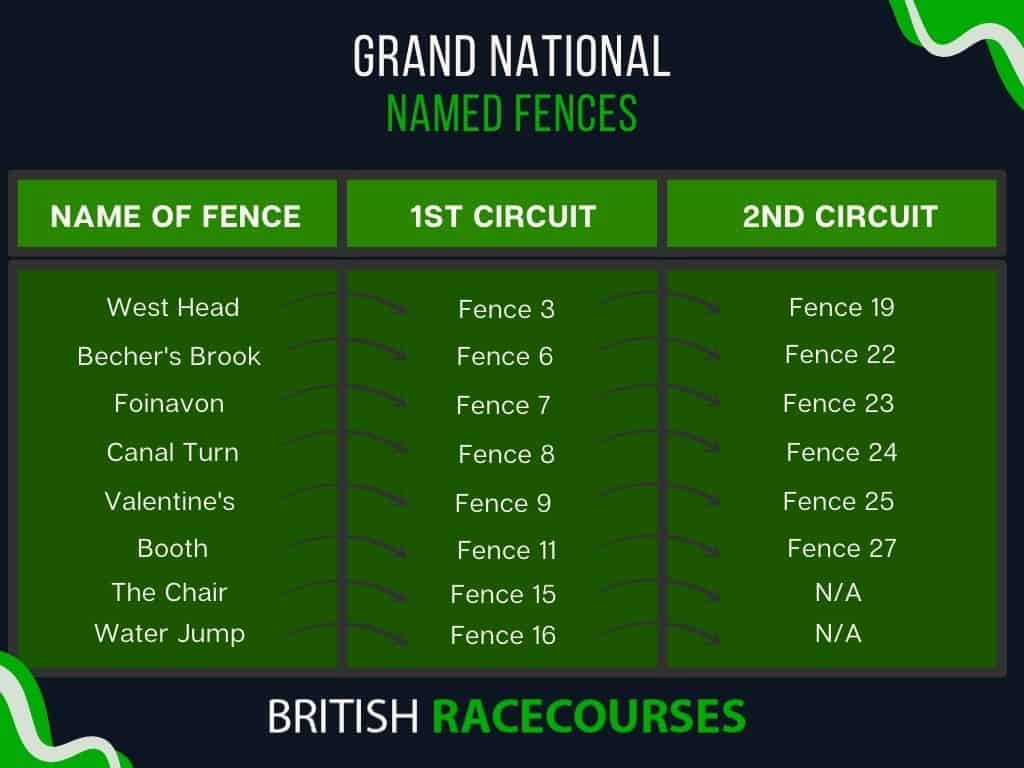
The named fences appear at the following points in the race.
| Fence Name | First Circuit | Second Circuit |
|---|---|---|
| Westhead | 3 | 19 |
| Becher’s Brook | 6 | 22 |
| Foinavon | 7 | 23 |
| Canal Turn | 8 | 24 |
| Valentine’s Brook | 9 | 25 |
| Booth | 12 | 28 |
| The Chair | 15 | Not jumped |
| Water Jump | 16 | Not jumped |
The first 14 fences are jumped on both circuits. The Chair and Water Jump complete the first circuit but are omitted on the second.
All 30 Grand National Fences Explained
The fence numbers below follow the order in which runners encounter the obstacles. Heights are the published course dimensions; the experience of jumping a fence also depends on its width, approach, landing area and the horse’s position in the field.
Fence 1 and Fence 17: The First Fence
Height: 4ft 6in
The first fence is one of the smaller obstacles on the course, but its position makes it important.
A large field approaches it after the run from the start. Jockeys need to establish a rhythm, find space and avoid using too much energy in the opening stages.
A horse that races too keenly can reach the first fence travelling faster than its rider wants. Another may become unsettled by horses jumping close to it.
The first fence is jumped again as fence 17, when the field is generally more spread out and the horses have already completed one circuit.
The physical obstacle is the same, but the racing situation is very different.
Fence 2 and Fence 18
Height: 4ft 7in
The second fence is slightly taller and wider than the first.
It gives jockeys another opportunity to establish their horse’s jumping rhythm before the first open ditch.
A horse that has jumped the first awkwardly needs to recover its balance quickly. Conversely, a horse travelling comfortably can settle into the race without being asked to make an unnecessary effort.
Fence 3 and Fence 19: Westhead
Height: 5ft
Westhead is the first open ditch on the course.
An open ditch has a ditch on the take-off side, requiring the horse to cover additional ground before clearing the fence.
Westhead is named after Steve Westhead, who worked on Aintree’s fences during the 1970s.
The obstacle demands a different jumping effort from the first two fences. Horses must judge both the ditch and the fence rather than concentrating on the height alone.
On the second circuit, Westhead becomes fence 19. By then, jumping accuracy can be affected by fatigue, the pace of the race and how much ground a horse has covered.
Fence 4 and Fence 20
Height: 4ft 10in
The fourth fence is a plain fence.
Its landing area has been modified as part of changes to the Grand National course.
The obstacle follows Westhead, so horses need to regain their rhythm after the open ditch.
On the second circuit, the same fence is numbered 20.
Fence 5 and Fence 21
Height: 5ft
Fence five is a substantial plain fence.
Its landing side was levelled in 2013 as part of course modifications.
The fence comes immediately before Becher’s Brook, making it an important point for jockeys to assess their position and prepare for the next obstacle.
A horse that makes a mistake here can arrive at Becher’s without the rhythm its rider would prefer.
Fence 6 and Fence 22: Becher’s Brook
Height: 4ft 10in
Becher’s Brook is the most recognisable Grand National fence.
Its defining feature is the difference between the take-off and landing sides. The landing area has been remodelled over time, but the fence still requires horses to cope with a change in ground level.
The fence is named after Captain Martin Becher, who was unseated from Conrad during the 1839 Grand National and ended up in the brook.
Becher’s is jumped as fence six on the first circuit and fence 22 on the second.
Its position matters. On the first circuit, horses can approach in a relatively compact field. On the second, they have already covered a considerable distance and may be feeling the effects of the race.
Jockeys need their horses to remain balanced on landing. A horse that jumps too steeply or loses its rhythm can struggle with the change in ground level.
The obstacle has been modified repeatedly, including changes to its landing area. Its present form should not be confused with the fence shown in historical footage.
Fence 7 and Fence 23: Foinavon
Height: 4ft 6in
Foinavon is one of the smaller fences on the Grand National course.
Its reputation comes from the 1967 Grand National, when a major incident at the fence disrupted much of the field on the second circuit.
Foinavon avoided the trouble and went on to win at 100/1.
The fence was subsequently named after the horse.
Foinavon illustrates an important feature of the Grand National: the challenge is not determined by fence height alone.
A horse can jump accurately but still be affected by another runner stopping, falling or changing direction in front of it.
Foinavon is fence seven on the first circuit and fence 23 on the second.
Fence 8 and Fence 24: Canal Turn
Height: 5ft
The Canal Turn combines a substantial fence with a sharp left-hand turn immediately after landing.
It takes its name from the nearby Leeds and Liverpool Canal.
The turn is close to 90 degrees, making the approach and landing particularly important.
Jockeys need to position their horses so they can jump safely and negotiate the change of direction without losing balance or momentum.
A horse racing wide may cover additional ground. A horse trying to take a tighter line needs sufficient room and a clear approach.
The Canal Turn is jumped as fence eight and again as fence 24.
The second visit can be especially significant because the field has already travelled a long way and the pace may be increasing as runners move towards the closing stages.
Fence 9 and Fence 25: Valentine’s Brook
Height: 5ft
Valentine’s Brook has a brook on the landing side.
The fence was originally known as Second Brook and is associated with a horse called Valentine, which was said to have jumped it hind legs first in the 1840 Grand National.
Valentine’s is encountered immediately after the Canal Turn.
Horses therefore need to regain their jumping rhythm after negotiating the sharp change of direction.
It is jumped as fence nine and fence 25.
The combination of the Canal Turn and Valentine’s Brook is a distinctive section of the course, demanding balance, accurate jumping and the ability to settle quickly between obstacles.
Fence 10 and Fence 26
Height: 5ft
Fence ten is a plain fence.
Although it lacks a famous name, it remains a substantial obstacle and comes after a demanding sequence involving Becher’s Brook, Foinavon, the Canal Turn and Valentine’s Brook.
Jockeys need to keep their horses organised rather than treating an unnamed fence as an opportunity to relax.
On the second circuit, this becomes fence 26.
Fence 11 and Fence 27: Open Ditch
Height: 5ft
Fence 11 is another open ditch.
The ditch on the take-off side increases the distance a horse must cover, making it a different jumping test from a plain fence of the same height.
The fence is also associated with Golden Miller, the 1934 Grand National winner, who came to grief here in the 1935 race.
Golden Miller remains a notable figure in racing history because he won the Cheltenham Gold Cup and Grand National in the same season in 1934.
The open ditch is jumped again as fence 27.
Fence 12 and Fence 28: Booth
Height: 5ft
Booth is named after John Booth, who worked on Aintree’s course maintenance team.
It has a ditch on the landing side.
The fence is numbered 12 on the first circuit and 28 on the second.
The distinction between Booth and the preceding open ditch is important. The open ditch at fence 11 has its ditch before the obstacle; Booth has its ditch on the landing side.
Horses therefore face different jumping and landing demands at consecutive fences.
On the second circuit, Booth is one of the final three obstacles.
Fence 13 and Fence 29
Height: 4ft 7in
Fence 13 is a plain fence.
Its landing area was smoothed ahead of the 2013 Grand National.
On the second circuit, it becomes the penultimate fence.
At fence 29, the race is approaching its decisive stages. Horses that have travelled comfortably still need to jump accurately, while those under pressure must maintain enough energy to complete the course.
A mistake here can cost ground at a point when there is little time to recover.
Fence 14 and Fence 30: The Final Fence
Height: 4ft 6in
Fence 14 is a relatively small plain fence.
On the first circuit, it precedes The Chair and the Water Jump.
On the second circuit, it becomes fence 30, the final obstacle in the Grand National.
Clearing the final fence does not mean the race is over. The runners still face the long run towards the winning post, including the famous Elbow.
A horse can jump the final fence in front and still be caught on the run-in.
Jockeys must judge how much effort their horses have left after the demanding trip.
Fence 15: The Chair
Height: 5ft 2in
The Chair is the tallest fence in the Grand National.
It has a wide ditch on the take-off side and a raised landing area, creating a substantial jumping test.
The fence is jumped only on the first circuit.
Its name comes from the chair used by the distance judge, who assessed the distance between the winner and other runners.
The original chair is now displayed at Aintree.
The Chair requires a horse to cover both the ditch and the fence while maintaining enough balance for the raised landing side.
Its height and spread make it one of the most distinctive obstacles on the course.
Fence 16: The Water Jump
Height: 2ft 6in
The Water Jump is the lowest obstacle on the Grand National course.
Its challenge comes from the water on the landing side and the distance the horse needs to cover.
It is the final jump of the first circuit and is not jumped again.
The Water Jump was introduced in the nineteenth century, replacing an earlier stone wall.
After clearing it, runners continue onto the second circuit and return to the first fence, which becomes fence 17.
Grand National Course Map
Keep the existing Grand National course map here.
The course has 16 physical fences arranged around the Grand National circuit.
Horses jump all 16 on the first circuit. On the second, they jump fences one to 14 again, giving 30 jumps in total.
The Chair and Water Jump are omitted on the second circuit.
The route also includes the sharp turn at the Canal Turn and the long run-in after the final fence.
A course map is useful when assessing the race because it shows how the fences are grouped. Becher’s Brook, Foinavon, the Canal Turn and Valentine’s Brook follow one another, while The Chair and Water Jump complete the first circuit.
Which Are the Most Famous Grand National Fences?
Several obstacles have become part of the race’s history because of their dimensions, position or association with memorable events.
Becher’s Brook
Becher’s Brook is named after Captain Martin Becher and is known for its landing-side drop.
It has been remodelled over time, including changes to the landing area.
The Canal Turn
The Canal Turn requires horses to jump a substantial fence and then negotiate a sharp left-hand turn.
Its position makes race tactics and available space particularly important.
The Chair
The Chair is the tallest fence in the race at 5ft 2in.
Its open ditch and raised landing side create a different challenge from the other named obstacles.
Foinavon
Foinavon takes its name from the 100/1 winner of the 1967 Grand National.
The horse avoided a major incident at the fence on the second circuit before going on to win.
Valentine’s Brook
Valentine’s Brook is associated with a horse said to have jumped the obstacle hind legs first in 1840.
Its landing-side brook makes it distinctive.
What Are Grand National Fences Made Of?
The Grand National fences are constructed using Sitka or Norway spruce brought from the Lake District.
The spruce is woven into a flexible structure rather than forming a completely rigid obstacle.
Aintree’s groundstaff prepare the fences ahead of the Grand National Festival, with construction taking several weeks.
Earlier versions of the course used natural thorn hedges, which gave rise to the description of the old obstacles as thorn fences.
The construction has changed considerably since those early races.
Modern fence design is intended to retain the distinctive Grand National jumping test while allowing more flexibility when a horse makes contact with an obstacle.
Have the Grand National Fences Become Smaller?
The Grand National fences and their landing areas have been modified over time.
Changes have included adjustments to Becher’s Brook, levelling and smoothing landing areas, and alterations to fence construction.
It would be misleading to say that every fence has simply become smaller.
The course has changed in several ways, and the challenge of a fence depends on more than its published height.
The approach, width, landing area, ground conditions and position within the race all affect the jumping test.
Why Are the Grand National Fences Different From Ordinary Chase Fences?
Grand National fences have distinctive construction, dimensions and approaches.
They are also encountered during a race over an unusually long distance, often with a large field.
The combination creates demands that are not identical to those of a conventional steeplechase.
A horse can be an accomplished jumper over ordinary fences but still lack experience of the Grand National course.
That is why previous runs over the National fences can be useful when assessing a horse’s suitability.
However, course experience is only one factor. A horse must also have the stamina, jumping ability and race conditions to perform well.
Which Grand National Fence Is the Hardest?
There is no single fence that is necessarily the hardest for every horse.
The Chair is the tallest and has a substantial ditch.
Becher’s Brook requires horses to handle a change in ground level on landing.
The Canal Turn combines a fence with a sharp change of direction.
The first fence can also present difficulties because of the size and speed of the field approaching it.
The challenge changes as the race develops. A fence that a horse jumps comfortably on the first circuit can become harder on the second if it is tiring.
For a separate look at historical incidents and non-finishers, see our Grand National fallers page.
How the Grand National Fences Affect Betting Analysis
A horse’s chance in the Grand National depends on more than its handicap mark or recent finishing position.
The course places a premium on jumping accurately over a long distance.
When assessing the runners, consider the horse’s jumping record, experience in large fields, stamina and previous performances over the National fences.
Jumping Record
Look beyond the number of times a horse has fallen.
A horse can complete races while repeatedly losing ground through untidy jumping.
Watch how it approaches fences, whether it adjusts its stride and how quickly it regains momentum after landing.
Grand National Course Experience
A previous run over the National fences can provide useful evidence.
The Becher Chase and Grand Sefton Chase are among the races that give horses experience of the course.
A horse that has jumped the fences successfully still needs to prove it can reproduce that performance under the Grand National’s different distance, pace and field conditions.
Stamina
The Grand National is a long-distance test.
A horse can jump well for most of the race and still struggle over the final fences if its stamina runs out.
Consider its previous performances over extended distances and how strongly it finished.
Handicap Weight
The Grand National is a handicap, so the weight each horse carries matters.
Weight should be considered alongside ability, stamina, jumping and the likely race conditions rather than used as a reason to dismiss a horse automatically.
Our handicap ratings explanation covers how the system works.
Ground Conditions
The going can change the effort required to complete the trip.
A horse that stays well on good ground may face a different stamina test on soft or heavy going.
Review the official conditions and the horse’s previous performances on similar ground.
Our going guide explains the different descriptions.
Race Position
The Grand National is not simply a race in which every horse follows the same route at the same speed.
Jockeys must find room, conserve energy and decide when to improve their position.
A horse racing too keenly early can use energy it needs later. A horse held too far back can encounter traffic or be forced to make up substantial ground.
The best position depends on the individual horse and how the race develops.
Grand National Fences FAQs
How many fences are in the Grand National?
There are 16 physical fences on the Grand National course. Fourteen are jumped twice, giving 30 jumps during the race.
How many fences does the winner jump?
A horse completing the full Grand National course jumps 30 fences.
Which Grand National fences are jumped only once?
The Chair and Water Jump are jumped only on the first circuit.
How many Grand National fences are jumped twice?
Fourteen fences are jumped twice.
What is the tallest Grand National fence?
The Chair is the tallest at 5ft 2in.
What is the smallest Grand National fence?
The Water Jump is the lowest at 2ft 6in.
What number is Becher’s Brook?
Becher’s Brook is fence six on the first circuit and fence 22 on the second.
What number is the Canal Turn?
The Canal Turn is fence eight and fence 24.
What number is Foinavon?
Foinavon is fence seven and fence 23.
What number is The Chair?
The Chair is fence 15 and is jumped only once.
What is the final Grand National fence?
Fence 30 is the final obstacle. It is the same physical fence as fence 14 on the first circuit.
How long is the run-in after the final fence?
The Grand National has a long run-in of approximately 494 yards, including the Elbow, before the winning post.
What is an open ditch?
An open ditch has a ditch on the take-off side of the fence, requiring the horse to cover additional ground as it jumps.
What are the Grand National fences made from?
The fences use Sitka or Norway spruce woven into a flexible structure.
Why is Becher’s Brook famous?
It is named after Captain Martin Becher, who was unseated at the obstacle during the 1839 Grand National. Its landing-side drop is a distinctive feature.
Why is Foinavon named after a horse?
Foinavon won the 1967 Grand National at 100/1 after avoiding a major incident at the fence that now bears its name.
How many horses can run in the Grand National?
The maximum field is 34 runners, although the final number can be lower if horses are withdrawn.
Where can I find the Grand National runners?
Our Grand National runners and riders page covers the declared field.
Summary
The Grand National has 16 physical fences and 30 jumps across two circuits of Aintree’s Grand National course.
Fourteen fences are jumped twice. The Chair and Water Jump appear only on the first circuit.
Becher’s Brook, Foinavon, the Canal Turn, Valentine’s Brook and The Chair are the best-known obstacles, but every fence matters over a race of approximately four miles and two and a half furlongs.
A horse needs accurate jumping, stamina and the ability to cope with the race’s changing demands. Previous experience over the National fences can help when assessing the runners, but it should be considered alongside the horse’s overall form, handicap mark and suitability for the ground.
For further race analysis, see our Grand National betting tips and Grand National each-way places pages.
Related 2026 Grand National Betting Articles
Here are all the related articles to the Randox Grand National 2026.
-

Aintree Racecourse Guide
-
How Many Places Pay Out in the Grand National?
-
Mersey Novices’ Hurdle
-
Maghull Novices’ Chase
-
Top Novices’ Hurdle
-
Manifesto Novices’ Chase: Aintree Grade 1 Race Guide, Winners & Trends
-
Nickel Coin Mares’ Standard Open NH Flat Race
-
Red Rum Handicap Chase
-
Anniversary 4-Y-O Novices’ Hurdle
-
Topham Chase
-
Liverpool Hurdle
-
Ladies Days At The Races
-
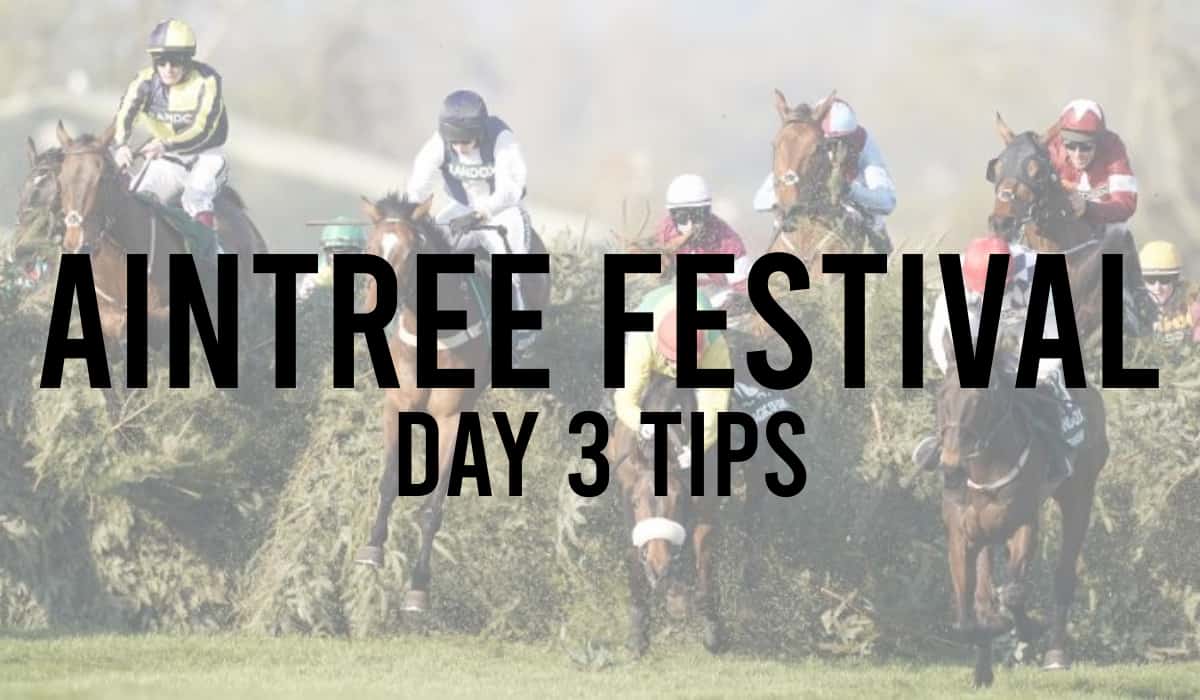
Aintree Festival Day 3 Tips
-
Aintree Festival Day 2 Tips
-
Aintree Festival Day 1 Tips
-
Aintree Festival
-
Aintree Foxhunters Chase
-
Sefton Novices Hurdle
-
Mildmay Novices Chase
-
Melling Chase: Aintree Grade 1 Race Guide, Winners & Trends
-
Aintree Hurdle
-
Grey Horses in the Grand National
-
Grand National Dark Horses
-
Grand National Betting Odds 2027: Compare Prices and Each-Way Terms
-
Watch the Grand National Live
-
Grand National Favourites 2027: Betting Market and Previous Winners
-
Grand National Start Time
-
Bet On Grand National Online
-
Grand National Facts
-
Grand National Runners and Riders 2027: Entries, Horses and Confirmed Field
-
Grand National Fallers: 2026 Results, Non-Finishers and Historical Statistics
-
Grand National Fences: Complete Guide to All 30 Jumps at Aintree
-
Grand National Tips 2027: Ante-Post Analysis, Form and Betting Guide
-
Grand National Weights 2027: Handicap Weights, Entries and How They Work
-
Grand National Tickets
-
Grand National Prize Money
-
Grand National Previous Winners: Full Results, Horses, Jockeys and Trainers
-
Grand National Betting Offers 2027: Free Bets, Extra Places and Promotions
-
Grand National 2027

















If you do choose to bet, please bet responsibly.












