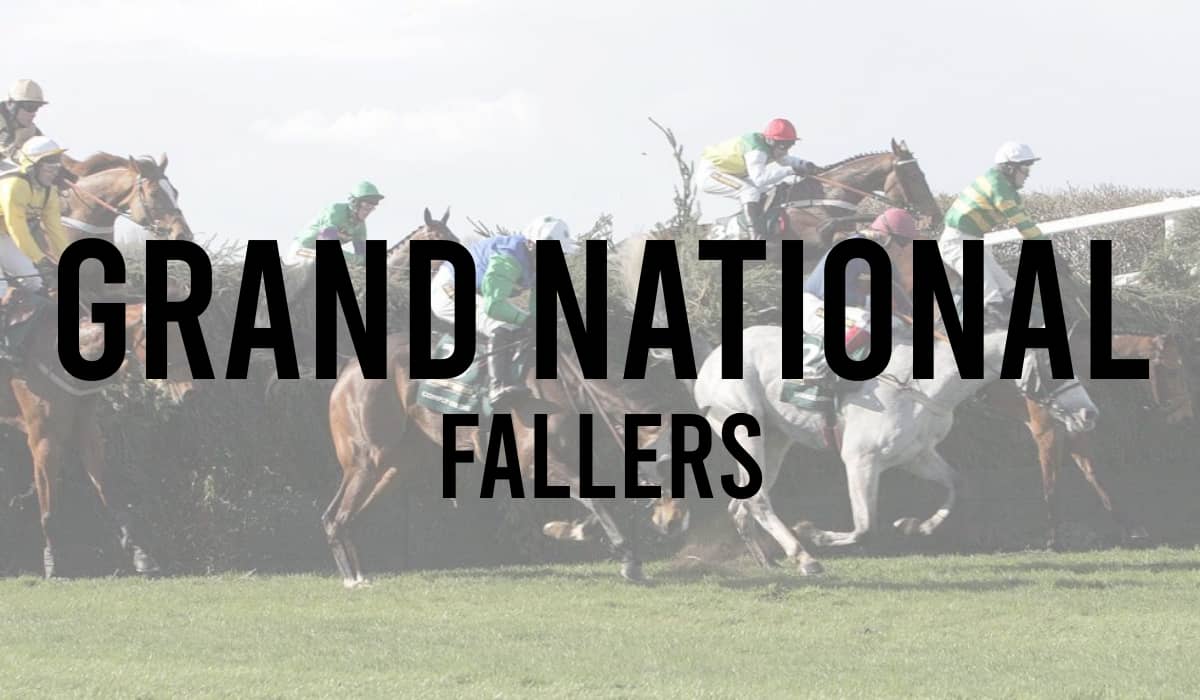
Seven horses fell in the 2026 Grand National. Another seven unseated their riders and four were pulled up, leaving 16 finishers from the 34 runners.
Falling is only one reason a horse may fail to finish the Grand National. A horse can also unseat its rider, be brought down, refuse, run out or be pulled up. These outcomes have different meanings in the official result and should not be combined when reporting the number of fallers.
The Grand National takes place over approximately four miles and two and a half furlongs at Aintree. Runners face 30 jumps across two circuits of the Grand National course. The race’s distance, fences and large field make accurate jumping and stamina important, but the number of fallers varies considerably from year to year.
How Many Horses Fell in the 2026 Grand National?
Seven horses fell in the 2026 Grand National, which took place on 11 April.
The race was won by I Am Maximus, ridden by Paul Townend and trained by Willie Mullins.
The official race outcome can be broken down as follows:
| 2026 Grand National Outcome | Horses |
|---|---|
| Runners | 34 |
| Finishers | 16 |
| Fell | 7 |
| Unseated rider | 7 |
| Pulled up | 4 |
| Total non-finishers | 18 |
The distinction matters. Eighteen horses failed to finish, but only seven of those horses fell.
Which Horses Fell in the 2026 Grand National?
The seven fallers were:
| Horse | Fence |
|---|---|
| Quai De Bourbon | 2 |
| Panic Attack | 3 |
| Mr Vango | 6, Becher’s Brook |
| Gerri Colombe | 7, Foinavon |
| Marble Sands | 15, The Chair |
| Stellar Story | 19 |
| Top Of The Bill | 30, the final fence |
Top Of The Bill fell at the final fence, demonstrating that a horse can negotiate almost the entire course and still fail to finish.
All seven horses that fell were reported to have got back to their feet. Some underwent further veterinary assessment after the race.
Which Horses Unseated Their Riders in 2026?
Seven horses unseated their riders during the 2026 Grand National.
They were Grangeclare West, Banbridge, Beauport, Perceval Legallois, Captain Cody, Jagwar and Oscar’s Brother.
Grangeclare West unseated Patrick Mullins at the first fence. It should therefore appear in the unseated-rider category, not in the list of horses that fell.
An unseated rider is recorded separately from a fall because the horse does not necessarily fall when the jockey becomes dislodged.
Which Horses Were Pulled Up in the 2026 Grand National?
Four horses were pulled up:
- The Real Whacker
- Amirite
- Lecky Watson
- Spanish Harlem
A horse is pulled up when its rider stops it before completing the race.
This can happen because the horse is tiring, is not travelling comfortably or has another problem that makes continuing inappropriate. Pulling up is not the same as falling.

Were Any Horses Brought Down in the 2026 Grand National?
No horses were recorded as brought down in the 2026 Grand National.
A horse is brought down when another runner’s fall or an associated incident causes it to fall.
This is different from a horse making its own jumping error.
Did All the Horses Survive the 2026 Grand National?
All 34 horses that started the 2026 Grand National were reported to have walked away from the race.
The seven fallers were reported to be on their feet afterwards, although some required further veterinary checks. Robbie Dunne, who rode Stellar Story, was taken to hospital following his fall.
Horse and jockey welfare should be reported accurately. A horse getting up after a fall does not mean it was not assessed or treated afterwards.
Grand National Fallers by Year
The number of fallers changes from one Grand National to another. Field size, ground conditions, pace and the way individual races unfold all affect the result.
The table below separates the number of fallers from the wider number of non-finishers where the figures have been checked.
| Year | Fallers | Finishers | Notes |
|---|---|---|---|
| 2026 | 7 | 16 | 34 runners; seven unseated and four pulled up |
| 2025 | 3 | 16 | Separate falls from other non-finishing outcomes |
| 2024 | 0 | 21 | No horses fell during the race |
| 2023 | 4 | 17 | Other horses failed to finish for different reasons |
The 2024 Grand National is an important example of why fallers and non-finishers should not be treated as interchangeable. No horses fell, but not every runner completed the course.
Editorial note: Keep the existing historical year-by-year material only where its figures can be matched to official results. Do not add an older year to this table simply because the existing article describes every non-finisher as a faller.
What Is the Difference Between a Faller and a Non-Finisher?
A faller is a horse recorded as having fallen during the race.
A non-finisher is any horse that started but did not complete the race. That includes fallers, but it also includes horses that unseat their riders, are pulled up or fail to finish for other reasons.
The main result abbreviations are:
| Result | Meaning |
|---|---|
| F | Fell |
| U or UR | Unseated rider |
| PU or P | Pulled up |
| BD | Brought down |
| R | Refused |
| RO | Ran out |
A horse that is officially declared a non-runner is different again. It is not counted as a runner that failed to finish.
Our horse racing non-runners page explains the distinction between a withdrawal, a horse that refuses to race and a horse denied a fair start.
What Does Fell Mean in Horse Racing?
A fall is recorded when a horse falls during the race.
A fall can occur at a fence or during another part of the race. The official result identifies the horse as a faller rather than a finisher.
For form analysis, the abbreviation F tells you the horse did not complete the race because it fell. It does not, by itself, explain why the fall happened or establish that the horse is generally an unreliable jumper.
Review the race footage and the horse’s wider jumping record before drawing conclusions.
What Does Unseated Rider Mean?
An unseated rider is a jockey who becomes dislodged from the horse.
This can happen at a fence, on landing or between obstacles. The horse may remain on its feet throughout the incident.
A horse that unseats its rider cannot complete the race as a ridden runner, so it is recorded as a non-finisher.
Unseating and falling should be counted separately in Grand National statistics.
What Does Pulled Up Mean?
A horse is pulled up when its jockey stops it before the finish.
Riders may pull up when a horse is tiring, has lost its chance or is not moving comfortably.
A pulled-up horse has not fallen simply because it failed to complete the race.
Pulling up can also prevent a horse from being asked to continue when doing so would be inappropriate.
What Does Brought Down Mean?
A horse is brought down when an incident involving another runner causes it to fall.
For example, a horse may fall directly in the path of a following runner, leaving that horse unable to avoid the incident.
The following horse can be recorded as brought down rather than as having fallen through its own jumping error.
This distinction matters when assessing a horse’s jumping record. Being brought down does not establish that the horse made a mistake.
Which Grand National Fence Has the Most Fallers?
Historical faller totals depend on the period being measured and the way incidents are classified.
The first fence and Becher’s Brook have featured prominently in historical Grand National faller data. However, a historical count should not be presented as a current prediction or used without its date range.
The course has changed over time. Fence construction, landing areas, the starting position and the maximum field size have all been altered.
A dataset covering races from the 1980s cannot be treated as though every race took place under today’s course conditions.
The existing page contains graphics showing historical fallers by fence. Those graphics can remain if their source period and counting method are confirmed and displayed alongside them.
Why Is Becher’s Brook Associated With Grand National Fallers?
Becher’s Brook is one of Aintree’s best-known obstacles because of its landing-side drop and its place in the race’s history.
It is jumped as fence six on the first circuit and fence 22 on the second.
The fence has been modified over time, including changes to its landing area. Historical footage and statistics therefore describe versions of the obstacle that differ from the present fence.
Its reputation should not be used as a substitute for analysing current race conditions or an individual horse’s jumping ability.
Our Grand National fences page explains the course and all 30 jumps.
Why Do Horses Fall in the Grand National?
A fall can result from several interacting factors.
A horse may misjudge a fence, lose its balance, make contact with an obstacle or be affected by another runner. Fatigue and the way a race develops can also affect jumping.
The Grand National adds the demands of an extended distance and a large field.
A horse may jump accurately early in the race but become less fluent as it tires. Another may encounter traffic at a fence despite jumping well in clear space.
It is rarely useful to attribute every fall to one simple cause.
Does the Going Affect Grand National Fallers?
Ground conditions can affect how horses travel, jump and conserve energy.
Soft or heavy ground can make the race more demanding for some horses. Faster ground can create a different test, particularly if the race is run at a strong pace.
A horse’s suitability for the going matters more than assuming one ground description always produces the most falls.
The existing article contains percentages of fallers by going, but it does not establish a consistent sample, the number of runners in each ground category or whether the figures account for changes to the course.
Those percentages should not be republished as current Grand National fall probabilities without verifying the underlying data.
Read our going in horse racing explanation for the different ground descriptions.
Does the Number of Runners Affect Falls?
A large field can create more traffic and reduce the room available to individual horses.
That does not mean the number of fallers can be predicted from field size alone.
The Grand National now has a maximum field of 34 runners. Older races were run with larger fields, so comparisons across different periods need to account for that change.
The pace, ground, experience of the runners and incidents during the race also matter.
When comparing years, use the number of starters rather than the number of horses originally entered.
Do More Horses Fall on the First or Second Circuit?
The two circuits present different challenges.
On the first circuit, runners can be closely grouped, particularly at the early fences. Horses and jockeys need to find space and establish a rhythm.
On the second circuit, the field is generally more spread out, but horses have covered more ground and may be tiring.
A fence can therefore present a different test on the second circuit even though it is the same physical obstacle.
A reliable comparison requires fence-by-fence results across a defined period. It should not be based on a single race or an undated graphic.
How Many Horses Finish the Grand National?
The number of finishers varies each year.
In 2026, 16 of the 34 runners completed the race. In 2024, 21 horses finished.
A finishing total does not tell you how many horses fell. The remaining runners may have unseated their riders, been pulled up or failed to finish for other reasons.
For the finishing order and previous winners, see our Grand National previous winners page.
How Have the Grand National Fences Changed?
Aintree has made a series of changes to the Grand National course over the years.
These have included modifications to fence construction and landing areas, as well as changes affecting the start and field size.
The aim has been to retain the distinctive character of the race while improving safety for horses and jockeys.
Changes to the course are one reason historical faller figures need context. A count from an earlier period does not measure exactly the same racing conditions as a count from recent renewals.
Do Grand National Fallers Affect Betting?
A conventional win bet on a horse that falls loses.
The same applies to the place part of an each-way bet if the horse does not finish in one of the qualifying paid positions.
A fall does not make a horse a non-runner. A horse that started and fell is recorded as a runner that failed to finish.
For a multiple bet, a falling selection is normally a losing leg rather than a void selection.
Bookmakers may offer separate promotions with different conditions, so check the terms of any special offer before betting.
Our Grand National each-way places page explains how place payouts work.
Should You Avoid a Horse That Has Fallen Before?
A previous fall is relevant, but it should be considered in context.
Look at the horse’s complete jumping record, the circumstances of the fall and its performances since the incident.
A horse that fell after being hampered by another runner presents a different form question from one that repeatedly makes mistakes when jumping in clear space.
Also consider whether the horse has experience of the Grand National fences, its stamina and the likely ground.
The objective is to understand the evidence rather than treat every F in the form figures as equivalent.
Our horse racing form page explains how to interpret previous results.
Grand National Fallers FAQs
How many horses fell in the 2026 Grand National?
Seven horses fell. Another seven unseated their riders and four were pulled up.
How many horses finished the 2026 Grand National?
Sixteen of the 34 runners finished.
Did any horses die in the 2026 Grand National?
All 34 horses that started the race were reported to have walked away afterwards. Some underwent further veterinary assessment.
Did any horses fall in the 2024 Grand National?
No. There were no fallers in the 2024 race.
Is an unseated rider counted as a fall?
No. An unseated rider and a fall are separate official result categories.
Is a pulled-up horse a faller?
No. A horse that is pulled up has been stopped by its rider before completing the race.
What does brought down mean?
A horse is brought down when an incident involving another runner causes it to fall.
Does a horse that falls get its stake refunded?
No. A horse that starts and falls is a runner that failed to finish, not a non-runner. A conventional win or each-way bet on it loses unless a separate applicable promotion provides otherwise.
Which Grand National fence is Becher’s Brook?
Becher’s Brook is fence six on the first circuit and fence 22 on the second.
How many fences are jumped in the Grand National?
Runners jump 30 fences over two circuits. There are 16 physical fences, 14 of which are jumped twice.
How many horses can run in the Grand National?
The maximum field is 34 runners.
Are Grand National fences the same as ordinary chase fences?
No. The Grand National fences have distinctive construction, dimensions and approaches. They form a different test from conventional chase fences.
Summary
Seven horses fell in the 2026 Grand National, while 18 of the 34 runners failed to finish. The other non-finishers comprised seven horses that unseated their riders and four that were pulled up.
These distinctions are essential when reporting Grand National statistics. A non-finisher is not necessarily a faller, and historical comparisons need to account for changes to the course, field size and race conditions.
For a closer look at the obstacles and where they appear during the race, read our Grand National fences guide.
Here are all the related articles to the Randox Grand National 2026:
-

Aintree Racecourse Guide
-
How Many Places Pay Out in the Grand National?
-
Mersey Novices’ Hurdle
-
Maghull Novices’ Chase
-
Top Novices’ Hurdle
-
Manifesto Novices’ Chase: Aintree Grade 1 Race Guide, Winners & Trends
-
Nickel Coin Mares’ Standard Open NH Flat Race
-
Red Rum Handicap Chase
-
Anniversary 4-Y-O Novices’ Hurdle
-
Topham Chase
-
Liverpool Hurdle
-
Ladies Days At The Races
-
Aintree Festival Day 3 Tips
-
Aintree Festival Day 2 Tips
-
Aintree Festival Day 1 Tips
-
Aintree Festival
-
Aintree Foxhunters Chase
-
Sefton Novices Hurdle
-
Mildmay Novices Chase
-
Melling Chase: Aintree Grade 1 Race Guide, Winners & Trends
-
Aintree Hurdle
-
Grey Horses in the Grand National
-
Grand National Dark Horses
-
Grand National Betting Odds 2027: Compare Prices and Each-Way Terms
-
Watch the Grand National Live
-
Grand National Favourites 2027: Betting Market and Previous Winners
-
Grand National Start Time
-
Bet On Grand National Online
-
Grand National Facts
-
Grand National Runners and Riders 2027: Entries, Horses and Confirmed Field
-
Grand National Fallers: 2026 Results, Non-Finishers and Historical Statistics
-
Grand National Fences: Complete Guide to All 30 Jumps at Aintree
-
Grand National Tips 2027: Ante-Post Analysis, Form and Betting Guide
-
Grand National Weights 2027: Handicap Weights, Entries and How They Work
-
Grand National Tickets
-
Grand National Prize Money
-
Grand National Previous Winners: Full Results, Horses, Jockeys and Trainers
-
Grand National Betting Offers 2027: Free Bets, Extra Places and Promotions
-
Grand National 2027















If you do choose to bet, please bet responsibly.