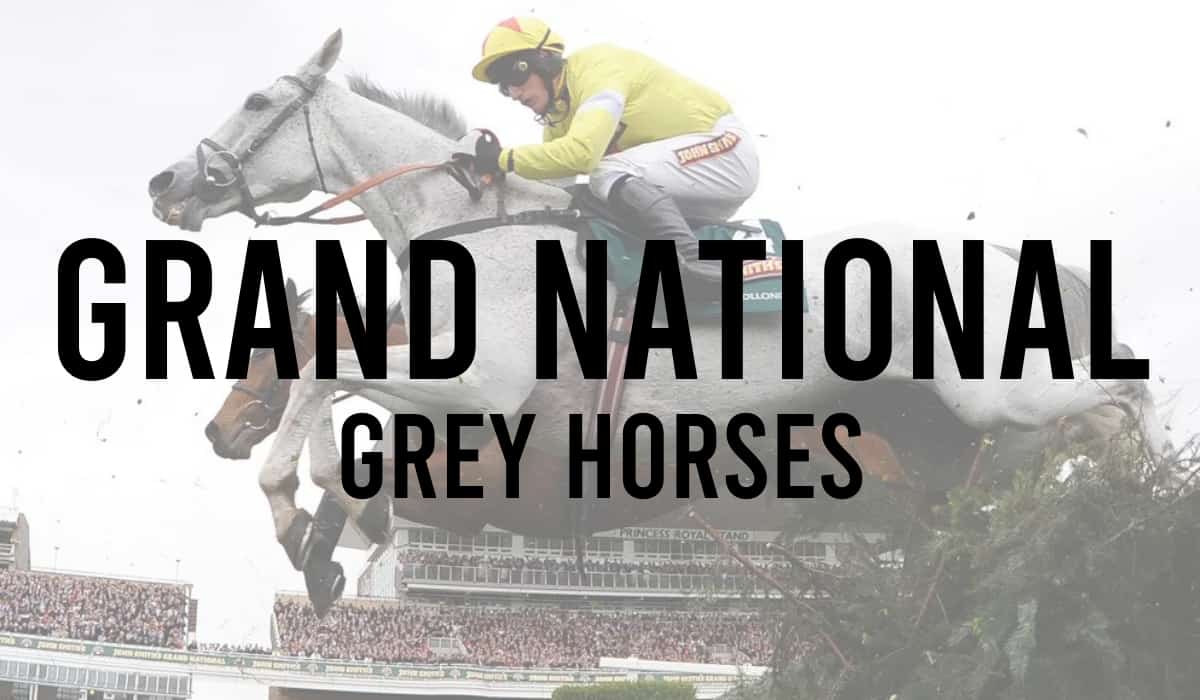
Some horse racing fans love to back grey horses when choosing who to bet on in the Grand National.
Many people consider backing greys lucky; they are certainly stunning animals to look at, with their natural colour also making it easier when watching the Grand National to pick them out from the other horses competing.
Grey horses are something of a rarity in general, and although three greys have won the Grand National before, they don’t have the best record in the race; however, this is more down to fewer of them competing than any difference in genetics or chance.
In our guide, we will look at all the grey horses competing in the Grand National this year, as well as interesting Grand National facts about the history of grey horses in previous Grand Nationals.
Find out more about grey horses in the Grand National:
What Grey Horses are Running in the 2026 Grand National?
Here are all the grey horses running in this year’s Aintree Grand National race.
The Grand National 2026 grey horses are popular among many horse racing punters.
Has a Grey Horse Ever won the Grand National?
Three grey horses have won the Grand National. The Lamb won the race twice, so that means a grey horse has won the great race 4 times.
We look at previous grey Grand National winners.
The Lamb 1868 and 1871
The Lamb – as the name suggests – was a miniature horse. He was so small that many thought he didn’t have the scope to be a professional racehorse.
The Lamb was initially a family horse, but he proved difficult to ride. He was therefore sent into training in Ireland, taking part in races and enjoying some success, leading to the decision to enter him in the Grand National in 1868.
Heavy rain in the days leading up to the Grand National meant that the ground was extremely muddy that year, with the Lamb taking full advantage. He won the race by a short distance, missing the 1869 running after a clerical error over his age. A wasting disease meant that he missed the following year, but when he returned to Aintree in 1871, he reclaimed his crown. Interestingly, a horse named the Colonel had won in 1869 and 1870, meaning that the title was shared between two horses for four years.
Nicolaus Silver
The fact that you’ve got to fast forward nearly 100 years to find the next grey to win the National tells a story all of its own. The success this time belonged to Nicolaus Silver, a gelding that was foaled in 1952. Bred by James Heffernan in Tipperary, Ireland, Nicolaus Silver was sired by Nicolaus out of Rays of Montrose, who had also been a grey. Having trained in Ireland, his trainer died suddenly, and so the eight-year-old was sold in November of 1960. Betting was keen on account of the fact that he’d already qualified for the Grand National.
Charles Vaughan paid £2,600 for him, and he was sent to Fred Rimell for training. Ridden by Bobby Beasley and given odds of 28/1, he outran 34 other runners in order to win by five lengths. Rimell had already trained a winner in ESB five years earlier, meaning that Nicolaus Silver added to his tally even though dopers had targeted him before the race. He took part in the Grand National again in 1962 and 1963, finishing seventh and tenth respectively, meaning that he never got to repeat his success.
Neptune Collonges
It was another 51 years before a grey won the main race at Aintree. Foaled in 2001, Neptune Collonges was bred in France out of Castille Collonges. Owned by John Hales and trained by Paul Nicholls, he developed a good relationship with Ruby Walsh, having begun his racing career as a three-year-old. When he suffered an injury during the 2009 Cheltenham Gold Cup, he was put out of action for the entire 2009-2010 season. He had won £685,279 in prize money by that point, thanks to 14 wins, two second places and three third-place finishes.
When he took part in the 2012 Grand National, he was unfancied by the bookies, being offered a Starting Price of 33/1. Daryl Jacobs took on the job of riding him, mainly because Walsh had suffered a fall from Zarkander in the build-up to the race and was unable to take part in the race. He won the National in the closest finish to the race ever, leading to his immediate retirement. Following that, the horse was retrained to participate in dressage competitions alongside John Hales’ daughter, making public appearances to support various charities.
Grey Runner Ups in The Grand National
- 1997 Suny Bay (2nd)
- 1998 Suny Bay (2nd)
- 2002 What’s Up Boys (2nd)
- 2002 Kingsmark (4th)
- 2008 King John’s Castle (2nd)
Summary of Grey Horses in the Grand National
Grey horses are always hugely popular with punters in the Grand National. They seem to have a place in people’s hearts.
Over the years, there has been some success for grey horses.
In the 2026 Grand National, we expect Snow Leopardess to add her name to the winners or placed horses!
Here are all the related articles to the Randox Grand National 2026.
-

Aintree Racecourse Guide
-
How Many Places Pay Out in the Grand National?
-
Mersey Novices’ Hurdle
-
Maghull Novices’ Chase
-
Top Novices’ Hurdle
-
Manifesto Novices’ Chase: Aintree Grade 1 Race Guide, Winners & Trends
-
Nickel Coin Mares’ Standard Open NH Flat Race
-
Red Rum Handicap Chase
-
Anniversary 4-Y-O Novices’ Hurdle
-
Topham Chase
-
Liverpool Hurdle
-
Ladies Days At The Races
-
Aintree Festival Day 3 Tips
-
Aintree Festival Day 2 Tips
-
Aintree Festival Day 1 Tips
-
Aintree Festival
-
Aintree Foxhunters Chase
-
Sefton Novices Hurdle
-
Mildmay Novices Chase
-
Melling Chase: Aintree Grade 1 Race Guide, Winners & Trends
-
Aintree Hurdle
-
Grey Horses in the Grand National
-
Grand National Dark Horses
-
Grand National Betting Odds 2027: Compare Prices and Each-Way Terms
-
Watch the Grand National Live
-
Grand National Favourites 2027: Betting Market and Previous Winners
-
Grand National Start Time
-
Bet On Grand National Online
-
Grand National Facts
-
Grand National Runners and Riders 2027: Entries, Horses and Confirmed Field
-
Grand National Fallers: 2026 Results, Non-Finishers and Historical Statistics
-
Grand National Fences: Complete Guide to All 30 Jumps at Aintree
-
Grand National Tips 2027: Ante-Post Analysis, Form and Betting Guide
-
Grand National Weights 2027: Handicap Weights, Entries and How They Work
-
Grand National Tickets
-
Grand National Prize Money
-
Grand National Previous Winners: Full Results, Horses, Jockeys and Trainers
-
Grand National Betting Offers 2027: Free Bets, Extra Places and Promotions
-
Grand National 2027













If you do choose to bet, please bet responsibly.