
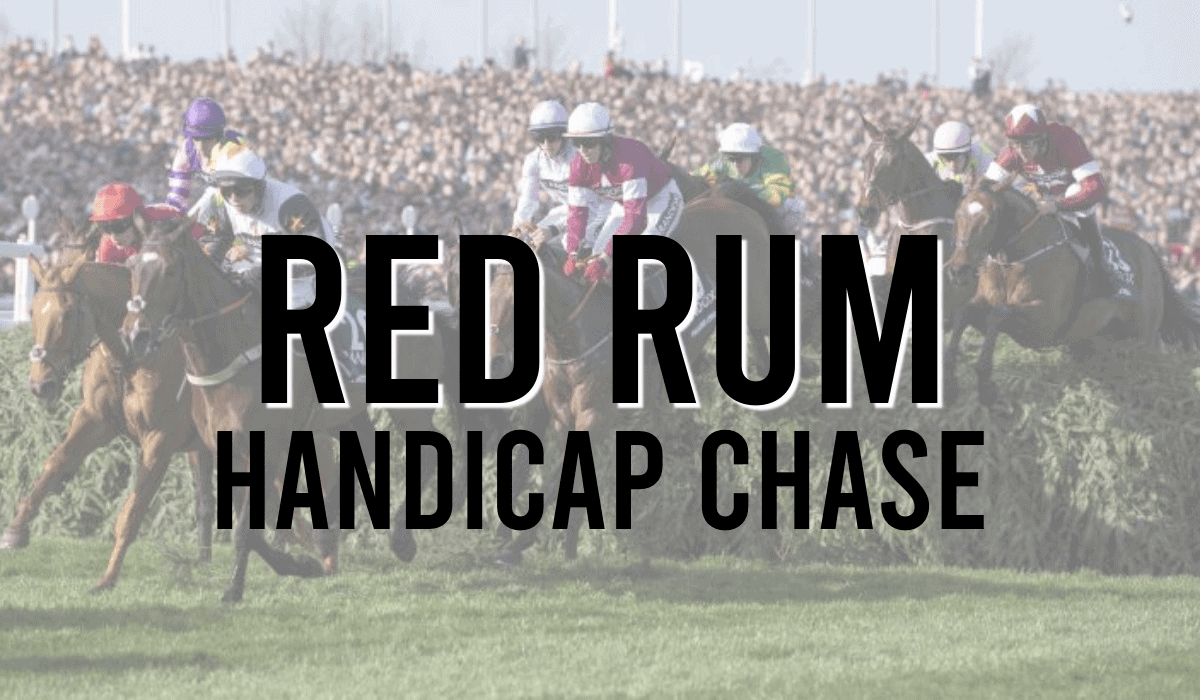
The Red Rum Handicap Chase is a Premier Handicap run over two miles on the Mildmay course at Aintree Racecourse during the Grand National Festival.
Horses tackle 12 fences over 1 mile, 7 furlongs and 176 yards, making this one of the fastest major handicap chases of the spring. The relatively short distance places greater emphasis on jumping at speed, track position and the ability to travel strongly without using too much energy early in the race.
The race takes its name from Red Rum, the only horse to win the Grand National three times. Although the Red Rum Handicap Chase does not use the famous Grand National fences, its position on the opening day of the meeting gives it an important place in Aintree’s three-day Festival.
Notable winners include Champion Chase winner Katabatic, dual winners Little Bay and Kathies Lad, subsequent Grade 1 winner Editeur Du Gite and Sans Bruit, who became the first horse in 40 years to win consecutive renewals when successful in 2024 and 2025.
Red Rum Handicap Chase Key Facts
| Race detail | Red Rum Handicap Chase |
|---|---|
| Racecourse | Aintree |
| Course | Mildmay course |
| Race type | National Hunt handicap chase |
| Classification | Premier Handicap |
| Distance | 1m 7f 176yds, approximately 2 miles |
| Fences | 12 |
| Eligibility | Horses aged 5+ |
| Usual month | April |
| Meeting | Grand National Festival |
| Surface | Turf |
Older records describe the Red Rum Handicap Chase as a Grade 3. Britain’s leading Grade 3 jump handicaps were reclassified as Premier Handicaps, which is the race’s current status.
Red Rum Handicap Chase Previous Winners
The previous winners table is useful for tracking how the race has developed and should be considered alongside changes in race conditions, handicapping and the strength of individual renewals.
| Year | Winner | Age | Jockey | Trainer |
|---|---|---|---|---|
| 2013 | Oiseau de Nuit | 11 | Brendan Powell | Colin Tizzard |
| 2014 | Parsnip Pete | 8 | Paddy Brennan | Tom George |
| 2015 | Surf And Turf | 9 | Brian Hughes | Kevin Frost |
| 2016 | Katachenko | 7 | Wayne Hutchinson | Donald McCain |
| 2017 | Double W’s | 7 | Brian Hughes | Malcolm Jefferson |
| 2018 | Bentelimar | 9 | Jonathan Burke | Charlie Longsdon |
| 2019 | Moon Over Germany | 8 | Rachael Blackmore | Henry de Bromhead |
| 2020 | No race | |||
| 2021 | Editeur Du Gite | 7 | Joshua Moore | Gary Moore |
| 2022 | The Last Day | 10 | Adam Wedge | Evan Williams |
| 2023 | Dancing On My Own | 9 | Rachael Blackmore | Henry de Bromhead |
| 2024 | Sans Bruit | 6 | Bryony Frost | Paul Nicholls |
| 2025 | Sans Bruit | 7 | Harry Cobden | Paul Nicholls |
| 2026 | Ryan’s Rocket | 8 | Jonathan Burke | Fergal O’Brien |
There was no race in 2020 after the Grand National meeting was cancelled.
The recent results are particularly interesting because Sans Bruit’s consecutive victories broke a long sequence without a repeat winner. His success also provides a useful example of why previous course form and running style can matter more than trying to find a winner through rigid age or weight statistics.
Why Is the Race Named After Red Rum?
The race honours Red Rum, one of the most famous horses in British racing history.
Red Rum won the Grand National in 1973, 1974 and 1977 and finished second in both 1975 and 1976. No other horse has won the race three times.
His association with Aintree extended beyond those victories. Red Rum became synonymous with the racecourse and played an important role in maintaining public interest in the Grand National during a difficult period in the event’s history.
The modern race was previously known as the Aintree Chase. It took the Red Rum name in 1997, two years after the horse died.
Despite the name, the race should not be confused with the Grand National itself. The Red Rum Handicap Chase takes place over approximately two miles on Aintree’s conventional Mildmay course rather than the separate National course.
The Mildmay Course at Aintree
Understanding that distinction is important when analysing the race.
Aintree has more than one racing circuit. The Grand National takes place on the National course with its distinctive spruce-covered obstacles, while the Red Rum Handicap Chase is staged on the Mildmay course.
The Mildmay is a conventional steeplechase circuit and provides a completely different jumping test from the Grand National fences.
The Red Rum is therefore a fast two-mile handicap rather than an abbreviated version of the National.
Horses need to jump 12 fences while maintaining their position around a relatively flat, left-handed track. With little opportunity to recover from significant mistakes, efficient jumping becomes particularly valuable.
A horse losing two or three lengths at a fence in a staying chase may have several miles to recover. In a race taking around four minutes, the same error can prove much harder to overcome.
Why Pace Matters in the Red Rum Handicap Chase
Pace is one of the most important elements of the race.
Two-mile chasers tend to possess considerable early speed, and a large handicap field can contain several horses that prefer to race prominently. That creates the potential for competition over position from an early stage.
A strong early gallop can expose horses that race too freely.
The opposite can also happen. If one natural front-runner secures the lead without being challenged, it may be able to establish a comfortable jumping rhythm and conserve enough energy for the finish.
Sans Bruit provided an excellent example.
He made all when winning in 2024 and repeated the approach in 2025, again controlling the race from the front before going clear approaching the final fence.
That does not establish a permanent front-running bias. It demonstrates what can happen when a good jumper with sufficient speed obtains the race position that suits it.
Before each renewal, a horse racing pace map can help identify which runners are likely to contest the lead and which may benefit from the expected shape of the race.
Jumping at Speed
The Red Rum demands a different type of jumping from a long-distance chase.
Staying chasers often have time to organise themselves approaching their fences. Two-mile chasers generally reach the obstacles at greater speed, leaving less time to adjust.
Fluency therefore matters.
A horse that meets its fences accurately can preserve momentum and maintain its racing position without wasting energy. A runner that continually puts in extra strides or lands without momentum can quickly lose ground.
One serious mistake can be decisive.
Ryan’s Rocket made an error earlier in the 2026 race but remained competitive and recovered. The decisive moment came at the final fence, where Highlands Legacy made a bad mistake while challenging, leaving Ryan’s Rocket clear.
That result demonstrates two sides of jumping analysis. An early error can sometimes be overcome, but a mistake at a critical stage of a two-mile chase may leave too little time to recover.
When reading horse racing form, it is therefore worth looking beyond the finishing position and assessing where mistakes occurred and how much momentum they cost.
Sans Bruit’s Back-to-Back Wins
Sans Bruit produced one of the most significant recent achievements in the race when winning in both 2024 and 2025 for Paul Nicholls.
In 2024, the six-year-old carried 10st 2lb and made all under Bryony Frost. He travelled strongly, jumped efficiently and went clear after the second-last fence before beating Saint Roi by four lengths.
He returned as a seven-year-old in 2025 and won from the same official rating of 130.
This time Harry Cobden took the ride. Sans Bruit again went forward, controlled the race and moved clear approaching the final fence before beating Calico by four and a half lengths.
The victory made him the first horse for 40 years to win consecutive editions of the Red Rum Handicap Chase.
His performances are more useful analytically than a simple statistic about repeat winners. Sans Bruit had demonstrated that his running style, jumping and speed were particularly well suited to the race, while his handicap mark remained manageable enough for him to reproduce the performance a year later.
Ryan’s Rocket Wins in 2026
Ryan’s Rocket won the 2026 Red Rum Handicap Chase for trainer Fergal O’Brien and jockey Jonathan Burke.
The eight-year-old carried 11st and raced from an official rating of 132.
His route through the race was very different from the one Sans Bruit had used during the previous two seasons. Ryan’s Rocket was squeezed out shortly after the start and raced keenly before settling into a position behind the leaders.
He made progress approaching three fences from home and became involved in the fight for the lead.
Highlands Legacy briefly headed him after the second-last fence, but Ryan’s Rocket regained a narrow advantage before his rival made a significant mistake at the last.
Ryan’s Rocket stayed on to win by three and a half lengths.
The result provides another reminder not to turn the tactics of previous winners into a system. Sans Bruit dominated from the front. Ryan’s Rocket had to overcome early interference and win through a different race shape.
Dancing On My Own and Rachael Blackmore
Dancing On My Own won the race in 2023 for Henry de Bromhead and Rachael Blackmore.
It was Blackmore’s second victory in the race after partnering Moon Over Germany to success for the same trainer in 2019.
That gave the De Bromhead and Blackmore combination two wins from four editions of the race between 2019 and 2023, with the 2020 running absent.
Dancing On My Own was nine when successful, while Moon Over Germany was eight. Their victories provide further evidence that experienced chasers can remain highly effective in this race when their handicap marks and racing style allow them to compete.
Editeur Du Gite
Editeur Du Gite won the Red Rum in 2021 carrying 10st 9lb for Gary Moore and jockey Joshua Moore.
He subsequently progressed beyond handicap company and established himself as a high-class two-mile chaser.
His most notable later victory came in the Clarence House Chase in 2023, when the race was transferred from Ascot to Cheltenham.
That progression is important when looking back at his Red Rum success.
A horse winning a major handicap can sometimes be improving faster than the handicapper can respond. Editeur Du Gite’s subsequent Grade 1 form demonstrated that his ability eventually exceeded the level normally associated with a two-mile handicap chaser.
That is why assessing whether a horse is ahead of its handicap mark can be more useful than looking for a particular weight range among previous winners.
Katabatic
Katabatic is one of the highest-class horses to have won the Red Rum.
He won the Queen Mother Champion Chase at Cheltenham in 1991 before winning at Aintree in 1992.
Katabatic carried 12st to victory, demonstrating the class required to overcome a major weight burden in a competitive handicap.
His performance is also useful when considering the relationship between the Queen Mother Champion Chase and Aintree’s two-mile races.
The demands are different. Cheltenham is more undulating, while Aintree’s Mildmay course places a premium on speed and fluent jumping around a flatter circuit.
A horse can be suited to both, but form should not be transferred mechanically from one course to the other.
Dual Red Rum Handicap Chase Winners
Repeat winners have been unusual, which makes the horses that achieved the feat particularly notable.
Little Bay won in 1982 and 1984 for trainer Gordon Richards.
Kathies Lad then won consecutive renewals in 1985 and 1986 for Alan Jarvis.
It took almost four decades for another horse to complete consecutive victories.
Sans Bruit finally did so in 2024 and 2025.
The long gap is understandable in handicap racing. A strong performance normally leads to a higher official rating, meaning a returning winner may be asked to carry more weight or race from a less favourable mark the following season.
Sans Bruit’s ability to win from the same rating of 130 in successive years was therefore particularly significant.
Does Cheltenham Festival Form Matter?
The Red Rum takes place only a few weeks after the Cheltenham Festival, so some runners arrive at Aintree after competing there.
That can provide useful evidence, but the two meetings create different challenges.
Cheltenham is undulating and places significant emphasis on balance and the ability to finish strongly up the hill. Aintree’s Mildmay course is flatter and can reward horses capable of travelling and jumping at speed.
The Grand Annual Chase is the most obvious Cheltenham comparison because it is another major handicap for two-mile chasers.
Even then, the finishing order should not simply be transferred from one race to another.
A horse that struggled with Cheltenham’s undulations could improve at Aintree. Another may have endured a hard race at the Festival and have had relatively little recovery time.
Look at how the horse ran rather than treating participation at Cheltenham as a positive or negative by itself.
How Important Is the Going?
Ground can change the character of the Red Rum significantly.
Good or good-to-soft conditions allow two-mile chasers to use their speed and place even greater emphasis on fluent jumping.
Soft ground increases the stamina requirement.
The official distance does not change, but horses expend more energy travelling through the surface. A runner that appears to have ample speed for two miles can therefore become vulnerable late if it does not handle testing conditions efficiently.
The 2024 race was run on soft ground, while Sans Bruit’s second victory in 2025 came on good to soft. Ryan’s Rocket also won on good to soft in 2026.
Previous form should be compared with the expected conditions rather than reduced to a simple record of wins on one broad going description.
Our horse racing going guide explains how the racing surface can change the demands placed on a horse.
Does Weight Matter?
Weight is important because the Red Rum is a handicap, but looking only at the number of stones and pounds a horse carries can be misleading.
The handicapper uses official ratings to determine the relationship between runners. Better-rated horses are generally required to carry more weight.
That means a high weight is also evidence of established ability.
Katabatic’s historic victory under 12st demonstrates the point at the extreme end of the scale.
More recently, Sans Bruit won his first Red Rum from 10st 2lb, while Ryan’s Rocket carried 11st in 2026.
Neither performance establishes an ideal weight range.
The better question is whether a horse’s current handicap rating accurately reflects its ability.
Improving chasers are particularly interesting because their performances can develop more quickly than their official marks. Conversely, an experienced horse can become competitive again after its rating falls to a level that better reflects its current ability.
Age and Experience
The winners table shows successful horses across a broad age range.
Oiseau de Nuit won as an eleven-year-old in 2013. Sans Bruit was six when winning in 2024, while several recent winners have been seven, eight or nine.
There is little reason to turn that history into a rigid age system.
Younger chasers may still be improving, which creates the potential to get ahead of the handicapper. Older horses bring greater experience and may already have demonstrated exactly what conditions suit them.
Current ability matters more than age in isolation.
A ten-year-old whose rating has fallen while retaining its speed can be better handicapped than a younger rival whose mark has risen sharply after recent wins.
Is Previous Aintree Form Important?
Aintree course form is worth considering, but it carries a different meaning here than it does in races over the National fences.
The Red Rum uses the Mildmay course, so previous experience of the Grand National or Becher Chase does not demonstrate that a horse is suited to the same jumping test.
What matters is evidence on the conventional Aintree circuit.
Previous strong performances at the Grand National Festival can show that a horse handles the relatively flat course and remains effective at this stage of the season.
The context remains important.
Our guide to course-and-distance winners explains why a previous win at a track should be assessed alongside the quality of the race, ground and current handicap mark.
Sans Bruit provides a particularly strong example because he returned twelve months after his first victory and reproduced his performance against a new field.
Red Rum Handicap Chase and the Maghull Novices’ Chase
The Maghull Novices’ Chase is another major two-mile chase staged on the Mildmay course during the Grand National Festival.
The races serve different types of horse.
The Red Rum is a handicap for experienced and developing chasers aged five and older. The Maghull is a Grade 1 for novice chasers.
Even so, analysing the races together can improve understanding of how the two-mile Mildmay course is riding during the meeting.
Ground conditions, the effectiveness of prominent racers and the way horses are jumping at speed can provide useful context across the three days.
That should not be mistaken for a fixed track bias. Weather, pace and the individual composition of each field can change the result.
What Matters Most in the Red Rum Handicap Chase?
The Red Rum is better analysed through the demands of a fast two-mile handicap than through old statistics about favourites or the weights carried by previous winners.
Pace matters. Several horses competing for the lead can produce a very different race from one controlled by a single front-runner.
Jumping matters. Horses have less time to recover from mistakes than they would in a staying chase.
Handicap marks matter. The strongest candidates often include horses whose current ability is greater than their official rating suggests.
Going matters. Softer conditions increase the stamina requirement, while quicker ground can place greater emphasis on speed.
Recent form needs context. A horse does not need to have won its previous race to be well handicapped at Aintree.
Course suitability helps. Previous strong form on the Mildmay circuit is more relevant than generic references to Aintree form over the National fences.
These factors have a logical connection with how the race is actually run. That makes them more useful than relying on a statistic such as how many of the previous eleven winners started outside the first three in the betting.
How to Analyse the Red Rum Handicap Chase
Start by establishing the likely pace.
Identify the horses that normally lead and those happiest racing prominently. If several runners want the same position, the early stages could become competitive and create opportunities for horses able to settle behind them.
Then assess jumping.
Two-mile chase form should reveal which horses can maintain accuracy when travelling at speed. Pay particular attention to mistakes made late in races, when pressure and fatigue are increasing.
Next look at the handicap marks.
The aim is not simply to find the highest-rated horse. Look for runners capable of performing above the level implied by their current rating.
Ground and recent workload should then be considered.
A horse arriving from the Cheltenham Festival may have strong recent form but relatively little recovery time. Another may have deliberately bypassed Cheltenham to arrive fresh at Aintree.
Finally, compare your assessment with the betting market.
Identifying the horse most likely to win is not the same as identifying the best bet. Our guide to finding value bets in horse racing explains why the available price needs to be compared with the chance you believe the horse has of winning.
Readers comparing where to place their racing bets can use our horse racing betting sites comparison for the wider bookmaker selection process.
Red Rum Handicap Chase FAQs
Where is the Red Rum Handicap Chase run?
The Red Rum Handicap Chase is run at Aintree Racecourse in Liverpool.
Which Aintree course is used?
The race takes place on the Mildmay course, not the Grand National course.
Does the Red Rum Handicap Chase use the Grand National fences?
No. The race uses conventional fences on Aintree’s Mildmay course. The Grand National, Becher Chase and Topham Chase are among the races that use the separate National course.
How far is the Red Rum Handicap Chase?
The race is run over 1 mile, 7 furlongs and 176 yards, commonly described as approximately two miles.
How many fences are jumped?
Horses jump 12 fences.
Is the Red Rum Handicap Chase a Grade 3?
No. Historical records may describe it as a Grade 3, but the Red Rum is now classified as a Premier Handicap.
What age horses can run?
The race is open to horses aged five and older.
When is the Red Rum Handicap Chase?
The Red Rum Handicap Chase is normally staged on the opening day of the Grand National Festival at Aintree in April.
Who won the Red Rum Handicap Chase in 2026?
Ryan’s Rocket won the 2026 race for trainer Fergal O’Brien and jockey Jonathan Burke.
Who won the Red Rum Handicap Chase in 2025?
Sans Bruit won in 2025 for Paul Nicholls and Harry Cobden, completing consecutive victories in the race.
Who won in 2024?
Sans Bruit also won the 2024 Red Rum Handicap Chase, ridden by Bryony Frost.
Which horses have won the Red Rum Handicap Chase twice?
Little Bay, Kathies Lad and Sans Bruit are among the dual winners. Kathies Lad and Sans Bruit both won consecutive renewals.
Why is the race named after Red Rum?
The race honours Red Rum, who won the Grand National three times at Aintree in 1973, 1974 and 1977.
Did Red Rum ever win the Red Rum Handicap Chase?
No. The race took the Red Rum name long after his racing career had ended.
What should I look for when analysing the race?
Concentrate on pace, jumping at speed, handicap marks, ground, recent form and previous experience of Aintree’s Mildmay course. These factors provide more useful evidence than rigid historical trends based on age, weight or starting price.
Red Rum Handicap Chase Summary
The Red Rum Handicap Chase is one of the leading two-mile handicaps of the British jumps season and provides a very different challenge from the staying races more commonly associated with Aintree.
Its position on the Mildmay course means the Grand National fences play no part. Instead, horses need enough speed to hold a competitive position while jumping 12 conventional fences accurately at a strong pace.
The race also has considerable history. Katabatic won after becoming a Champion Chase winner, Editeur Du Gite progressed to Grade 1 success, while Little Bay, Kathies Lad and Sans Bruit demonstrated that horses can return and win the race more than once.
Sans Bruit’s consecutive victories in 2024 and 2025 provided an especially useful lesson. His prominent racing style, fluent jumping and handicap position combined particularly well with the demands of the race. Ryan’s Rocket then won through a different race shape in 2026, underlining why previous tactical patterns should never become automatic systems.
Pace, jumping, handicap ratings, ground and current form provide the strongest foundations for analysing future renewals.
The Red Rum Handicap Chase remains an important part of the Aintree Festival and a distinctive test for Britain’s leading two-mile handicap chasers.
Related 2026 Aintree Festival Articles
Here are all the related articles to the Aintree Festival 2026.
-

Aintree Racecourse Guide
-
How Many Places Pay Out in the Grand National?
-
Mersey Novices’ Hurdle
-
Maghull Novices’ Chase
-
Top Novices’ Hurdle
-
Manifesto Novices’ Chase: Aintree Grade 1 Race Guide, Winners & Trends
-
Nickel Coin Mares’ Standard Open NH Flat Race
-
Red Rum Handicap Chase
-
Anniversary 4-Y-O Novices’ Hurdle
-
Topham Chase
-
Liverpool Hurdle
-
Ladies Days At The Races
-
Aintree Festival Day 3 Tips
-
Aintree Festival Day 2 Tips
-
Aintree Festival Day 1 Tips
-
Aintree Festival
-
Aintree Foxhunters Chase
-
Sefton Novices Hurdle
-
Mildmay Novices Chase
-
Melling Chase: Aintree Grade 1 Race Guide, Winners & Trends
-
Aintree Hurdle
-
Grey Horses in the Grand National
-
Grand National Dark Horses
-
Grand National Betting Odds 2027: Compare Prices and Each-Way Terms
-
Watch the Grand National Live
-
Grand National Favourites 2027: Betting Market and Previous Winners
-
Grand National Start Time
-
Bet On Grand National Online
-
Grand National Facts
-
Grand National Runners and Riders 2027: Entries, Horses and Confirmed Field
-
Grand National Fallers: 2026 Results, Non-Finishers and Historical Statistics
-
Grand National Fences: Complete Guide to All 30 Jumps at Aintree
-
Grand National Tips 2027: Ante-Post Analysis, Form and Betting Guide
-
Grand National Weights 2027: Handicap Weights, Entries and How They Work
-
Grand National Tickets
-
Grand National Prize Money
-
Grand National Previous Winners: Full Results, Horses, Jockeys and Trainers
-
Grand National Betting Offers 2027: Free Bets, Extra Places and Promotions
-
Grand National 2027


































If you do choose to bet, please bet responsibly.












