
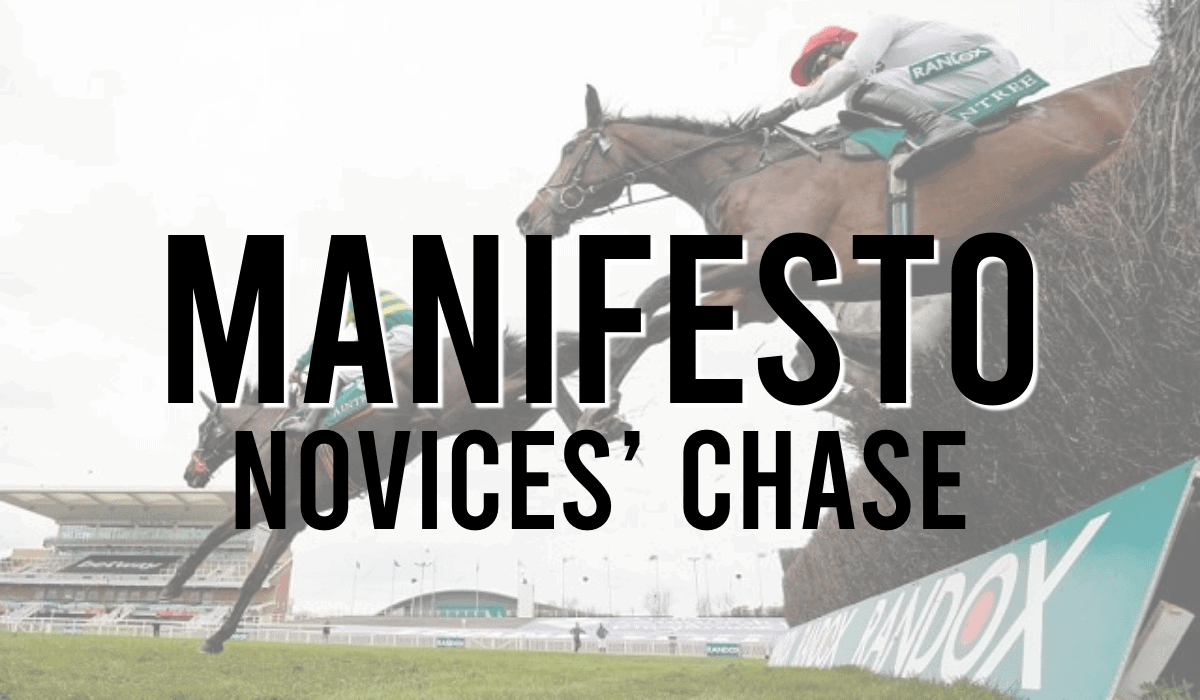
The Manifesto Novices’ Chase is the first Grade 1 chase of the Grand National Festival and one of the leading end-of-season targets for novice chasers in Britain and Ireland.
Run over approximately two and a half miles on Aintree’s Mildmay Course, the race sits between the specialist two-mile and staying novice divisions.
That creates an interesting field.
Horses can step up in distance after the Arkle at Cheltenham, remain around an intermediate trip after another spring target or drop back after racing over three miles.
Past winners include Wishfull Thinking, Menorah, Uxizandre, Protektorat, Banbridge, Il Etait Temps and Impaire Et Passe.
The latest winner is Koktail Divin, who won the 2026 Manifesto Novices’ Chase for Henry de Bromhead and Darragh O’Keeffe.
Manifesto Novices’ Chase 2026 Result
Koktail Divin won the 2026 Manifesto Novices’ Chase at Aintree on Thursday 9 April.
The six-year-old was trained by Henry de Bromhead and ridden by Darragh O’Keeffe.
He started at 3/1 and beat Blueking D’Oroux by 2¼ lengths.
Mambonumberfive finished third.
Koktail Divin had contested the Brown Advisory Novices’ Chase at the Cheltenham Festival on his previous start, where the longer distance had stretched his stamina.
Dropping back to approximately two and a half miles at Aintree suited him much better.
He raced prominently in a strongly run contest, moved into a clear lead after the third-last fence and responded when challenged by Blueking D’Oroux.
The result also demonstrated the importance of jumping.
Lulamba started as the 1/2 favourite after finishing third in the Arkle at Cheltenham but unseated Nico de Boinville during the race.
Koktail Divin’s jumping allowed him to remain involved throughout before his stamina and speed proved enough on the run-in.
The race was run on good-to-soft ground.
What Is the Manifesto Novices’ Chase?
The Manifesto Novices’ Chase is a Grade 1 National Hunt steeplechase for novice chasers aged five and older.
It takes place at Aintree Racecourse during the three-day Grand National Festival.
The race is run over approximately:
2 miles and 4 furlongs
and the runners jump:
16 fences
It takes place on Aintree’s Mildmay Course rather than over the Grand National fences.
The race is restricted to novice chasers.
A novice chaser is a horse in the early stage of its chasing career under the applicable racing rules. The Manifesto gives many of the season’s leading novices another opportunity to compete at Grade 1 level after the Cheltenham Festival.
Is the Manifesto Novices’ Chase a Handicap?
No.
The Manifesto Novices’ Chase is not a handicap.
It is a Grade 1 novice chase run under conditions that determine the weights carried.
This is important because older descriptions of the race can incorrectly refer to it as a handicap.
In a handicap, horses carry different weights according to their ratings in an attempt to equalise their chances.
That is not how the Manifesto works.
Official Ratings remain useful when comparing the established ability of the runners, but the race itself is not a handicap.
Our horse racing handicap ratings guide explains how ratings and handicap weights work.
When Is the Manifesto Novices’ Chase?
The Manifesto Novices’ Chase takes place in April during the Aintree Grand National Festival.
It is staged on the opening day of the meeting.
The 2026 race took place on Thursday 9 April.
Aintree’s three-day meeting contains several Grade 1 races alongside the Grand National, giving horses from different divisions the opportunity to compete again after Cheltenham.
Our Grade 1 Jump races page covers the major championship races across the British National Hunt season.
How Far Is the Manifesto Novices’ Chase?
The Manifesto Novices’ Chase is run over 2 miles, 3 furlongs and 200 yards, generally described as approximately two and a half miles.
This distance is central to the race.
The Manifesto can attract horses stepping up from two miles and others dropping back from around three miles.
The former group needs to prove its stamina.
The latter needs enough speed to remain competitive against potentially quicker rivals.
The 2026 result provided a good example.
Lulamba arrived from the two-mile Arkle.
Koktail Divin arrived after racing over the longer Brown Advisory distance.
They therefore approached the Manifesto from opposite sides of the novice-chase programme.
How Many Fences Are Jumped?
There are 16 fences in the Manifesto Novices’ Chase.
They are standard steeplechase fences on Aintree’s Mildmay Course.
They are not hurdles and they are not the distinctive Grand National fences.
This distinction matters because Aintree hosts racing over several different types of obstacle during Grand National week.
The Manifesto is a conventional steeplechase.
Which Aintree Course Is Used?
The race takes place on the Mildmay Course.
Aintree is famous for fences such as Becher’s Brook, The Chair and the Canal Turn, but those belong to the Grand National course.
Manifesto runners do not jump them.
The Mildmay Course is a conventional left-handed National Hunt track.
It is relatively flat compared with Cheltenham and places a premium on fluent jumping at speed.
That difference can help horses improve on their Cheltenham form.
A horse that struggled with Cheltenham’s undulations or uphill finish can find Aintree more suitable.
Our Aintree Racecourse page explains the different courses used at the venue.
History of the Manifesto Novices’ Chase
The Manifesto Novices’ Chase is one of the newer Grade 1 races in the British National Hunt programme.
It was first run in 2009.
Tartak won the inaugural renewal for trainer Tom George and jockey Paddy Brennan.
The race was initially staged as a Grade 2 before being promoted to Grade 1 status in 2012.
Menorah won the first renewal after that upgrade.
Despite its relatively short history, the Manifesto has already produced several horses that subsequently established themselves at the highest level.
Its position immediately after the Cheltenham Festival also gives the race an important role in bringing together novice chasers who followed different routes earlier in the season.
Why Is It Called the Manifesto Novices’ Chase?
The race is named after Manifesto, one of the most remarkable horses in Grand National history.
Manifesto competed in the Grand National eight times.
He won the race twice, in 1897 and 1899, and also produced several other placed efforts.
His longevity and extraordinary Aintree record made him an appropriate horse to commemorate at the Grand National Festival.
The modern Manifesto Novices’ Chase is run on the Mildmay Course rather than over the Grand National fences on which its namesake became famous.
Manifesto Novices’ Chase Winners
| Year | Winner | Age | Jockey | Trainer |
|---|---|---|---|---|
| 2009 | Tartak | 6 | Paddy Brennan | Tom George |
| 2010 | Mad Max | 8 | Barry Geraghty | Nicky Henderson |
| 2011 | Wishfull Thinking | 8 | Richard Johnson | Philip Hobbs |
| 2012 | Menorah | 7 | Richard Johnson | Philip Hobbs |
| 2013 | Captain Conan | 6 | Barry Geraghty | Nicky Henderson |
| 2014 | Uxizandre | 6 | Tony McCoy | Alan King |
| 2015 | Clarcam | 5 | Ruby Walsh | Gordon Elliott |
| 2016 | Arzal | 6 | Gavin Sheehan | Harry Whittington |
| 2017 | Flying Angel | 6 | Noel Fehily | Nigel Twiston-Davies |
| 2018 | Finian’s Oscar | 6 | Robbie Power | Colin Tizzard |
| 2019 | Kalashnikov | 6 | Jack Quinlan | Amy Murphy |
| 2020 | No Race | – | – | – |
| 2021 | Protektorat | 6 | Harry Skelton | Dan Skelton |
| 2022 | Millers Bank | 8 | Kielan Woods | Alex Hales |
| 2023 | Banbridge | 7 | J J Slevin | Joseph O’Brien |
| 2024 | Il Etait Temps | 6 | Paul Townend | Willie Mullins |
| 2025 | Impaire Et Passe | 7 | Paul Townend | Willie Mullins |
| 2026 | Koktail Divin | 6 | Darragh O’Keeffe | Henry de Bromhead |
The race was not staged in 2020 when the Grand National Festival was cancelled.
Famous Manifesto Novices’ Chase Winners
The race has only existed since 2009, but several winners subsequently developed into leading chasers.
Menorah – 2012
Menorah won the first Grade 1 running of the Manifesto in 2012 for Philip Hobbs and Richard Johnson.
He had already demonstrated top-level ability over hurdles and went on to enjoy a long career over fences.
His later victories included the Peterborough Chase and Charlie Hall Chase.
Uxizandre – 2014
Uxizandre won the 2014 Manifesto for Alan King and Tony McCoy.
He returned to Cheltenham the following season and produced one of his best performances to win the Ryanair Chase.
That subsequent success demonstrated the quality required to win the Manifesto.
Protektorat – 2021
Protektorat won the 2021 Manifesto for Dan and Harry Skelton.
He subsequently developed into a leading staying chaser.
His later career included victory in the Betfair Chase at Haydock and a third-place finish in the Cheltenham Gold Cup.
His career also illustrates an important feature of novice racing.
The distance that suits a horse as a novice does not necessarily define the division in which it will eventually establish itself.
Banbridge – 2023
Banbridge won the 2023 Manifesto for Joseph O’Brien and J J Slevin.
He subsequently developed into a high-class open chaser, proving particularly effective when conditions suited.
His victory reinforced the Manifesto’s position as a race capable of identifying horses with the ability to remain competitive at Grade 1 level after leaving novice company.
Il Etait Temps – 2024
Il Etait Temps gave Willie Mullins his first Manifesto victory in 2024.
His success began a particularly strong two-year period for the Mullins stable in the race.
Impaire Et Passe – 2025
Impaire Et Passe followed Il Etait Temps by winning for Willie Mullins and Paul Townend in 2025.
That made Mullins the third trainer to record two victories in the race and Townend the third jockey to ride two winners.
Koktail Divin – 2026
Koktail Divin won the 2026 Manifesto for Henry de Bromhead and Darragh O’Keeffe.
He had been tried over a longer distance in the Brown Advisory at Cheltenham before dropping back in trip at Aintree.
The change suited him.
He jumped strongly, raced prominently and beat Blueking D’Oroux by 2¼ lengths.
Which Trainers Have the Best Manifesto Record?
No trainer has dominated the Manifesto Novices’ Chase.
Three trainers have won the race twice:
- Philip Hobbs: Wishfull Thinking in 2011 and Menorah in 2012.
- Nicky Henderson: Mad Max in 2010 and Captain Conan in 2013.
- Willie Mullins: Il Etait Temps in 2024 and Impaire Et Passe in 2025.
Willie Mullins became the latest trainer to join the two-win group after taking consecutive renewals.
That is a useful update to older statistics which listed only Hobbs and Henderson as multiple-winning trainers.
The spread of successful trainers reflects the nature of the race.
Leading novices can emerge from several different British and Irish yards and arrive at Aintree through different races.
Which Jockeys Have the Best Manifesto Record?
Three jockeys have ridden two winners:
- Richard Johnson: Wishfull Thinking in 2011 and Menorah in 2012.
- Barry Geraghty: Mad Max in 2010 and Captain Conan in 2013.
- Paul Townend: Il Etait Temps in 2024 and Impaire Et Passe in 2025.
No jockey has yet won the race three times.
Darragh O’Keeffe became the latest rider to add his name to the roll of honour aboard Koktail Divin in 2026.
Key Manifesto Novices’ Chase Form
The Manifesto is particularly interesting because there is no single route every winner needs to follow.
Its position over approximately two and a half miles allows horses from several novice divisions to meet.
Cheltenham Festival form remains important, but the specific race needs to be considered alongside the horse’s characteristics.
Arkle Chase Form
The Arkle Challenge Trophy is the leading two-mile novice chase at the Cheltenham Festival.
Arkle runners stepping up to the Manifesto face an additional stamina test.
That does not make the step up negative.
Some horses race over two miles because that is where their novice programme has taken them rather than because two miles is their absolute stamina limit.
A horse finishing strongly in the Arkle can become particularly interesting over the extra distance at Aintree.
Lulamba brought Arkle form into the 2026 Manifesto.
He had finished third at Cheltenham and started the Aintree race as the 1/2 favourite.
His race ended when he unseated Nico de Boinville.
That result also demonstrates why historical form routes cannot be treated as automatic betting systems.
The horse still has to jump.
Intermediate-Distance Cheltenham Form
A novice arriving from a race around two and a half miles has the obvious advantage of already being proven around a similar distance.
The challenge is interpreting the Cheltenham performance correctly.
Cheltenham and Aintree are very different courses.
A horse can be beaten at Cheltenham and still improve significantly at Aintree.
Consider how it travelled, jumped and finished rather than looking only at its finishing position.
A strongly run Grade 1 at Cheltenham can also leave a mark on an inexperienced novice, particularly when Aintree follows only a few weeks later.
Brown Advisory Novices’ Chase Form
The Brown Advisory Novices’ Chase is a longer test at Cheltenham.
Horses dropping back from that race need sufficient speed for the Manifesto.
Koktail Divin demonstrated the potential of this route in 2026.
He had raced over the longer Brown Advisory distance before dropping back to approximately two and a half miles at Aintree.
The shorter trip proved more suitable.
A horse can therefore be beaten because a race stretches its stamina rather than because it lacks Grade 1 ability.
When that horse drops back in distance, the previous defeat needs to be interpreted in context.
This is one of the reasons horse racing form should be read beyond the bare finishing position.
Manifesto, Mildmay or Maghull?
Aintree stages three important Grade 1 novice chases across different distances.
The Maghull Novices’ Chase is run over approximately two miles.
The Manifesto Novices’ Chase is run over approximately two and a half miles.
The Mildmay Novices’ Chase is run over approximately three miles and one furlong.
These races give trainers options according to the strengths of their novice.
A fast two-mile horse can target the Maghull Novices’ Chase.
A stronger stayer can contest the Mildmay Novices’ Chase.
The Manifesto occupies the middle ground.
That can make it the right target for a genuine intermediate-distance horse, an Arkle runner expected to improve for further or a staying novice whose stamina was stretched too far over three miles.
How Important Is Jumping?
Jumping is fundamental to the Manifesto.
Novices are still developing their technique and experience over fences.
Grade 1 pace exposes mistakes quickly.
A horse can lose momentum through one major error or gradually surrender ground through a series of smaller mistakes.
The 2026 renewal demonstrated the point clearly.
Lulamba was the 1/2 favourite but unseated his rider.
Koktail Divin, by contrast, jumped effectively while racing close to the pace.
When analysing previous form, do not simply record whether the horse completed.
Look at how it jumped.
Did it lose ground at its fences?
Did it jump left or right?
Did pressure affect its technique?
Did it improve as the race progressed?
Was it gaining ground in the air?
Those details can be more informative than the final finishing position.
Pace in the Manifesto Novices’ Chase
The Manifesto often attracts a relatively small field, but that does not mean pace is unimportant.
Running style can have a significant effect on the result.
A horse comfortable racing prominently may gain an advantage if the race develops steadily.
A strong gallop can place more pressure on stamina and jumping.
The mixture of two-mile, intermediate and staying novices makes the likely pace particularly important.
A horse stepping up from the Arkle may bring natural speed.
A runner dropping back from a longer race may want a stronger gallop to make stamina count.
Map the likely leaders and prominent racers before deciding how the race is likely to develop.
Our horse racing pace maps page explains how to build a likely race shape from previous running styles.
Does Pace Bias Matter?
Pace and course position should be considered together.
A front-runner is not automatically advantaged simply because a race has a small field.
If several horses want to lead, they can pressure each other.
A lone front-runner may instead be allowed to dictate.
Hold-up horses need enough pace ahead of them to bring their finishing speed into play.
Our horse racing pace bias guide explains why running style should be considered alongside course configuration and the likely competition for early positions.
Does the Going Matter?
Ground conditions can change the demands of the Manifesto.
Good ground can increase the emphasis on speed and fluent jumping.
Softer ground increases the stamina requirement.
That is particularly important when horses are changing distance.
A two-mile novice stepping up to the Manifesto on testing ground faces a more demanding stamina question.
A horse dropping back from three miles may find softer conditions help bring its stamina into play.
Koktail Divin won the 2026 race on good-to-soft ground.
Use previous going form as evidence, but do not reduce the assessment to wins and defeats on the same official description.
Course, distance, pace and opposition also affect how a horse performs.
Our horse racing going guide explains how the main going descriptions affect racing.
Does Previous Aintree Form Matter?
Previous Aintree experience can help, but many Manifesto runners will be racing at the course for the first time.
That makes it less important than in races for older, more experienced chasers.
Look instead for evidence that the horse should suit the Mildmay Course.
Aintree is flatter than Cheltenham.
Horses need to jump efficiently while travelling at Grade 1 speed.
A novice that looked uncomfortable on Cheltenham’s undulations can improve at Aintree without necessarily producing a dramatic improvement in underlying ability.
If a horse already has strong Aintree form, that removes one question.
Our course and distance winners page explains how previous course evidence can be used as part of wider race analysis.
Manifesto Novices’ Chase Betting Trends
Older versions of Manifesto trends quickly become misleading because the race has only existed since 2009.
A statistic based on “the last eleven winners” can change materially after only a few additional renewals.
The better approach is to identify broader patterns and then assess whether they make sense.
Six and Seven-Year-Olds Have a Strong Record
Six-year-olds have performed particularly well.
Recent results continue that pattern.
Il Etait Temps won at six in 2024.
Impaire Et Passe was seven in 2025.
Koktail Divin was six in 2026.
That does not mean horses of other ages should automatically be eliminated.
Clarcam won as a five-year-old in 2015.
Millers Bank won as an eight-year-old in 2022.
Age is most useful when it tells us something about the horse’s stage of development rather than acting as an arbitrary filter.
Grade 1 Ability Matters
The Manifesto is a championship novice chase.
Many runners arrive with form from the Cheltenham Festival or other Graded races.
That means proven high-level ability matters.
A horse moving directly from much weaker company needs to improve sufficiently to compete against novices already proven in stronger races.
Official Ratings, Racing Post Ratings, speed figures and the strength of previous opposition can all help establish the level already achieved.
Cheltenham Form Matters, but Winning There Is Not Essential
The Manifesto is frequently contested by horses that ran at Cheltenham.
They do not need to have won there.
A defeat at the Festival can still provide strong evidence.
The important questions are:
- Why Was the Horse Beaten?
- Did the Distance Suit?
- Did It Jump Fluently?
- Did Cheltenham’s Course Suit?
- How Strong Was the Opposition?
- Will Aintree Present a Better Test?
Koktail Divin is a useful modern example.
His Cheltenham defeat did not prevent him winning at Aintree once he returned to a more suitable distance.
Favourites Are Not Automatic Bets
The old Manifesto statistics placed considerable emphasis on the record of favourites.
The 2026 race demonstrated the weakness of treating that as a betting rule.
Lulamba started at 1/2.
He did not complete after unseating his rider.
A short price reflects the market’s assessment of probability.
It does not remove the normal risks associated with novice chasing.
Jumping errors, race shape, distance and development can all overturn the market expectation.
Bigger Prices Can Win
The Manifesto is not restricted to short-priced winners.
Protektorat won at 17/2 in 2021.
Millers Bank won at 7/1 in 2022.
Blueking D’Oroux was a 22/1 runner-up in 2026.
This does not mean outsiders should be backed indiscriminately.
It shows why the market price needs to be compared with the individual horse’s chance rather than used as a substitute for analysis.
Official Ratings and the Manifesto
Official Ratings are useful because they provide a standardised assessment of what each horse has achieved.
The old version of this page stated that a specific run of winners were all rated between 147 and 155.
That type of historical range should not become a permanent rule.
The race changes each year.
An improving novice can also produce a career-best performance at Aintree.
Koktail Divin entered the 2026 race with an Official Rating of 150.
Blueking D’Oroux was rated 143 but still finished second at 22/1.
Ratings therefore provide a useful starting point rather than the answer.
Our Official Ratings guide explains how the figures are produced and how to interpret them.
Reading Manifesto Form
Start with the quality of the horse’s previous races.
A finishing position means little without context.
A fourth in a strong Grade 1 can represent better form than a comfortable victory in a weak novice chase.
Consider:
- Race Grade: What level was the horse competing at?
- Opposition: How strong were the horses around it?
- Distance: Was the trip suitable?
- Going: Did conditions help or hinder?
- Jumping: Did errors affect the result?
- Pace: Was the horse suited by how the race developed?
- Course: Could Aintree suit better?
- Finishing Effort: Was the horse weakening or finishing strongly?
- Beaten Distance: How far was it from the winner?
Our horse racing form resource explains how to read the figures and abbreviations found on a racecard.
Form Lines and Common Opponents
Manifesto runners often have common form through Cheltenham and the main novice-chase programme.
That makes horse racing form lines useful.
Do not assume the horse that finished ahead previously must do so again.
Check what has changed.
The distance may be different.
The ground may have changed.
The course certainly has if the previous meeting was at Cheltenham.
The expected pace can also be different.
Form lines provide evidence rather than a guaranteed finishing order.
Speed Ratings
Speed ratings offer another way of comparing novices arriving from different races.
A horse can win slowly because the race was tactical.
Another can finish third in a strongly run Grade 1 while producing a superior time-based performance.
That makes speed figures useful when comparing bare form.
They still need context.
A fast figure over two miles does not prove the horse will stay the Manifesto distance.
A strong figure over three miles does not prove it has enough speed when dropping back.
Our horse racing speed ratings page explains how time-based figures fit alongside traditional form analysis.
How to Analyse the Manifesto Novices’ Chase
Begin by separating the runners according to their previous distance.
Identify horses stepping up from two miles.
Identify established intermediate-distance novices.
Identify horses dropping back from three miles.
Then assess whether the change suits each horse.
Next examine jumping.
Novice chases can change quickly after one error, so a horse with a consistent and efficient jumping record deserves credit.
Assess the likely pace.
Consider the ground.
Compare the quality of previous opposition.
Only then move to the betting market.
Our professional horse race analysis page explains how to combine these factors into a structured assessment.
Finding Value in the Manifesto
Finding the most likely winner and finding the best bet are different tasks.
Suppose you assess a horse as having a 25% chance of winning.
That equates to fair odds of:
3/1
If the available market price is 5/1, your assessment suggests the horse is overpriced.
If the market offers 2/1, your assessment suggests it is underpriced.
The horse can win at 2/1 and still have been a poor-value bet according to your original probabilities.
It can lose at 5/1 and still have represented value.
The quality of your probability estimate is therefore central.
Our value betting guide explains this distinction, while how to price a horse race covers creating your own fair prices.
Market Movement Before the Manifesto
Novice-chase markets can move considerably as confidence develops around particular horses.
A shortening price tells you the market has changed.
It does not tell you why.
The move may reflect new information, weight of money or a change in the perceived chances of another runner.
Suppose a horse shortens from 8/1 to 4/1.
Anyone who backed at 8/1 has obtained a substantially better price than someone considering the same horse at 4/1.
That matters even if both bets ultimately win.
Our Starting Price betting guide explains shortening, drifting and comparing an earlier price with the eventual SP.
British Racecourses also tracks notable daily market moves through our best backed horses today page.
Each-Way Betting on the Manifesto
The Manifesto often attracts a small field.
The 2026 renewal had only five runners.
That can make conventional each-way betting less attractive because the number of qualifying places is restricted.
Always check:
- Number of Runners
- Number of Places Paid
- Each-Way Fraction
- Win Odds
- Bookmaker Terms
Do not assume that backing a bigger-priced runner each-way automatically reduces risk enough to make the wager attractive.
The place part has its own price and value.
Our each-way betting guide explains how the two parts of the bet are settled.
Comparing Manifesto Odds
Once you have decided to back a horse, compare the available prices.
Small differences matter.
A bettor consistently taking 5/1 when 6/1 is available elsewhere gives away potential return before the race starts.
Best Odds Guaranteed can also be relevant when qualifying bookmaker terms apply.
Our Best Odds Guaranteed page explains how eligible bets can benefit if the Starting Price is bigger than the fixed price originally taken.
For broader comparisons, our horse racing betting sites page looks at bookmakers specifically from a racing perspective.
Mobile bettors can use our separate horse racing betting apps comparison.
Manifesto Novices’ Chase FAQs
What is the Manifesto Novices’ Chase?
The Manifesto Novices’ Chase is a Grade 1 National Hunt steeplechase for novice chasers aged five and older. It takes place at Aintree during the Grand National Festival.
Who won the 2026 Manifesto Novices’ Chase?
Koktail Divin won the 2026 Manifesto Novices’ Chase for Henry de Bromhead and Darragh O’Keeffe.
How old was Koktail Divin when he won the Manifesto?
Koktail Divin was six when he won in 2026.
What price was Koktail Divin?
Koktail Divin started at 3/1.
Who finished second in the 2026 Manifesto?
Blueking D’Oroux finished second at 22/1, beaten 2¼ lengths by Koktail Divin.
What happened to Lulamba in the 2026 Manifesto?
Lulamba started as the 1/2 favourite but unseated Nico de Boinville during the race.
Who won the 2025 Manifesto Novices’ Chase?
Impaire Et Passe won the 2025 renewal for Willie Mullins and Paul Townend.
Who won in 2024?
Il Etait Temps won in 2024, also for Willie Mullins and Paul Townend.
Is the Manifesto Novices’ Chase a handicap?
No. The Manifesto is a Grade 1 novice chase, not a handicap.
What distance is the Manifesto Novices’ Chase?
It is run over approximately two and a half miles, officially 2 miles, 3 furlongs and 200 yards.
How many fences are jumped?
There are 16 fences.
Are they Grand National fences?
No. The Manifesto takes place on Aintree’s Mildmay Course and uses standard steeplechase fences.
When was the Manifesto Novices’ Chase first run?
The first running took place in 2009.
Who won the first Manifesto?
Tartak won the inaugural race in 2009 for trainer Tom George and jockey Paddy Brennan.
When did the Manifesto become a Grade 1?
The race was promoted from Grade 2 to Grade 1 status in 2012.
Why is it called the Manifesto Novices’ Chase?
The race commemorates Manifesto, who competed in the Grand National eight times and won it in 1897 and 1899.
Which trainer has won the most Manifesto Novices’ Chases?
Philip Hobbs, Nicky Henderson and Willie Mullins share the leading record with two victories each.
Which jockey has won the most Manifesto Novices’ Chases?
Richard Johnson, Barry Geraghty and Paul Townend have each ridden two winners.
Which Cheltenham races produce Manifesto runners?
Manifesto contenders can arrive from the Arkle and longer novice chases at Cheltenham. The intermediate distance at Aintree allows horses from different novice divisions to meet.
Can Arkle runners win the Manifesto?
Yes. Two-mile novices can step up in distance at Aintree if they possess sufficient stamina for approximately two and a half miles.
Can three-mile novices win the Manifesto?
Yes. Horses can drop back from longer novice races if they possess enough speed. Koktail Divin followed that route successfully in 2026 after contesting the Brown Advisory at Cheltenham.
What is the difference between the Manifesto and Maghull Novices’ Chase?
The Manifesto is run over approximately two and a half miles. The Maghull is a shorter Grade 1 novice chase over approximately two miles.
What is the difference between the Manifesto and Mildmay Novices’ Chase?
The Manifesto is run over approximately two and a half miles. The Mildmay is a staying novice chase over approximately three miles and one furlong.
Where can I find Aintree tips?
Our Aintree betting tips page covers racing at the course, while our free horse racing tips section covers current selections.
Summary
The Manifesto Novices’ Chase has become an important part of the Grand National Festival since its introduction in 2009.
Its Grade 1 status and intermediate distance give it a distinct role.
Two-mile novices can step up.
Staying novices can drop back.
Horses already proven around two and a half miles can remain at their established trip.
That mixture has produced winners including Menorah, Uxizandre, Protektorat, Banbridge, Il Etait Temps, Impaire Et Passe and Koktail Divin.
Koktail Divin’s 2026 victory demonstrated several of the factors that make the race interesting.
He dropped back from the longer Brown Advisory distance, jumped effectively at Aintree and defeated Blueking D’Oroux by 2¼ lengths.
The heavily backed Lulamba did not complete after unseating his rider.
For future renewals, concentrate on the quality of previous form, distance suitability, jumping, pace, going and how well each horse should adapt to the Mildmay Course.
Historical trends can provide context, but a young race with relatively small fields should not be reduced to rigid age, rating or favourite statistics.
For the wider meeting, see our Aintree Festival and Aintree Racecourse pages.
The Mildmay Novices’ Chase and Maghull Novices’ Chase complete Aintree’s three-distance programme of Grade 1 novice chases.
Related 2026 Grand National Betting Articles
Here are all the related articles to the Randox Grand National 2026.
-

Aintree Racecourse Guide
-
How Many Places Pay Out in the Grand National?
-
Mersey Novices’ Hurdle
-
Maghull Novices’ Chase
-
Top Novices’ Hurdle
-
Manifesto Novices’ Chase: Aintree Grade 1 Race Guide, Winners & Trends
-
Nickel Coin Mares’ Standard Open NH Flat Race
-
Red Rum Handicap Chase
-
Anniversary 4-Y-O Novices’ Hurdle
-
Topham Chase
-
Liverpool Hurdle
-
Ladies Days At The Races
-
Aintree Festival Day 3 Tips
-
Aintree Festival Day 2 Tips
-
Aintree Festival Day 1 Tips
-
Aintree Festival
-
Aintree Foxhunters Chase
-
Sefton Novices Hurdle
-
Mildmay Novices Chase
-
Melling Chase: Aintree Grade 1 Race Guide, Winners & Trends
-
Aintree Hurdle
-
Grey Horses in the Grand National
-
Grand National Dark Horses
-
Grand National Betting Odds 2027: Compare Prices and Each-Way Terms
-
Watch the Grand National Live
-
Grand National Favourites 2027: Betting Market and Previous Winners
-
Grand National Start Time
-
Bet On Grand National Online
-
Grand National Facts
-
Grand National Runners and Riders 2027: Entries, Horses and Confirmed Field
-
Grand National Fallers: 2026 Results, Non-Finishers and Historical Statistics
-
Grand National Fences: Complete Guide to All 30 Jumps at Aintree
-
Grand National Tips 2027: Ante-Post Analysis, Form and Betting Guide
-
Grand National Weights 2027: Handicap Weights, Entries and How They Work
-
Grand National Tickets
-
Grand National Prize Money
-
Grand National Previous Winners: Full Results, Horses, Jockeys and Trainers
-
Grand National Betting Offers 2027: Free Bets, Extra Places and Promotions
-
Grand National 2027




If you do choose to bet, please bet responsibly.












